
If your business is considering overseas suppliers, outside help is only part of the picture. You also need a clear process for directing that help and keeping control of the decisions that belong to you. Supplier communication, product information, samples, commercial discussions, and shipment details can involve several parties. A sourcing agent may help organize those activities, but the buyer still needs to define the assignment and approve important decisions.
What does a sourcing agent do? A sourcing agent may help turn a buyer’s product requirements into a supplier search, coordinate communication, collect supplier information, support sample review, follow up on agreed production matters, and handle quality-control or logistics coordination when those activities are included in the engagement. The role is buyer-side coordination support, not a guarantee of supplier performance, product quality, delivery, price, or regulatory compliance.
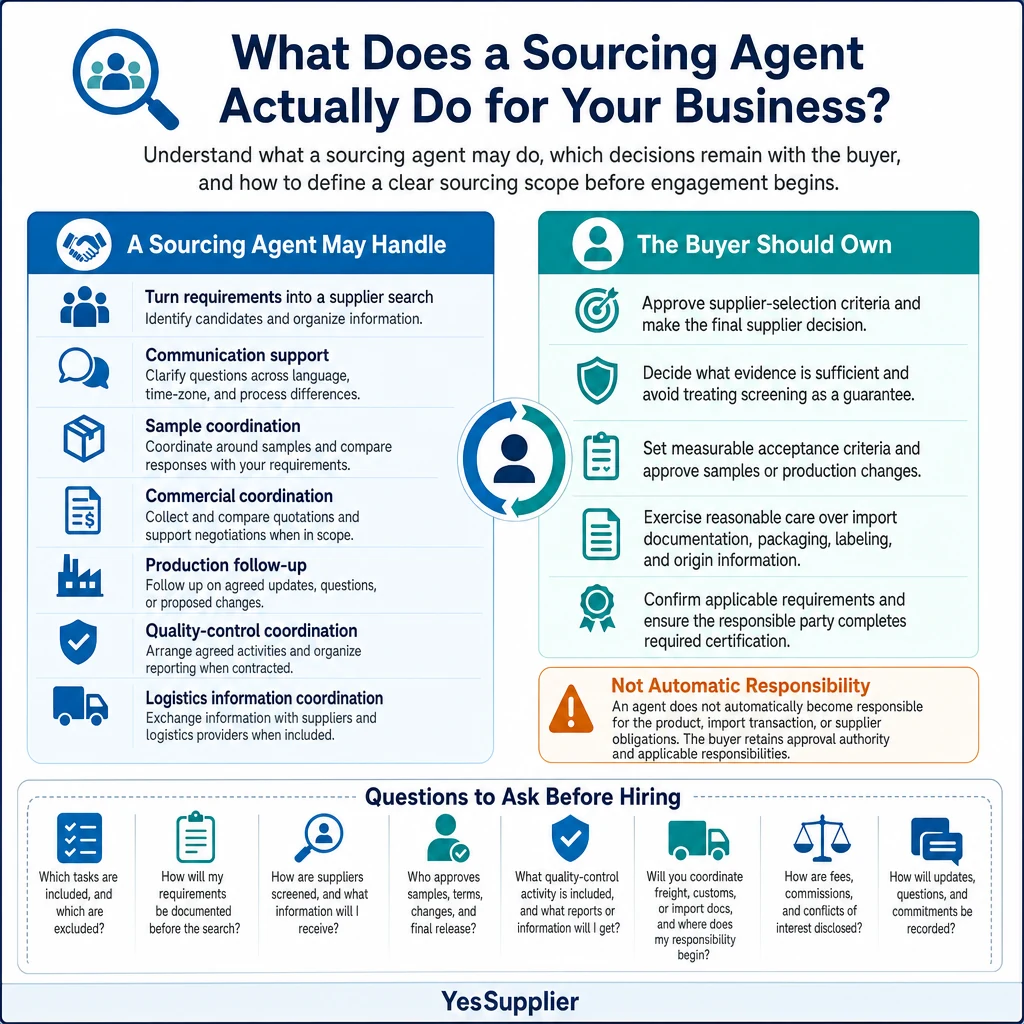
The core role: turning product requirements into a supplier search
A sourcing assignment starts with the buyer’s brief. Before a supplier search can be evaluated properly, the buyer needs to explain what it is trying to purchase and how it plans to compare potential suppliers. A general product description may not be enough because suppliers can interpret materials, finishes, packaging, functionality, quality expectations, and commercial terms differently.
A working brief can include the product description, available specifications, intended use, packaging expectations, destination market, order expectations, documentation needs, and supplier-selection criteria. The purpose is to give supplier communication a consistent reference point and reduce assumptions that can create confusion later in the process.
After the buyer establishes its requirements, an agent may translate them into a supplier search and organize introductory information for review. This can be useful when the buyer has limited familiarity with a supplier market or needs support communicating requirements clearly. The International Trade Administration’s guidance on China market entry describes the need for due diligence and understanding local regulations in cross-border business activity. In a sourcing context, that supports a deliberate evaluation process rather than treating an introduction to a supplier as a final approval.
The buyer should determine which criteria matter most for the project. That may include a particular product capability, clarity of communication, the supplier’s response to documented requirements, or other commercial considerations chosen by the buyer. An agent can help structure information and facilitate contact, but the buyer should approve the criteria and make the final supplier decision.
Common tasks a sourcing agent may handle
Services vary by provider and contract. The activities below may be offered by some agents but are not standard obligations for every sourcing engagement:
- Supplier identification and initial screening: researching potential suppliers, collecting introductory information, and organizing candidate details against the buyer’s stated criteria.
- Communication support: helping clarify questions between buyer and supplier where language, time-zone, or process differences make direct communication more difficult.
- Sample coordination: arranging communication around samples and helping compare supplier responses with the buyer’s documented requirements. The buyer should define its approval criteria and make the approval decision.
- Commercial coordination: collecting and comparing supplier quotations, and supporting negotiations when this work is expressly included in the service scope.
- Production follow-up: communicating with suppliers about agreed updates, questions, or proposed changes during production. The buyer should retain approval authority for material changes and commercial decisions.
- Quality-control coordination: arranging agreed activities and organizing reporting where contracted. The buyer should set measurable acceptance criteria before relying on a review process.
- Logistics information coordination: helping exchange relevant information among the buyer, supplier, and logistics providers when included in the engagement.
The main benefit of this support is continuity. Rather than managing separate supplier conversations without a shared record of requirements, the buyer may have a designated party helping keep questions, documents, samples, and status updates organized. This does not transfer ownership of the sourcing project. The buyer remains responsible for deciding whether the commercial and operational information is sufficient for its needs.
| Business need | An agent may support | The buyer should own |
|---|---|---|
| Find potential suppliers | Translate requirements into a supplier search, identify candidates, and organize initial information. | Approve supplier-selection criteria and make the final supplier decision. |
| Evaluate supplier risk | Coordinate due-diligence activities and collect supplier information within the agreed scope. | Decide what evidence is sufficient and avoid treating screening as a guarantee. |
| Manage external quality expectations | Help communicate specifications, sample expectations, and agreed quality-control steps. | Set measurable acceptance criteria and approve samples or production changes. |
| Prepare for import | Coordinate information with suppliers and logistics providers where contracted. | Exercise reasonable care over import documentation, packaging, labeling, and origin information. |
| Address applicable consumer-product rules | Assist with obtaining or organizing supplier-provided compliance information where contracted. | Confirm applicable requirements and ensure the responsible party completes required certification. |
What a sourcing agent does not automatically take responsibility for
The boundary of the role is as important as the list of possible services. A sourcing agent does not automatically become responsible for the product, the import transaction, or the supplier’s obligations. The responsibilities of each party depend on the agreement, the goods, the destination market, and the roles held in the transaction.
Buyers should not assume that an agent is making the final supplier selection, approving product design, creating complete technical specifications, or accepting goods on the buyer’s behalf. An agent may communicate concerns, coordinate information, or facilitate a review, but the buyer should state clearly who can approve samples, purchase terms, production changes, and final release.
Supplier research, a sample, or a quality-control activity should not be treated as proof that a supplier is trustworthy or that goods will meet every requirement. These activities can inform a decision, but they do not eliminate commercial, operational, or compliance risk. A defined process makes remaining questions more visible and gives the buyer clear moments to request additional information or withhold approval.
Logistics coordination is also different from importer responsibility. A provider may coordinate information among the parties involved, but that does not automatically make the provider the importer of record or transfer the buyer’s applicable obligations. Confirm the roles, documentation responsibilities, and approval authority in writing before goods move.
Why supplier vetting and quality planning matter
Supplier vetting is more useful when it is connected to the buyer’s actual requirements. Instead of asking only whether a supplier appears suitable, the buyer can identify what information it needs to support its decision. Depending on the project, that may include product capability, communication clarity, relevant documentation, sample expectations, production processes, and the supplier’s response to questions. The appropriate evidence will depend on the product and market.
Due diligence should be treated as a decision process, not as a promise that risk has disappeared. A buyer may ask an agent to collect information or coordinate agreed checks, then review the resulting material against its own supplier-selection criteria. If important questions remain unresolved, the buyer can request further information, revise its requirements, consult qualified advisers, or decide not to proceed.
Quality planning is most effective when it occurs before production is underway. The buyer can define approved specifications, acceptable variation where relevant, packaging expectations, the sample approval process, communication checkpoints, and the approach to proposed changes. This provides suppliers and any external coordinator with a clearer point of reference. It also makes reports more useful because observations can be assessed against stated acceptance criteria rather than general impressions.
ISO 9001:2015 is a quality-management standard whose requirements address control of externally provided processes, products, and services. That principle is relevant to sourcing because buyers should consider how externally provided goods and services will be evaluated and controlled. It does not mean certification is required, and it does not prove that a product will meet a buyer’s requirements.
Where import and product-compliance responsibilities stay with the buyer
Import and product-compliance obligations should not be handled through broad assumptions. Applicable requirements depend on the goods and the destination market. A sourcing agent may help collect or organize supplier-provided information where that work is included in the scope, but the buyer must identify the requirements relevant to its own product and transaction.
For imports into the United States, U.S. Customs and Border Protection states that importers must exercise reasonable care regarding accurate import documentation, packaging, labeling, and product-origin information. Its guide for commercial importers is a useful starting point for understanding that responsibility. It is not a substitute for verifying the requirements that apply to a particular product, shipment, or destination.
Consumer-product obligations also require product-specific analysis. The U.S. Consumer Product Safety Commission explains that, for applicable consumer-product safety rules, the domestic manufacturer or importer certifies compliance through a General Certificate of Conformity. Where those rules apply, an agent may assist with obtaining supplier-provided information if that support is contracted, but the responsible domestic manufacturer or importer must ensure applicable certification is completed.
Before placing an order, clarify who will prepare each document, who will review it, who will communicate with freight and customs providers, and who has authority to approve manufacturer-supplied information. Verify destination-market requirements with the appropriate authorities and qualified professionals, particularly where packaging, labeling, origin information, testing, certification, or safety obligations may be relevant.
Questions to ask before hiring a sourcing agent
A good engagement starts with written clarity. Ask prospective agents to describe their process in terms that relate directly to your project instead of relying on broad service labels.
- Which tasks are included, and which tasks are excluded?
- How will my requirements be documented before the supplier search begins?
- How are supplier candidates screened, and what information will I receive to support my own decision?
- Who approves samples, purchase terms, production changes, and final release?
- What quality-control activity, if any, is included, and what report or underlying information will I receive?
- Will you coordinate freight information, customs-broker communication, or import documentation, and where does my responsibility begin?
- How are service fees, supplier commissions, and potential conflicts of interest disclosed?
- How will updates, questions, and supplier commitments be recorded during the project?
These questions help identify whether a provider’s approach matches the level of involvement your business needs. They can also reduce a common sourcing problem: different parties believing that someone else owns an approval, requirement, or document.
When external sourcing support may be useful
External sourcing support may be useful when a business is entering an unfamiliar supplier market, needs help maintaining clear communication with suppliers, or wants a more structured way to compare candidates and coordinate an order. It may also help an internal team organize work that would otherwise be dispersed among product, procurement, logistics, and operations contacts.
An agent can improve information flow while keeping the buyer responsible for specifications, supplier choice, commercial approvals, and import obligations. A suitable engagement defines scope, approval paths, documented expectations, and the limits of external coordination.
If you are assessing whether this type of support fits your sourcing process, review the available services information from Yes Supplier and use the scope discussion to identify the tasks your business wants to retain and the tasks it may want help coordinating.