
Decide whether you can manage sourcing with sufficient clarity, time, and control, or whether outside support would help you make better decisions.
For a small business owner or first-time importer, sourcing can involve far more than finding a product listing and requesting a quote. You may need to explain product requirements, compare potential suppliers, assess samples, coordinate production updates, review shipping documents, and understand what applies in your destination market. A third party can assist with parts of that process, but it does not remove the need for disciplined buying decisions.
The right approach depends on the product, your ability to communicate directly with suppliers, the level of product detail involved, and your willingness to manage quality and import responsibilities yourself. The practical question is: Which tasks need support, and how will accountability be documented?
What is a China sourcing agent?
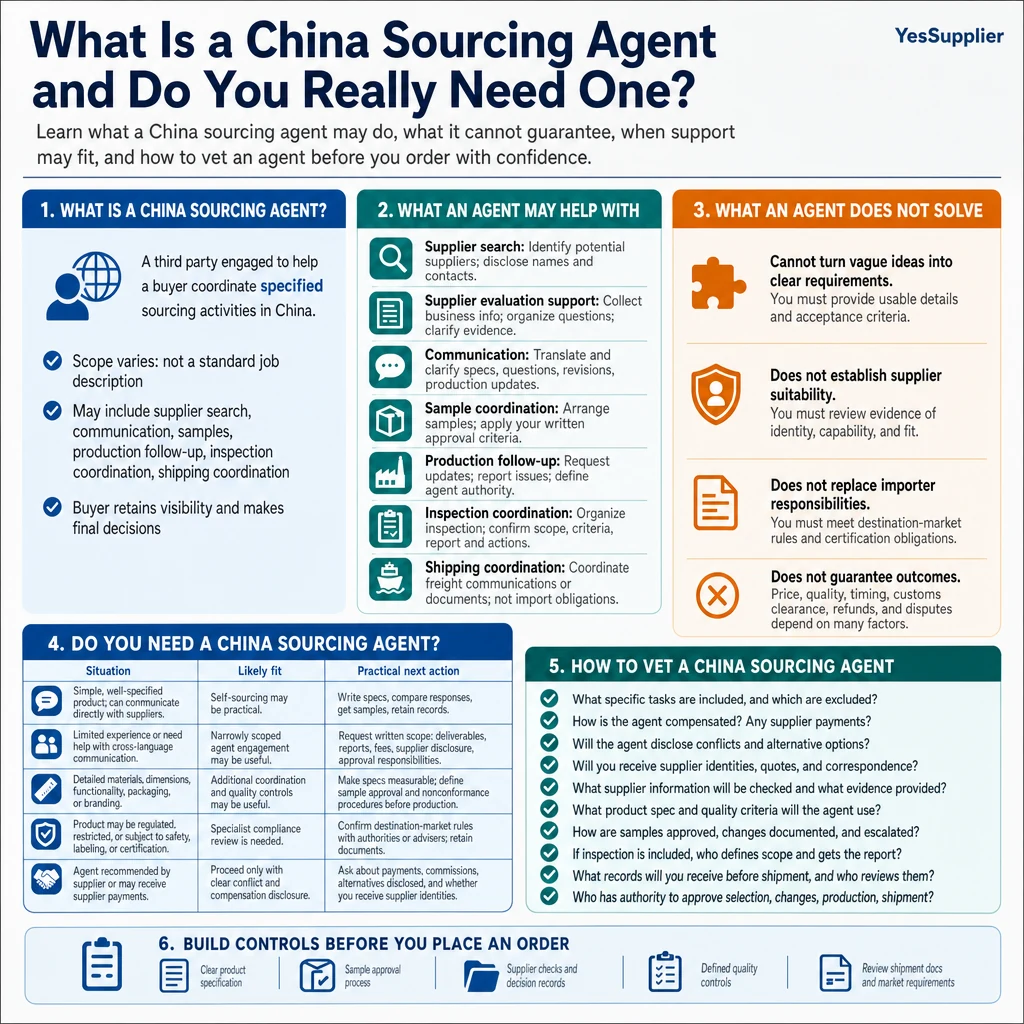
A China sourcing agent is a third party engaged to help a buyer coordinate specified sourcing activities in China. Depending on the agreement, that work may involve identifying potential suppliers, helping with communication, coordinating samples, following up on production, arranging inspection coordination, or assisting with shipping coordination.
The important word is specified. “Sourcing agent” is a broad commercial label, not a standard job description with a universal set of obligations. One engagement may be limited to supplier research and communication. Another may include sample coordination and production follow-up. A buyer should not assume that an agent will conduct supplier checks, inspect goods, negotiate terms, manage logistics, or review compliance documents unless those tasks are clearly included in writing.
Supplier selection may be part of an agent’s service scope, but the buyer still needs to understand how candidates were found, what information was reviewed, and who makes the final selection. Due diligence remains an important part of market entry and commercial decision-making, as the International Trade Administration notes in its China market-entry guidance.
Think of an agent as a potential coordination resource rather than a substitute for ownership. The buyer should retain visibility over the supplier, product specification, commercial terms, approval points, and records.
What an agent may help with
A sourcing engagement can be useful when it addresses specific coordination needs. That does not mean every agent offers the same services or performs them in the same way. Before relying on any service, confirm the deliverable, method, report format, exclusions, and escalation process in a written scope of work.
- Supplier search: An agent may identify businesses that appear relevant to a product request. Ask whether supplier names and direct contact details will be disclosed to you.
- Supplier evaluation support: The agent may collect business information or help organize questions for a prospective supplier. Clarify what evidence will be reviewed and what conclusions, if any, the agent is making.
- Communication: An agent may help translate or clarify specifications, questions, revisions, and production updates. You should still approve the final written requirements.
- Sample coordination: An agent may help arrange samples and gather feedback. Your written sample-approval criteria should determine whether a sample is accepted, revised, or rejected.
- Production follow-up: An agent may request updates or communicate open issues. Define what events must be reported and whether the agent has authority to make any decision on your behalf.
- Inspection coordination: An agent may organize or coordinate an inspection service. Confirm the inspection scope, acceptance criteria, report recipient, and the process if goods do not meet agreed requirements.
- Shipping coordination: An agent may help coordinate freight-related communications or documents. This differs from taking responsibility for import obligations or customs decisions.
These are possible service-scope items, not automatic promises. Control of externally provided processes, products, and services is also addressed in ISO 9001:2015. In practical buying terms, that supports defining requirements and retaining records rather than relying on informal assurances.
What an agent does not automatically solve
Outside assistance can support execution, but it cannot make important decisions disappear. You remain responsible for deciding what you are buying and for accepting the commercial and import risks attached to that decision.
First, an agent cannot turn an incomplete concept into a clear product requirement without your input. A supplier needs usable details: materials, dimensions, functionality, packaging, branding, finish, tolerances where relevant, and any other criteria that determine whether the goods are acceptable. If those requirements are vague, the resulting product may be vague as well.
Second, an agent does not automatically establish that a supplier is suitable for your needs. A business may be presented as a candidate, but you should ask what evidence supports its identity, capabilities, product experience, and ability to meet your stated requirements. Avoid treating labels such as “factory,” “verified,” or “reliable” as conclusions without understanding the evidence behind them.
Third, an agent does not replace your responsibility for destination-market requirements. The destination country and product category determine which rules may apply. Importers should review applicable requirements with the relevant authorities or qualified advisers before ordering. In the United States, Customs and Border Protection states that importers must exercise reasonable care regarding accurate import documentation, packaging, labeling, and product-origin information. See Importing into the United States.
If a consumer product is subject to an applicable U.S. product-safety rule, the domestic manufacturer or importer is the party that certifies compliance through a General Certificate of Conformity, according to the U.S. Consumer Product Safety Commission. An agent may help organize information, but commercial support does not transfer the importer’s responsibilities.
Finally, an agent does not guarantee a lower price, product quality, shipment timing, customs clearance, a refund, or dispute resolution. Those outcomes depend on the product requirements, supplier performance, agreement terms, available evidence, and decisions made throughout the transaction.
Do you need a China sourcing agent? A practical decision framework
You may not need a China sourcing agent if your product is simple and well specified, you can communicate directly with prospective suppliers, and you are prepared to organize supplier comparison, samples, production controls, and shipping records yourself. Direct sourcing is not automatically better or worse; it simply places more coordination responsibility with the buyer.
Scoped outside help may be useful when you have limited experience assessing suppliers, need support with cross-language communication, or do not have the internal capacity to manage detailed follow-up. The reason to engage an agent should be a defined need for assistance with clearly assigned tasks, rather than an assumption that sourcing becomes risk-free.
| Situation | Likely fit | Practical next action |
|---|---|---|
| You have a simple, well-specified product and can communicate directly with several suppliers. | Self-sourcing may be practical. | Create a written specification, compare responses against the same requirements, obtain samples, and retain supplier and shipment records. |
| You have limited experience assessing suppliers or managing cross-language communication. | A narrowly scoped agent engagement may be useful. | Request a written scope identifying deliverables, reports, fees, supplier-disclosure rules, and approval responsibilities. |
| Your product has detailed materials, dimensions, functionality, packaging, or branding requirements. | Additional coordination and documented quality controls may be useful, whether you source directly or use an agent. | Convert requirements into measurable specifications and define sample approval and nonconformance procedures before production. |
| The product may be regulated, restricted, or subject to safety, labeling, or certification requirements. | Specialist compliance review is needed before ordering. | Confirm applicable destination-market requirements with relevant authorities or qualified advisers, and retain supporting documents. |
| An agent was recommended by a supplier or may receive supplier payments. | Proceed only with clear conflict and compensation disclosure. | Ask how the agent is paid, whether supplier commissions exist, whether alternatives are disclosed, and whether you receive supplier identities. |
The decision does not have to be entirely direct sourcing or entirely outsourced sourcing. A buyer can define support for particular tasks while retaining approval authority over supplier selection, product changes, payments, production release, and shipment decisions. The key is to record those boundaries before work begins.
How to vet a China sourcing agent
Vetting an agent should be as structured as vetting a supplier. Ask questions that reveal how the relationship works in practice, not just what services appear on a website or in a sales conversation.
- What specific tasks are included, and which tasks are excluded?
- How is the agent compensated? Are there payments, commissions, or incentives from suppliers?
- Will the agent disclose potential conflicts of interest and alternative supplier options?
- Will you receive supplier identities, contact details, quotations, and relevant correspondence?
- What supplier information will be checked, and what evidence will be provided to you?
- What product specification and quality criteria will the agent use when communicating with suppliers?
- How are samples approved, changes documented, and deviations escalated?
- If inspection coordination is included, who defines the scope and receives the report?
- What records will you receive before shipment, and who reviews them?
- Who has authority to approve supplier selection, product changes, production release, or shipment?
Commission arrangements are a disclosure and conflict-of-interest question, not evidence of misconduct by themselves. What matters is whether the arrangement is transparent, whether it affects supplier selection, and whether the contract makes the agent’s duties to you clear.
If you are considering outside support, you can review available sourcing support services presented by Yes Supplier. Use any service discussion as the starting point for a written scope, not as a replacement for one.
Build controls before you place an order
Whether you work directly with a supplier or through an agent, the controls should be visible and documented before production begins. Good controls do not eliminate risk, but they make expectations testable and disagreements easier to identify.
Start with a product specification that a supplier and any third-party coordinator can follow. Include the characteristics that matter to your buyer: product materials, dimensions, functionality, packaging, branding, reference images where appropriate, and clear acceptance criteria. Avoid relying on broad descriptions such as “premium” or “high quality” unless you define what those terms mean for the product.
Next, establish a sample-approval process. Record what was requested, what sample was received, what was approved or rejected, and which changes must appear in production goods. If changes are agreed later, document them in writing and ensure that all relevant parties are working from the same current version.
Also document supplier checks and decision points. Keep the information used to select a supplier, the questions asked, the supplier’s responses, the commercial terms you accepted, and the people authorized to approve changes. An agent can help collect and organize this material, but the buyer should be able to access it.
For quality controls, define the inspection or review scope before goods are ready to ship. Identify the product criteria to be checked, how findings will be reported, who receives the report, and what action is required if the goods do not meet the agreed criteria. An inspection can provide information about the defined scope; it is not, by itself, proof that every aspect of product quality is assured.
Finally, review shipment documents and destination-market requirements before goods move. The appropriate review will vary by product and destination. Retain records that support your import decisions, and seek destination-specific guidance where needed. Commercial coordination may be useful, but responsibility for applicable obligations stays with the importer.
Making a controlled sourcing decision
A sourcing agent can be a practical resource when the engagement addresses a real gap in your process, such as communication, supplier research, sample coordination, production follow-up, or logistics coordination. It is not a universal requirement, and it should not be treated as a guarantee of commercial or compliance outcomes.
Some buyers do well with direct sourcing and thorough documentation. Others benefit from scoped support for specific tasks. In both cases use a clear specification, transparent supplier information, written responsibilities, documented approvals, defined quality controls, and an informed review of destination-market obligations. Choose the arrangement that gives you the visibility and control needed to support your decisions.