
Introduction: The Two Paths to Chinese Suppliers
When you source from China, you typically face a choice between two paths: going directly through Alibaba or engaging a sourcing agent to manage the process. Alibaba.com operates as a vast marketplace that connects buyers with suppliers, many of whom are traders rather than manufacturers. A sourcing agent, by contrast, serves as a local intermediary who verifies factories, coordinates samples, monitors production, and handles logistics on your behalf. The central question for many buyers is straightforward: which path fits your product, your working style, and your tolerance for risk?
For first‑time importers and for teams weighing risk, the decision isn’t purely about price. It’s about who you trust to navigate due diligence, quality assurance, and the intricacies of supplier management. This piece lays out what each option provides, where the value truly lies, and a practical decision framework you can apply to your specific product and stage of growth.
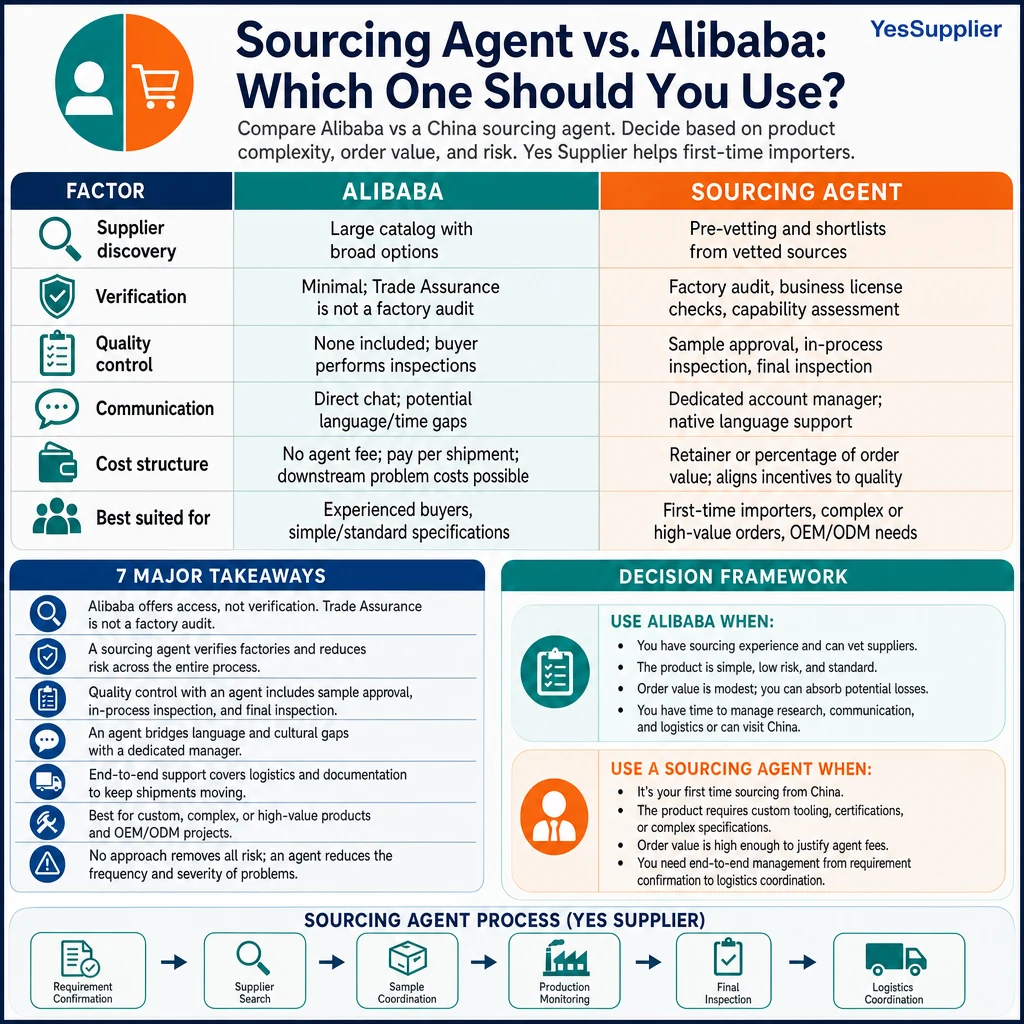
What Alibaba Actually Gives You
Alibaba is a massive online marketplace that lets you search for suppliers, compare offerings, and communicate directly with vendors. It offers features such as Trade Assurance, a form of buyer protection that covers certain issues related to shipments and defects. But Trade Assurance is not a substitute for a factory audit or a robust supplier verification process. In practice, many listings on Alibaba come from traders who source from various factories rather than operate as the manufacturing source themselves. The platform lacks built‑in, independent factory verification or a guaranteed standard of production capability.
- Supplier discovery: A broad catalog with filters and messaging that lets you reach many potential partners quickly.
- Direct communication: You talk to the supplier, navigate language differences, and negotiate terms directly.
Quality control is typically something the buyer arranges separately. There is no built‑in, platform‑driven quality‑assurance mechanism that substitutes for a real‑world factory audit, batch inspections, or a formal production monitoring program. Trade Assurance can offer limited protection for certain defects or delays, but it does not verify the authenticity of the factory, nor does it guarantee that a supplier can deliver to your exact specifications. A common risk in direct Alibaba sourcing is the mismatch between a perfect sample and a subpar bulk order, with no pre‑production governance baked into the platform.
From a cost perspective, Alibaba has the appeal of low upfront expenses, no agent fees to pay. Yet the potential downstream costs, quality issues, shipments held up in customs, and the time spent vetting suppliers and coordinating quality control, can erode any initial savings. The practical takeaway is that Alibaba can be a reasonable starting point for buyers who have sourcing experience, are dealing with simple, standard specifications, and are willing to invest time in supplier management and downstream inspection.
For a grounded understanding of the verification landscape and how to screen suppliers operating in China, many buyers reference practical guidance that emphasizes factory legitimacy checks, business licenses, and site verification. Keensourcing summarizes the steps involved in vetting before placing an order and highlights checks against official records of a company’s licensing and operations. These steps help clarify what counts as credible due diligence beyond what a marketplace platform provides. For more on this approach, you can review the guidance from Keensourcing.
In addition, broader commentary on Alibaba sourcing practices highlights that while the platform can connect you with manufacturers or traders, comprehensive due diligence remains essential. A practical view from industry observers emphasizes that factory capability, proper licensing, and production track records are not guaranteed by marketplace appearances alone. A sourcing‑savvy buyer understands this distinction and weighs Alibaba’s accessibility against the need for hands‑on verification and control.
What a Sourcing Agent Adds
A sourcing agent acts as your local representative and assumes responsibility for risk management across the supplier lifecycle. The core value is not simply “finding suppliers” but building a verified, workable supply chain and guiding you through production, inspection, and logistics. The agent model foregrounds on‑the‑ground verification and proactive problem‑solving, which can translate into more reliable outcomes, especially for complex or high‑value projects.
- Factory vetting: A sourcing agent can verify the factory’s legitimacy by cross‑checking business licenses and registrations, and, where applicable, reviewing the company’s manufacturing capabilities to distinguish manufacturers from traders. This due diligence often includes reference to official public records and corroborating signals from the factory floor. For example, reputable agents may check the business license via public information systems and conduct on‑site assessments to gauge whether the operation is truly manufacturing what it lists.
- Sample coordination: The agent helps ensure that your samples reflect production realities and that any deviations are addressed before scaling.
- Production monitoring: In‑process inspections help catch defects early and prevent expensive rework or rejected shipments. A well‑designed monitoring program relies on recognized sampling practices to determine when to check and how many units to inspect.
- Final inspection: A final check before shipment helps ensure that the finished goods align with your specs and quality expectations. A robust program uses structured sampling and clear criteria to pass or flag issues before the goods leave the factory.
- Logistics and documentation: Coordinating shipping arrangements, paperwork for customs, and related compliance tasks helps keep the supply chain moving. Yes Supplier’s service portfolio illustrates how a one‑stop service can cover the end‑to‑end process, from requirement confirmation to final inspection and logistics coordination.
- Product development support for OEM/ODM projects: When your product requires customization, tooling, or certification work, a sourcing agent can help align design intent with factory capability and guide you through the development milestones.
- Communication and cultural bridging: Language and cultural gaps often derail projects. A dedicated account manager who speaks the local language and understands business practices can reduce miscommunication, rework, and delays.
Yes Supplier provides end-to-end services including requirement confirmation, supplier search, sample coordination, production monitoring, final inspection, product development support, and logistics coordination. See the Yes Supplier services page for details.
A sourcing agent reduces the risk of scams, mismatched samples, and miscommunication by providing a structured process and on-the-ground oversight. That oversight is especially useful for custom products or when you lack local experience. Industry guidance stresses supplier variability and the need for due diligence. Yes Supplier packages these stages under a single managed program.
Head-to-Head Comparison Table
| Factor | Alibaba | Sourcing Agent |
|---|---|---|
| Supplier discovery | Large catalog with broad options | Pre‑vetting and shortlists from vetted sources |
| Verification | Minimal; Trade Assurance is not a factory audit | Factory audit, business license checks, capability assessment |
| Quality control | None included; buyer performs inspections | Sample approval, in‑process inspection, final inspection |
| Communication | Direct chat; potential language/time gaps | Dedicated account manager; native language support |
| Cost structure | No agent fee; pay per shipment; downstream problem costs possible | Retainer or percentage of order value; aligns incentives to quality |
| Best suited for | Experienced buyers, simple/standard specifications | First‑time importers, complex or high‑value orders, OEM/ODM needs |
Risk Scenarios and How Each Option Handles Them
Scenario A: You need a custom product (OEM/ODM)
When a product requires customization, tooling, or certifications, there is a higher risk that a supplier on a generic marketplace cannot fully demonstrate production capability. Alibaba listings may claim factory status, but distinguishing true manufacturers from traders can be challenging without on‑site verification. A sourcing agent can physically inspect the facility, review production records, and assess whether the factory actually has the capacity to deliver your design. This kind of diligence is captured in guidance that emphasizes factory audits, business license reviews, and due diligence as part of credible supplier verification. For readers seeking a practical reference on verification steps, the Keensourcing guidance on verifying Chinese suppliers is a useful anchor.
Beyond capability checks, an agent coordinates sample development and ensures sample approvals feed into production with clear milestones. Yes Supplier’s How It Works page describes the typical sequence from requirement confirmation to supplier search, sample coordination, and production monitoring. Industry sources on audits and licensing provide further context.
In this scenario, the combination of on‑site verification and structured development oversight reduces the risk of costly rework later in the project. It’s not a guarantee, but it is a practical approach to ensuring the supplier has the capability and intent to produce to specification. A credible agent is especially valuable when the product is technical or requires specialized materials or processes.
Guidance from industry practitioners and service providers often highlights the importance of verifying a company’s licensing and production capability before committing to tooling or large orders. The Yes Supplier service ecosystem emphasizes that this early due diligence is part of a broader program that supports OEM/ODM work, product development, and end‑to‑end logistics. The practical takeaway is that a sourcing agent’s early diligence helps align development expectations with factory reality.
Scenario B: You have a small budget and low volume (startup)
Startups with limited buying power may prefer Alibaba because there is no agent fee. But MOQs and poor supply chain alignment can erase early savings. Agents can often negotiate lower minimums or find factories that handle small, flexible runs. Guidance on supplier variability stresses the need for due diligence. Yes Supplier offers services to help reduce mismatch risk, though that may add service fees.
From a risk perspective, the trade‑off is between potential savings on the front end and the probability of quality issues or schedule slips later. When volume is small, the value of a vetted partner and a managed development path can be pronounced, especially if you anticipate growth or if your product requires more careful specification alignment. QualityInspection.org emphasizes the importance of on‑site checks and sampling as a guardrail against mismatches in the early stages of supplier relationships. The agent model offers a practical framework to manage early‑stage risk without assuming you can absorb losses from poorly executed initial runs.
In Yes Supplier’s ecosystem, small‑batch production and flexible factory searches are part of the offering, which can help startups find the right balance between cost control and risk management. As with the other scenarios, the key is to align expectations with the presence of a structured process rather than aiming for a single, inexpensive shortcut.
Scenario C: You are scaling and need repeatable quality
As a business scales, maintaining consistent quality across batches becomes more demanding. An agent’s on‑site inspections and production monitoring create a governance framework that helps catch defects early and reduces the chance of surprises at shipment time. The emphasis on in‑process inspections and a formal final inspection aligns with practices described in industry guidance that prefer on‑the‑ground checks throughout production rather than only at the end. The practical outcome is a tighter feedback loop that supports repeatable quality as volumes rise. The presence of a structured monitoring program, coordinated by a sourcing agent, contributes to more predictable outcomes as production scales.
QualityInspection.org’s guidance on production monitoring and inspection supports the idea that having a disciplined inspection routine is critical when you scale. While no process eliminates all risk, a robust monitoring and inspection plan reduces the frequency and impact of quality issues, which is especially valuable in high‑value or complex product programs. Yes Supplier’s end‑to‑end service model is designed to provide that governance if you need a single partner to manage the entire lifecycle from product concept through logistics.
Decision Framework: When to Choose Each
Use Alibaba when:
- You have sourcing experience and know how to vet suppliers yourself.
- The product is simple, low risk, and uses standard specifications.
- Your order value is modest, and you can absorb potential losses from a poor shipment without jeopardizing the business.
- You have the time to manage supplier research, communication, and logistics, or you can visit China to oversee activities in person.
Use a Sourcing Agent when:
- It’s your first time sourcing from China and you want to reduce missteps.
- The product requires custom tooling, certifications, or complex specifications that demand specialized oversight.
- Your order value is high enough that the agent’s fees are justified by the potential savings from avoiding a costly error.
- You need end‑to‑end management, from requirement confirmation through to logistics coordination, and you want a single partner to orchestrate the process.
Yes Supplier offers a one-stop service that covers requirement review, supplier search, sample coordination, production monitoring, final inspection, and logistics. The Yes Supplier services page describes this integrated approach for buyers who want continuity and governance across stages.
Limitations and Realistic Caveats
No sourcing approach eliminates all risk. Defects can occur, shipments can be delayed, and supplier relationships can encounter unexpected friction. The value of a sourcing agent lies in reducing the frequency and severity of problems, not in guaranteeing perfect outcomes. Agent fees introduce upfront costs, and the potential savings come from avoiding costly failures and rework rather than from inherently lower factory prices.
Because credibility matters, buyers should verify the agent’s track record and ask for evidence of successful engagements. Case studies and client testimonials can offer insight into how a specific agent operates in practice and how they handle disputes when they arise. Yes Supplier provides case studies that illustrate real sourcing projects and outcomes, which can help you assess fit for your own product and timeline.
For matters that touch on regulatory compliance, agents can help coordinate necessary certifications and documentation, but clearance with specific regulatory agencies depends on your product category and the destination market. If you are considering U.S. regulatory requirements, discuss the scope of coordination with your agent and legal counsel, and consult official agency resources for any compliance questions you may have. If you want a point of reference on how a provider frames these considerations, Yes Supplier’s FAQs offer practical guidance on service scope and cost expectations.
Finally, it’s important to anchor your decision in credible verification practices. The Keensourcing guide remains a useful reference for steps you can take to verify Chinese suppliers before ordering, and it can be complemented by other sources that discuss on‑site audits, licensing checks, and production capability assessments. A disciplined due‑diligence approach helps ensure that whichever path you choose, you are not relying on marketplace appearances alone to judge supplier credibility.
Your Next Step
If you are unsure which option fits your project, start with a free requirement review. Present your product specifications and expectations to see whether an agent is likely to help. You can review Yes Supplier’s process and FAQs for typical costs, timelines, and service scope, or request a supplier search and cost estimate.
Notes: For readers seeking direct references, practical verification guidance is discussed in publicly available resources that cover factory audits, licensing checks, and production capability assessments. Links to official guidance and service pages are provided to help readers evaluate options with credible sources in mind. The emphasis remains on grounded, real‑world practice rather than unverified claims.