
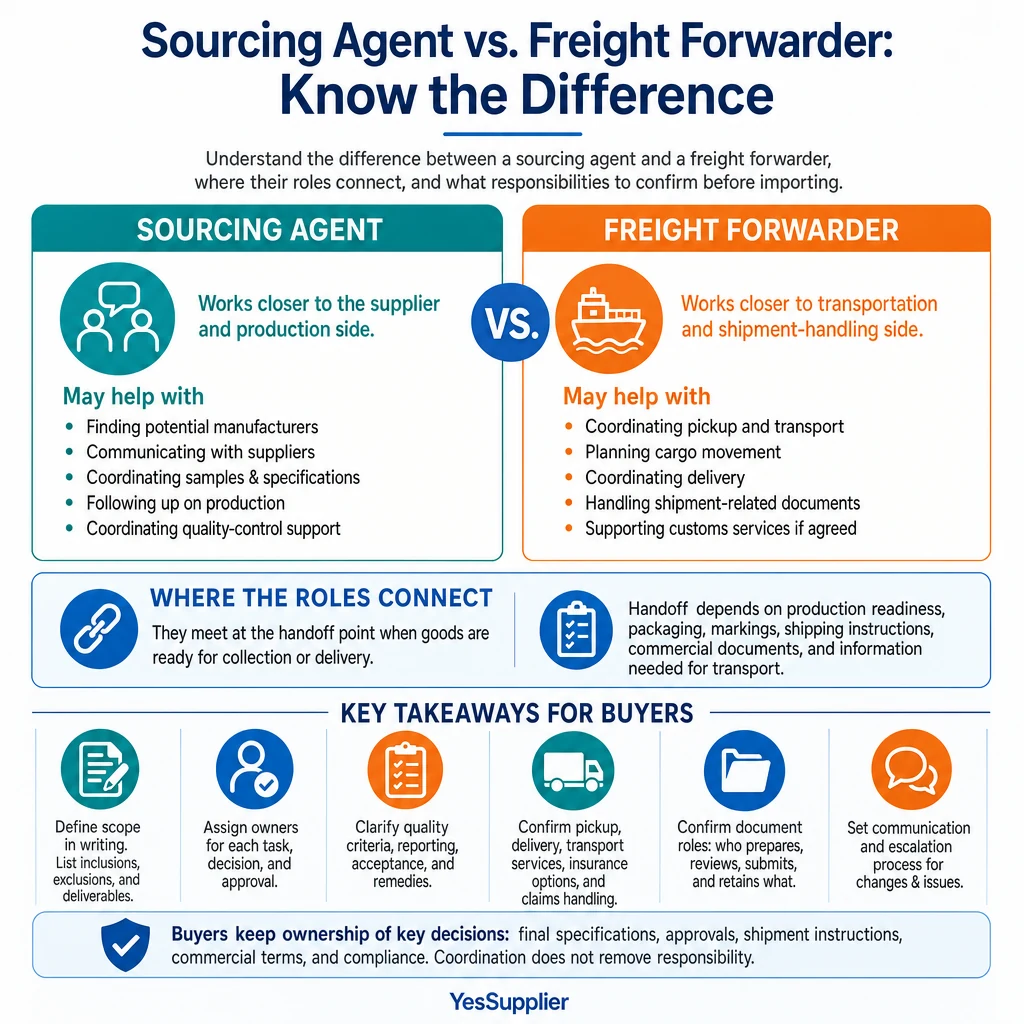
The choice between a sourcing agent and a freight forwarder comes down to which part of your purchase needs support and who handles each step. A sourcing agent works closer to the supplier and production side. A freight forwarder works closer to the transportation and shipment-handling side. Titles are not standardized, and what a provider actually does depends on the written scope of work.
The practical risk is leaving assumptions untested. A provider may coordinate a task without being responsible for the outcome. Another may offer a broader service package with stated exclusions. The approach is to identify the tasks in the purchase, assign each task to a named party, and agree on the process for incomplete information, goods that are not ready, or shipment exceptions.
What a sourcing agent may help with
A sourcing agent may support the supplier-facing portion of the buying process. Depending on the agreed scope, this may include identifying potential manufacturers, starting supplier communication, coordinating samples, communicating product specifications, following up on production status, or arranging quality-control support.
These activities may help a buyer organize the path from an initial product requirement to goods that are ready for shipment. They do not mean that every sourcing agent performs every task. Supplier identification is different from supplier verification. Coordinating a sample is different from approving it. Production follow-up is also different from accepting responsibility for product quality or supplier performance.
Buyers should convert broad service descriptions into specific deliverables. Where supplier screening is included, ask what information will be reviewed, what the review does not cover, and how findings will be presented. Where quality-control coordination is included, define the inspection criteria, timing, reporting format, and the party that decides whether goods are accepted. Where an agent communicates specifications with a supplier, retain a controlled version of the final specification and identify who may authorize changes.
Control of externally provided processes, products, and services is addressed in the ISO 9001:2015 quality-management requirements. In practical terms, a buyer should not rely on an informal understanding of what a supplier, sourcing agent, testing provider, or logistics company will do. Relevant controls, deliverables, and decision rights should be documented in the applicable agreement or purchase process.
A sourcing agent can be useful when the central need is upstream coordination. That may involve clarifying product requirements with a prospective supplier, maintaining communication around samples, or helping the buyer organize agreed supplier-facing work. The buyer should still keep ownership of commercial decisions, final specifications, and approval authority unless the written arrangement expressly assigns a different role.
What a freight forwarder may help with
A freight forwarder may coordinate transport and shipment-related handling after goods are ready to move. The scope may cover elements of pickup, transport planning, cargo movement, delivery coordination, or document handling. Buyers should verify the provider’s specific role instead of assuming that every freight forwarder handles every transport service or customs-related activity.
A written scope may explain whether the provider coordinates pickup, what transport arrangements are included, which delivery point applies, whether cargo insurance options are available, and how damage or delay claims are handled. It should also identify what document support is included, whether customs-related services are available through an authorized party, and which actions remain with the buyer, seller, or importer.
A freight forwarder is not automatically a supplier-vetting or production-quality provider. Unless a provider’s written scope says otherwise, a buyer should not assume the forwarder will assess a manufacturer, verify product specifications, monitor production, or inspect completed goods. Those are supplier-side questions that need their own assigned owner and process.
The functional distinction is straightforward: sourcing support concerns the supplier relationship and the readiness of goods, while freight-forwarding support concerns movement and handling after goods are ready to ship. In a well-defined purchase workflow, the workstreams meet at an identified shipment handoff point.
Typical responsibilities to confirm in writing
| Task or decision | Sourcing-agent side | Freight-forwarder side | What the buyer should confirm |
|---|---|---|---|
| Finding potential manufacturers | May assist with supplier identification and initial supplier communication. | Do not assume this is included. | Who performs supplier screening, what information is reviewed, and whether any verification is included. |
| Samples and product specifications | May coordinate samples and communicate agreed specifications with the supplier. | Usually outside transport coordination unless expressly included. | Who approves samples, owns the final specification, and handles changes before production. |
| Production and quality follow-up | May coordinate monitoring or quality-control services if included in scope. | Do not assume production oversight or product inspection is included. | Inspection timing, acceptance criteria, reporting format, remedies for nonconforming goods, and responsibility for independent testing where needed. |
| Transport planning and cargo movement | May coordinate with a logistics provider if included. | May coordinate shipment movement and transport-related services, subject to the agreed scope. | Pickup point, delivery point, transport mode, service inclusions, exclusions, and handling of delays or damage. |
| Commercial terms and shipment handoff | May help the buyer and supplier communicate agreed terms. | May work from shipment instructions and agreed commercial terms. | The applicable Incoterms rule, named place or port where relevant, transfer points, and each party’s responsibilities. |
| Import documentation and compliance | May help collect supplier-provided information, but this does not transfer importer obligations. | May support document handling only if explicitly agreed; do not assume legal, customs, or product-compliance responsibility. | Who prepares, reviews, submits, and retains each document; which party addresses destination-specific requirements; and whether qualified local advice is needed. |
Where the roles connect
The connection between sourcing and freight work is commonly the point at which completed goods are released for collection or delivery. That handoff can be affected by production readiness, packaging, markings, shipping instructions, commercial documents, and information needed by the parties arranging transport.
Neither workstream should rely on an outdated version of the purchase terms. If the supplier changes packaging details, product configuration, delivery readiness, or shipment location, the buyer should know whether the sourcing-side provider is expected to communicate the change and whether the logistics provider needs updated instructions. A responsibility map can make this visible by listing the task, owner, approval authority, required information, and escalation path.
Commercial terms should also align with the logistics plan. Incoterms are internationally recognized rules that define seller and buyer responsibilities in an export transaction. They are not a contract between the buyer and a sourcing agent or freight forwarder. The International Trade Administration’s Incoterms guidance explains their role in allocating seller-buyer responsibilities. Buyers should ensure that the selected rule and any relevant named place or port are accurately reflected in the seller-buyer agreement and understood by parties handling the shipment.
Clear communication does not remove the need for verification. A sourcing agent may relay supplier information, and a freight forwarder may act on shipment instructions, but the buyer should establish who checks that information is complete and consistent before goods move. This includes identifying which version of the commercial documents is controlling and who must be notified if details change.
Responsibilities the buyer should not leave unclear
The buyer should preserve ownership of decisions that define the product and transaction. These include the final product specification, approved sample status, packaging and labeling requirements, inspection criteria, shipment instructions, commercial terms, and the parties authorized to make changes. Delegating coordination does not remove the buyer’s need to verify applicable obligations and documentation.
Import and product requirements depend on the product and destination. A service provider may assist with information collection or document handling where that is agreed, but the buyer should not assume this transfers legal responsibility for classifications, origin determinations, duties, taxes, customs accuracy, or product compliance. Where specialist advice is needed, it should come from a qualified party familiar with the relevant product and destination.
For a U.S.-specific example, U.S. Customs and Border Protection states that importers must exercise reasonable care to help ensure imported goods have accurate documentation, packaging, and labeling regarding product origin. See Importing into the United States: A Guide for Commercial Importers. This example does not replace destination-specific advice outside the United States.
Product certification is also conditional rather than universal. Certain consumer products subject to applicable U.S. consumer product safety rules may require a General Certificate of Conformity. The U.S. Consumer Product Safety Commission’s guidance describes that certificate in its applicable context. Buyers should not treat it as a requirement for every product or destination.
When one service, the other, or both may be appropriate
Sourcing-side assistance may be relevant when the main uncertainty is upstream. This can include identifying potential suppliers, coordinating communications, managing samples, clarifying specifications, or arranging agreed quality-control support. Freight-forwarding support may be relevant when the main need is coordinating cargo movement and shipment handling.
A buyer may need both forms of support when supplier-side coordination and transport planning are separate needs. This does not necessarily require separate providers. A provider may offer a combined scope, but the buyer should assess that scope as a defined set of services rather than assuming responsibility across every stage of the purchase.
The decision should follow the workflow rather than the service title. A buyer that already has an established supplier relationship but needs shipment coordination may have a transport-side need. A buyer with transport arrangements but unresolved supplier communications or specification questions may have a sourcing-side need. Where both needs exist, the handoff should identify who confirms goods are ready, who sends shipment instructions, who receives supplier documents, and who decides how exceptions are handled.
Questions to ask before hiring
- Which deliverables are included, and which are expressly excluded?
- Will the provider identify suppliers, review information, coordinate samples, follow production, arrange quality-control support, or only communicate with the supplier?
- Who owns the final product specification and approves changes?
- What quality criteria, reporting format, and acceptance process apply where quality-control support is included?
- Which transport-related services are included, from which pickup point to which delivery point?
- Who provides shipment instructions, commercial documents, and supplier-provided information?
- What is the provider’s role in cargo insurance, damage claims, delays, and other exceptions?
- Who prepares, reviews, submits, and retains each import-related document?
- Which destination-specific compliance questions remain with the buyer and require qualified local advice?
- How will the supplier, sourcing-side provider, freight forwarder, and buyer communicate changes and escalate unresolved issues?
Clear scope creates a better handoff
The useful comparison is not about choosing a universally better service. It is about matching a provider’s written scope to the stage of the purchase that needs support. Supplier and production work, shipment coordination, commercial terms, documentation, and destination requirements should each have a clear owner.
Before placing an order, review the supplier-side and shipment-side work together. Confirm the handoff point, document ownership, approval authority, exclusions, and escalation process. Buyers seeking supplier-search, supplier-vetting, quality-control, and shipping-coordination support can review Yes Supplier’s sourcing and quality-control services and confirm whether the stated scope fits their purchase.