
When you order from a factory in China without someone on the ground, you rely on written messages to cover language gaps, quality expectations, and production realities. That approach often leads to misunderstandings. A sourcing agent reduces that risk by inserting a verifiable process between your requirements and the factory floor, though it cannot guarantee perfection.
YesSupplier structures this process around seven defined service areas: requirement confirmation, supplier search and vetting, sample coordination, production monitoring, final inspection, product development support, and logistics coordination. Each represents a phase in the procurement cycle where misunderstandings and defects typically originate. Below is how that sequence works in practice, phase by phase, with the real decisions you’ll face at each step.
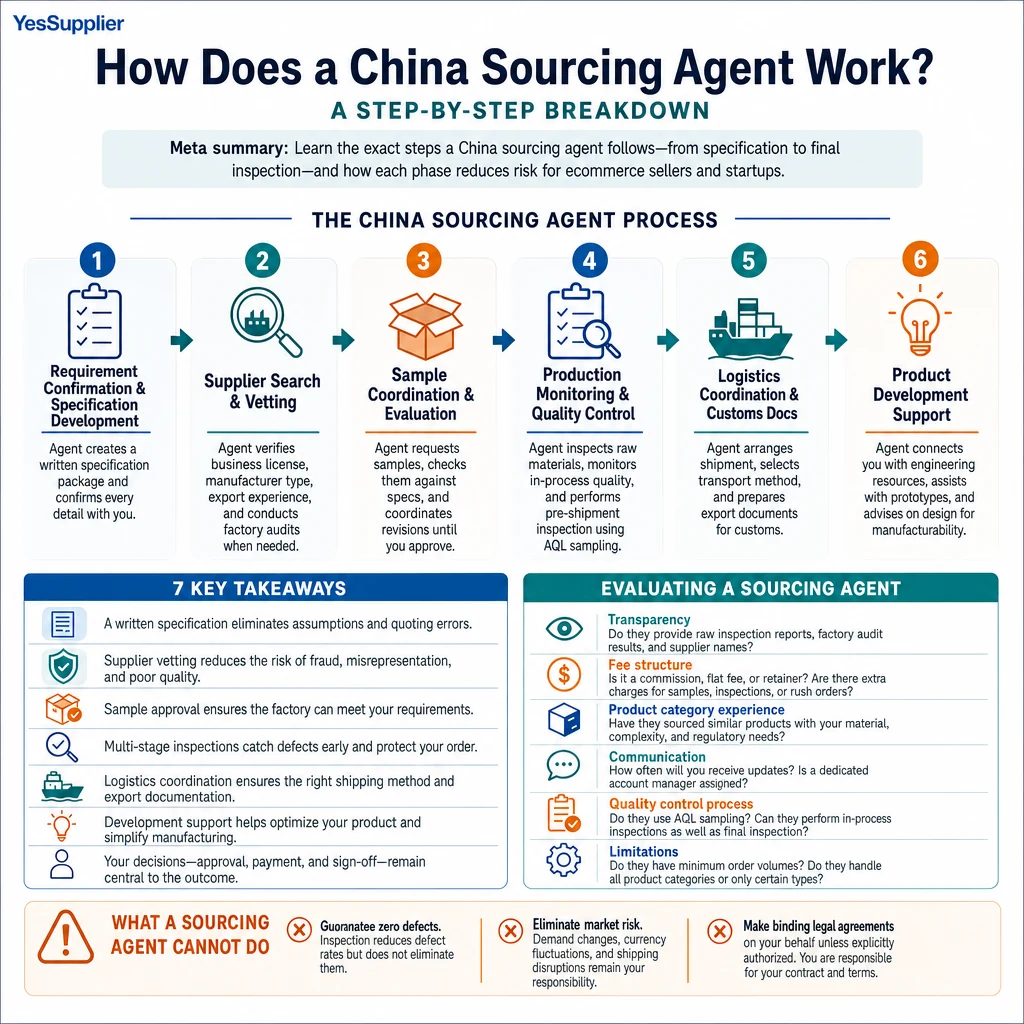
1. Requirement Confirmation and Specification Development
The process never starts with a photo or a verbal description. It begins with a written specification package that captures every attribute the product must have , material grade, dimensions, tolerances, packaging, labeling, and certifications. Without this document, a supplier in Shenzhen and a buyer in Chicago are working from different mental models of the same product.
What the agent does: You provide your product concept, sketch, existing sample, or CAD file. The agent translates that into a formal requirements document, then confirms every line with you before any factory sees it. This step eliminates the most common source of quoting errors: assumptions that were never written down.
What you should do: Be specific about what cannot change. If the product needs FDA-approved silicone or a carton that fits a specific shelf size, state it. Ambiguity at this stage almost always reappears as a rejected sample later.
2. Supplier Search and Vetting
Once the requirements are locked, the agent searches for factories that can produce to that spec. This is not a search engine query for “manufacturer + product name.” It is a targeted hunt narrowed by industry, production capacity, export history, and the supplier’s willingness to meet your timeline and quality demands.
Vetting involves several checks that go deeper than a B2B platform profile:
- Business license verification. The agent accesses China’s National Enterprise Credit Information Publicity System, the official government registry, to confirm the supplier is legally registered, operating in good standing, and not flagged for violations.
- Manufacturer vs. trading company identification. Many listings on Alibaba or Made-in-China are not factory owners but intermediaries. The agent determines whether the supplier owns its production line or acts as a pass-through. Both can be acceptable, but the distinction affects control over quality and pricing.
- Export experience. The agent checks whether the supplier has shipped comparable products to your target market and understands export documentation requirements such as certificates of origin or fumigation certificates.
- Factory audit (when needed). For higher-risk products or larger volumes, the agent may conduct an on-site audit to verify production lines, equipment, quality management systems, and labor practices. Some audits follow frameworks such as SMETA (Sedex Members Ethical Trade Audit), which provides a globally recognized standard for evaluating environmental performance and working conditions, as Sedex explains in their audit overview.
Without this vetting, you risk sending a deposit to a company that cannot produce your product at the required quality or volume. That risk is the primary reason sourcing agents exist.
3. Sample Coordination and Evaluation
With a shortlist of vetted suppliers, the agent requests samples. This phase confirms that the factory can physically produce what the specification document describes.
The agent handles the back-and-forth:
- Communicating exact sample requirements to the factory
- Setting deadlines
- Receiving samples and checking them against the specification document
- Taking measurements and photographs for your review
- Coordinating any revisions
You review the sample and decide to approve it or request changes. Only after sample approval does the agent proceed to negotiate order terms.
A common risk at this stage is that a supplier sends a high-quality sample from a separate sample workshop but delivers lower-quality goods from the production line during bulk production. The agent mitigates this by requesting samples from the actual production line after the run begins, not from a dedicated sample room.
4. Production Monitoring and Quality Control
After the order is placed and production starts, the agent monitors progress through a series of inspections timed to the production schedule. This is not a single check at the end.
- Raw material inspection. The agent verifies that incoming materials match the specification before they enter production.
- In-process inspection. During production, the agent checks workmanship, dimensions, and assembly at predetermined points. Defects found early can be corrected without scrapping the entire batch.
- Pre-shipment inspection. Before goods are packed for export, the agent performs a final random inspection using Acceptable Quality Limit (AQL) sampling. This inspection covers visual defects, function, packaging, and labeling.
You receive inspection reports with photographs and defect counts at each stage. Based on those reports, you decide whether to accept the goods, request rework, or reject the batch before it ships.
5. Logistics Coordination and Customs Documentation
After inspection approval, the agent coordinates shipment. This includes selecting the appropriate method , sea freight, air freight, express, or rail , based on your cost and time preferences, booking space with a forwarder, and preparing export documentation such as commercial invoice, packing list, bill of lading, and certificate of origin.
For buyers unfamiliar with Incoterms or customs clearance in their own country, the agent clarifies which party bears responsibility at each leg of the journey.
6. Product Development Support (for Custom Products)
If you are designing a new product rather than sourcing an existing one, some agents offer product development support. This may involve connecting you with factories that have in-house engineering, assisting with prototyping, or advising on design for manufacturability to reduce production costs.
Not all agents provide this service. If you need it, confirm upfront that the agent can support custom development and clarify how it is priced.
Evaluating a Sourcing Agent: A Practical Table
Not all agents operate the same way. Use the following assessment areas to evaluate whether a potential partner fits your needs.
| Assessment area | Questions to ask |
|---|---|
| Transparency | Do they provide raw inspection reports, factory audit results, and supplier names? |
| Fee structure | Is it a commission on the factory price, a flat project fee, or a monthly retainer? Are there charges for sample handling, extra inspections, or rush orders? |
| Product category experience | Have they sourced products similar to yours in terms of material, complexity, and regulatory requirements? |
| Communication | How often will you receive updates? Is a dedicated account manager assigned to your project? |
| Quality control process | Do they use AQL sampling? Can they perform in-process inspections as well as final inspection? |
| Limitations | Do they have a minimum order volume? Do they handle all product categories or only certain types? |
What a Sourcing Agent Cannot Do
Understanding the boundaries of the service is as important as understanding its value. A sourcing agent can reduce risk and save time, but the agent cannot:
- Guarantee zero defects. Inspection reduces defect rates but does not eliminate them.
- Eliminate market risk. Demand fluctuations, currency changes, and shipping disruptions remain your responsibility as the importer.
- Make binding legal agreements on your behalf unless explicitly authorized. You are responsible for your contract and payment terms.
Your own decisions, including product definition, supplier selection approval, and final inspection sign-off, remain central to the outcome.
Practical Next Step
If you are currently planning a sourcing project, start by documenting your product requirements in as much detail as possible. Include materials, dimensions, packaging, target price range, and required certifications. Then share that document with a sourcing agent and ask how they would handle each of the steps described above. For a detailed look at how an agent structures these steps, review the service breakdown on the YesSupplier services page or read about the typical timeline and deliverables. To understand our own approach at Yes Supplier, see how we work.