
A common scenario: the sample looks right in photos, the shipment arrives with surprises, and your contact is a sales representative who cannot influence the factory floor. The result is wasted time, inconsistent quality, and frustration that polite emails do not resolve. This pattern explains why many startups and small businesses hire a China sourcing agent. An agent is on the ground, speaks the language, and coordinates with the factory, the documentation, and logistics to reduce the disconnects that erode margins and timelines.
Below are the practical signs that going directly to suppliers has run its course, and why a sourcing agent becomes a realistic step forward. The guidance reflects established processes such as supplier vetting, production monitoring, and on request product development support offered by experienced sourcing partners.
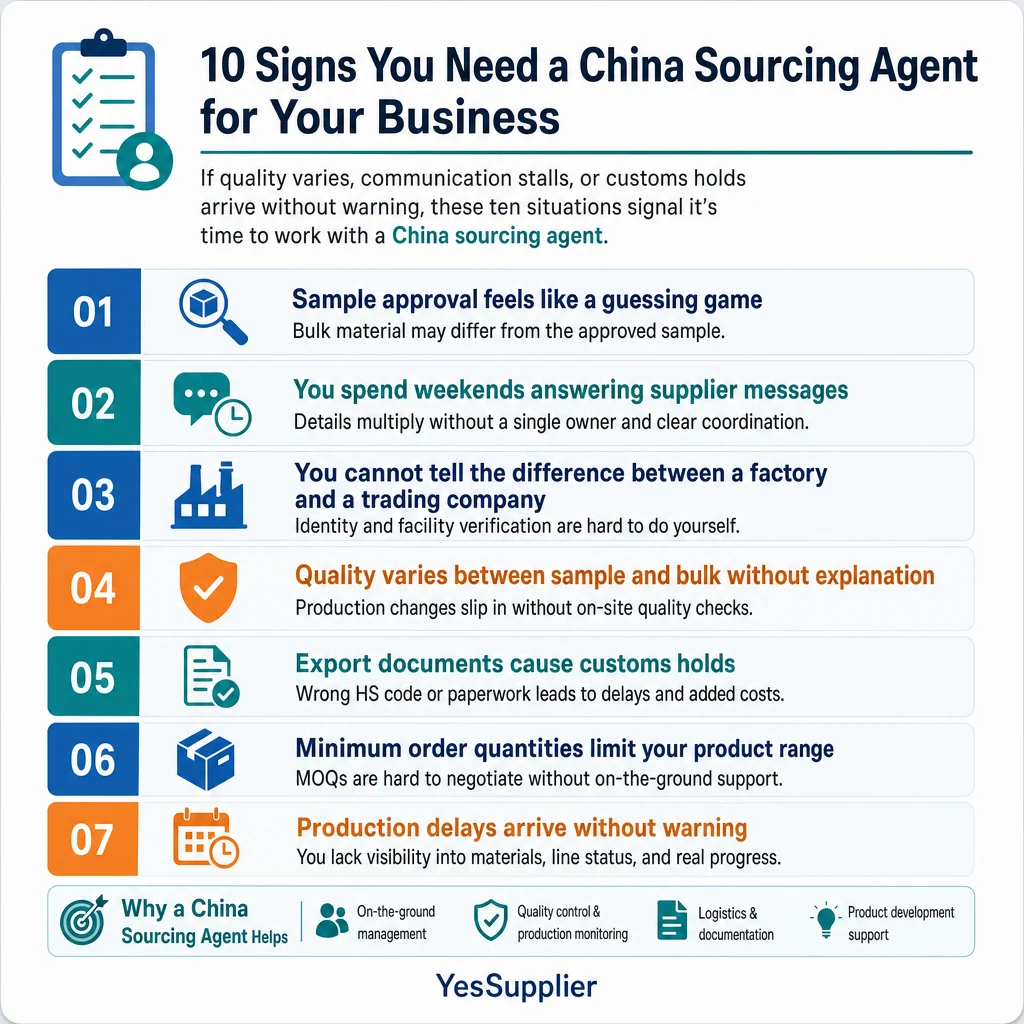
Step 1: Sample approval feels like a guessing game
You request a specific material spec or finish, and the sample appears plausible in photos but is not exact when you compare it to the reference. The factory may say the production version will differ, and your sign-off becomes an ongoing negotiation instead of a firm approval. Small deviations in material grade, thickness, or finish save the factory a little per unit, and those savings add up at scale. A sourcing agent based at or near the production line can compare bulk material to the approved sample and catch substitutions before they become a costly batch issue. They manage the sample approval process, confirm that the production sample matches the original spec, and flag any drift before a large run.
The best way to reduce guesswork in this phase is to ensure a dedicated on-site reviewer or production specialist is aligned with the spec and the reference material before the bulk order proceeds. A vetting process that confirms the supplier’s capability and the fidelity of samples helps prevent drift that would otherwise surface later in the supply chain.
Step 2: You spend weekends answering supplier messages
When communication becomes a nightly ritual, it is a signal that details require a single owner rather than a relay of messages through a sales representative. Questions about artwork files, packaging artwork, carton dimensions, labeling, or payment terms can multiply quickly if there is no clear ownership of the briefing and a single point of contact to chase down every detail. A coordination layer between you and the supplier reduces the interruptions you face during normal business hours, providing a precise brief up front and someone who follows up on the details before they become weekend crises. This kind of coordination is a core component of professional sourcing services that emphasize process clarity and timeline alignment.
With a dedicated coordinator handling the communications, you can preserve time for core business functions, customer work, product development, or day‑to‑day operations, without sacrificing control over the sourced product. The result is a smoother handoff from design to production and a more predictable production timeline.
Step 3: You cannot tell the difference between a factory and a trading company
The supplier shows a large facility on a listing, then deflects when you request a live video call of the factory floor. The business license signals a trading or import/export focus rather than manufacturing. This is a recurring issue in international sourcing: some entities pose as manufacturers to win orders, but their control over production, timeline, and quality is limited. A credible factory typically owns the production equipment and has an address that aligns with its licensing, while a trading company might coordinate multiple factories and fail to offer direct visibility into the actual production process.
When you can’t reliably differentiate, a practical check is to request a video walkthrough of the production floor showing your product category in production. A reliable guidebook notes that a real factory can usually accommodate this kind of request quickly, while trading entities may stall or rely on stock photos or excuses about where the factory is located. A sourcing agent can perform this identity verification on your behalf, checking the business license, visiting the registered address, and confirming whether the facility has the equipment and staff to produce the claimed volume. This vetting step reduces the risk of misrepresentation and aligns you with a supplier that can fulfill the order as described.
In the literature on supplier legitimacy, practitioners emphasize that verifying identity and facility capabilities is a critical guardrail before placing an order. The practical takeaway is that you should expect a credible partner to provide a clear path to on‑site verification and to avoid misleading representations about manufacturing capacity. Yes Supplier’s supplier vetting process explicitly includes these checks before any order is placed and is a reference point for this kind of on‑the‑ground verification. For additional context, Keen Sourcing’s guidance highlights that a real factory can usually accommodate a live facility view promptly, whereas a trading company may not.
Factory vs. Trading Company: Key Indicators
| Indicator | Likely a Real Factory | Likely a Trading Company |
|---|---|---|
| Business license scope | Manufacturing with specific product categories | Trading or Import and export |
| Ownership of equipment | Factory owns the machines listed on the floor | Cannot show proof of equipment ownership |
| Production capacity | Can show order load, shift schedules, raw material stock | Claims capacity but cannot provide specific data |
| Minimum order quantity | Typically higher for standard products | More flexible, often lower |
| Response to technical questions | Engineers answer with process‑specific details | Sales rep provides general answers |
| Factory address | Matches the business license and has a production floor | Often a commercial office address |
A sourcing agent verifies the supplier’s real identity before you place an order. This includes checking the business license, visiting the registered address, and confirming whether the facility has the equipment and staff to produce your product at the claimed volume. Yes Supplier’s supplier vetting process includes these checks before any order is placed.
That said, a trading company is not automatically a bad option. Some experienced trading companies provide good service for small orders, handle multiple factories for mixed containers, and offer payment flexibility that factories won’t. The problem is not the trading model itself but misrepresentation. If you know you are dealing with a trader and accept that tradeoff, the arrangement can work.
Step 4: Quality varies between sample and bulk without explanation
The sample is strong but the bulk order can differ in quality. The supplier may explain that the production version used a faster cycle to meet the delivery date. If you did not authorize that change, it has already happened. Quality drift between sample approval and bulk production is one of the most costly sourcing problems. It is rarely intentional; factories often optimize for speed and cost once an order is in production. The gap widens when the supplier has no on-site quality checks during manufacturing. They may run the first batch, confirm it meets the spec, and then proceed without verifying every unit.
A pre‑production quality planning session, followed by in‑process inspections during manufacturing, catches these adjustments while they can still be corrected. The on‑site inspector checks the first output against the approved sample, measures critical dimensions, and flags any unauthorized changes. Final random inspection before shipment becomes the last opportunity to reject defective goods before they leave the factory. This approach aligns with standard practices in professional sourcing operations and is reinforced by the use of structured inspection frameworks.
Having a defined on‑site quality plan and a clear inspection sequence reduces the chances of drift and provides you with documentation to address any discrepancies with the supplier before products ship.
Step 5: Export documents cause customs holds
Your shipment is held at the destination port because the commercial invoice uses an HS code that does not align with your product classification. The supplier’s freight forwarder may have assigned a code without consulting you, and the customs broker on your side flags the mismatch. The container may incur storage fees while you request corrected documentation. Meanwhile, inventory can run low and customers begin to inquire about delayed orders. Document errors are common when the supplier’s export team uses standard codes that do not reflect your product’s specific classification. The wrong code can trigger duties, delays, or even seizure for certain regulated products. Each country has its own classification nuances, and what works for one port may not work for another.
A sourcing agent coordinates the documentation package, confirms HS code classification, and prepares export paperwork in alignment with the receiving port’s requirements. Customs documentation is one of the logistics coordination services that helps prevent port‑side surprises. The agent also consolidates shipments, arranges cargo insurance, and verifies that the bill of lading matches the commercial invoice.
In practice, ensuring that the export package matches your receiving port’s requirements reduces the risk of port delays and helps keep your timeline intact. The documentation channel is a critical element of the supply chain that benefits from an experienced coordinator who can anticipate and resolve issues before they escalate.
Step 6: Minimum order quantities limit your product range
You want to test a new product design with a smaller batch, but the supplier requires a larger minimum. Negotiating MOQs often requires presence on the ground to explore alternative arrangements, such as bundling orders, adjusting materials, or finding a supplier whose production line supports smaller batches. Some agents specialize in low‑MOQ negotiations for startups and small businesses. A simpler option is to find a supplier that already produces a similar product and ask for a private label version; the mold cost is already amortized, which can lower the MOQ. You may trade off some design control, but you gain speed and lower risk in early testing. If the product is straightforward and there is high demand, direct sourcing can still be practical, with the agent handling the relationship as volumes grow.
In any case, the right path is to align your approach with the product’s complexity, the planned volumes, and the flexibility you need for iteration. The agent’s role includes negotiating MOQs and offering alternatives that fit your business model while preserving product quality and delivery reliability.
Step 7: Production delays arrive without warning
The supplier commits to a delivery window, but a delay emerges due to factors like raw material shortages or equipment downtime. With a direct channel, you often lack visibility into the actual status of the supply chain. You may not know whether raw materials have arrived, whether the production line has started, or whether a quality issue is holding up a batch. The absence of on‑the‑ground visibility makes late deliveries harder to manage and communicate to customers.
On‑the‑ground production monitoring provides timely confirmation of order status. A representative visits the factory, checks material stock, observes the line, and reports actual progress. If a delay is coming, you know early enough to adjust your customer communications or pivot to an alternative plan. Case studies from buyers who used production monitoring at different stages show how proactive oversight can avert last‑minute surprises and protect revenue, especially for seasonal products where timing is critical.
This kind of visibility is a service that a sourcing agent can provide as part of a broader monitoring and logistics package, helping you avoid dead stock or missed revenue windows when timing matters most.
Step 8: You are not sure if you are paying a fair price
The quote for one supplier is higher than another for the same spec, yet the cheaper option is described as using different materials. Without a transparent cost breakdown, you cannot verify which claim is accurate. The cost breakdown usually includes material costs, labor, tooling amortization, and profit margins, and buyers without reference points are left guessing. The lower price often comes with trade‑offs that affect quality, packaging, or consistency. An agent who sources similar products regularly maintains a baseline understanding of current material costs and labor rates, enabling them to spot quotes that fall outside a reasonable range and push back with specific data rather than vague requests for a better price. They can also identify the exact questions to ask, such as the grade of raw material, the number of cavities in the mold, and the typical yield rate for the process.
Understanding a fair price is not about chasing the lowest number; it is about ensuring a sustainable margin that delivers consistent quality. An experienced sourcing partner helps you determine the price point where the factory can deliver reliably, without compromising essential specifications or lead times.
Step 9: Product development has stalled
You have a product idea and a basic design file, but attempts to get engineering input from suppliers are slow or come with high engineering fees. The project lingers as you await feedback or estimates, and momentum stalls before you reach a prototype. Suppliers often prioritize clients with confirmed orders and may be reluctant to invest engineering resources in speculative projects from smaller buyers. An agent with product development support coordinates the path from design to prototype, helps identify the right manufacturing process, and connects you with suppliers who have the capability your design requires. This service can include requirement confirmation and supplier matching for projects that need custom tooling or engineering input, moving a concept toward a manufacturable product.
Having access to product development support reduces the friction in moving from idea to prototype and helps you identify the most feasible path to production in a way that preserves design intent and quality expectations. The aim is to align design for manufacturability with supplier capabilities to minimize rework and accelerate progress toward a tangible prototype.
Step 10: Problems scale faster than solutions
Your first order went smoothly, but as you scale to larger volumes, responses slow, quality drifts, and payment terms become less flexible. Growth introduces higher stakes: more units, longer lead times, and tighter coordination requirements. When volumes rise, the cost of misalignment increases, and the capacity of the supplier to manage multiple large orders may be tested. In this context, the value of on‑the‑ground management becomes apparent. The decision to engage an agent at this stage is often a straightforward calculation: if the time saved and the quality improvements are worth more than the agent’s fee, partnering with an on‑the‑ground specialist makes economic sense. The objective is not to avoid problems entirely but to allocate responsibility for complex coordination and problem resolution to a partner who operates daily in the space and can maintain consistent service levels as volume grows.
With a properly scoped partnership, you gain predictable timelines, improved communication, and access to a network of suppliers who can handle higher volumes while preserving the core product specs and quality standards. The math is not about the smallest unit price but about the overall value captured through steadier operations, fewer disruptions, and smoother scale.
What to do next
If several of these situations resonate with your experience, the practical next step is to clarify what kind of support you actually need. Some buyers require full‑service sourcing from supplier search through final inspection. Others need production monitoring for an existing supplier. A few look for help with product development or logistics documentation. Start by identifying the specific gap that costs the most or creates the most friction, and match that gap to a service scope. Yes Supplier structures its services around the gap you are experiencing rather than a one‑size package. The case studies show how different buyers used support for different stages of their sourcing. The decision to use an agent is not about avoiding all problems. It is about choosing which problems you want to solve yourself and which ones are better handled by someone who is on the ground, speaks the language, and does this daily. If your current sourcing process costs you more in time, stress, and quality issues than an agent would charge, the decision becomes straightforward. For more structured guidance, explore Yes Supplier’s range of sourcing support services designed to match your specific needs.