
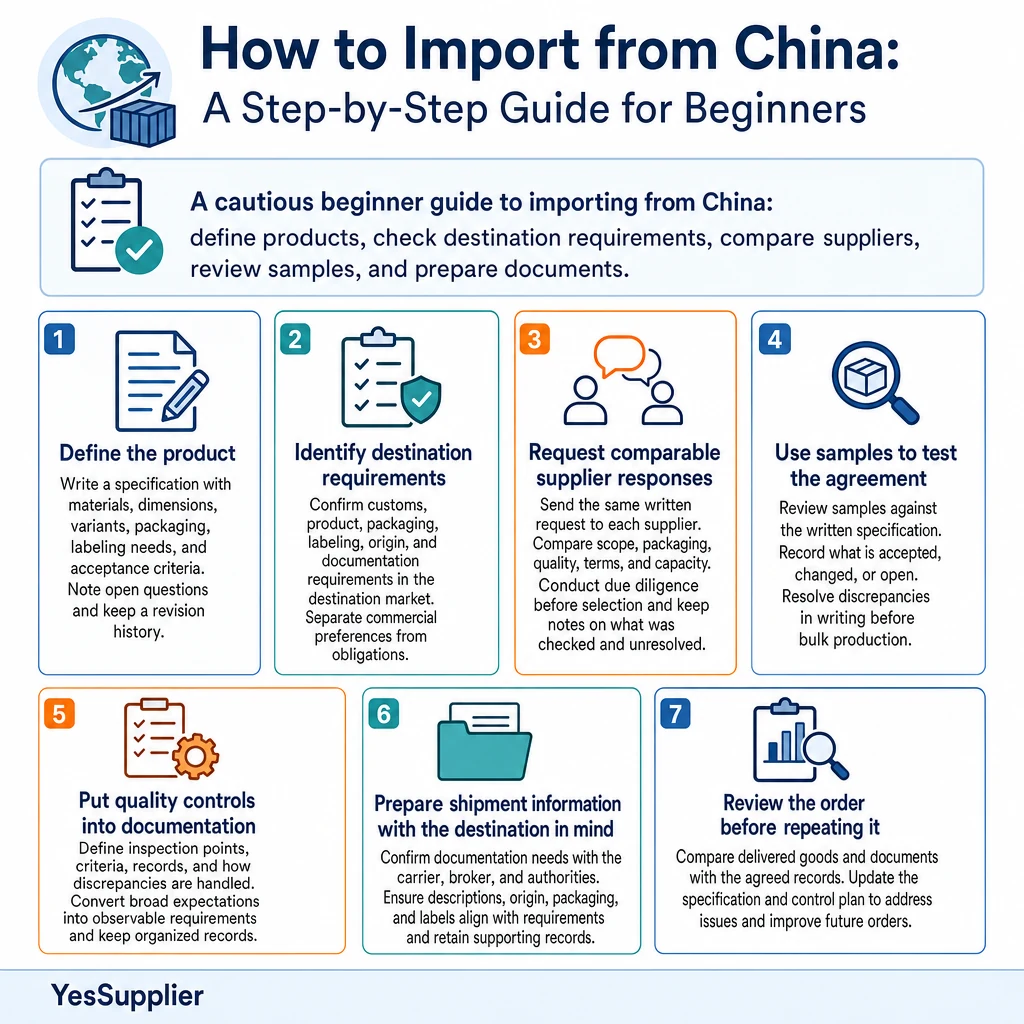
Importing from China starts with deciding what to buy, not just how to ship it. Before committing to a supplier, a beginner should be able to describe the intended product, identify the destination market, and understand which questions still need answers. A quotation can be useful, but it is not a complete sourcing plan. Product scope, quality expectations, documentation, packaging, origin information, and destination requirements may all affect whether an order is appropriate to place.
Treat the process as a series of documented checks. Documentation does not remove commercial or regulatory risk, but it can surface assumptions earlier, give suppliers a clearer basis for responding, and create records that support later decisions. The aim is not to assume that every product or supplier follows the same process, but to build a clearer basis for evaluating a proposed purchase.
1. Start with a written product definition
Before contacting suppliers, turn the product idea into a written specification. This document becomes the reference point for supplier requests, sample review, purchase documentation, quality review, and the later comparison of delivered goods with what was agreed.
A good specification covers materials, dimensions, variants, finish, function, packaging, labeling needs, and acceptance criteria that can be checked visually or functionally. It should also note destination-market information that is already known. When a requirement is still undecided, flag it as an open question rather than leaving it to interpretation.
The purpose is not to create a legal compliance file by default. It is to reduce ambiguity in a commercial discussion. Suppliers tend to give more comparable responses when they receive the same product description and are asked to identify assumptions, alternatives, or exclusions.
Keep a revision history as the specification develops. If a material, finish, package, or product feature changes, record the change and ensure that later requests refer to the current version. This matters especially when a sample differs from the initial description or when a supplier proposes an alternative configuration.
2. Identify destination requirements before making commitments
Import obligations depend on the destination country, product category, and shipment details. Before committing to a purchase, confirm which customs, product, packaging, labeling, origin, and documentation requirements apply in the destination market. Destination-country authorities, a customs broker, or a qualified adviser may help clarify requirements relevant to the proposed import.
For U.S.-bound commercial imports, U.S. Customs and Border Protection states that importers are expected to exercise reasonable care regarding import documentation, packaging, labeling, and origin information. CBP also encourages new importers to become familiar with applicable import requirements to help reduce merchandise-clearance problems. These are U.S.-specific points and should not be treated as rules for every destination.
For applicable U.S. consumer products, determine whether a General Certificate of Conformity is required. The U.S. Consumer Product Safety Commission explains that this certificate concerns compliance with applicable consumer-product safety rules. Whether it applies depends on the product and the relevant U.S. requirements; it should not be assumed for all goods or destinations.
At this stage, separate commercial preferences from legal or regulatory obligations. A preferred package appearance, for example, may be a purchasing choice, while a particular label or record may be required in a specific market. Both may belong in the product file, but they should be identified as different types of requirements.
3. Request comparable supplier responses
Supplier research is more useful when each potential supplier receives the same written request. Provide the current specification and ask suppliers to clarify product scope, proposed packaging, quality expectations, payment terms, production capacity, and shipping terms. If a response relies on an alternative material, construction, package, or configuration, ask for that difference to be identified in writing.
This approach makes comparison more disciplined. An initial price indication alone may not show whether suppliers are responding to the same product scope. Differences in a response may reflect different assumptions, excluded elements, or unresolved requirements. The point is not to pick the best supplier right away, but to understand what each one is proposing.
Due diligence belongs before supplier selection. The International Trade Administration advises robust due diligence when engaging with suppliers and the China market. The depth of that work should reflect the transaction, the product, and the risks that matter to the buyer. Keep notes on what was checked, which documents or explanations were reviewed, and which questions remain unresolved.
Do not describe a supplier as verified, reliable, certified, audited, or a manufacturer unless supplier-specific evidence supports that statement. A responsive sales conversation, a platform profile, or a quotation does not by itself establish that a supplier can meet every requirement in bulk production.
| Stage | Beginner action | Record to keep | Risk the action can help reduce |
|---|---|---|---|
| Product definition | Write a specification and acceptance criteria before contacting suppliers. | Product specification and revision history. | Ambiguous quotations and inconsistent expectations. |
| Supplier comparison | Request written responses to the same requirements and conduct due diligence before selection. | Comparable quotations, supplier responses, and due-diligence notes. | Selecting a supplier based only on an initial price indication. |
| Sample review | Check the sample against the written specification and document approval conditions. | Sample review record, photos, and approved specification. | Proceeding to bulk production without documented expectations. |
| Import preparation | Confirm destination-specific documentation, packaging, labeling, and origin requirements before shipment. | Import documentation checklist and product-origin records. | Avoidable clearance issues caused by incomplete or inaccurate information. |
| U.S. consumer-product compliance | Determine whether the product is subject to applicable consumer-product safety rules and certification requirements. | Applicable compliance records and certificates. | Overlooking conditional U.S. consumer-product certification obligations. |
4. Use samples to test the written agreement
A sample review is most useful when it is tied directly to the written specification. Compare the sample’s materials, finish, dimensions, functions, packaging, labeling presentation, and other agreed criteria with the current document. Record what was reviewed and what was accepted, changed, or left open.
If the sample reveals a discrepancy, resolve it in writing before bulk production. A general approval is less useful than a record identifying the approved version and any conditions attached to approval. Photos and dated review notes can help connect a visual assessment to the underlying specification, but they do not replace a clear written description.
Sample approval reduces risk, but it does not guarantee that later goods will match the sample. Bulk production, packaging, handling, and shipment can introduce additional variables. The sample process gives you a more specific basis for communication and later quality review.
Hypothetical example: A buyer receives a sample with an acceptable product finish but packaging that differs from the written requirement. Rather than approving the sample without comment, the buyer can record that the product finish is accepted while the packaging remains subject to a documented revision. This preserves the distinction between what has been approved and what still needs agreement.
5. Put quality controls into purchase documentation
Quality control should be planned as part of the purchase process, rather than treated solely as a final conversation after goods are ready. Define the inspection points, the criteria to be checked, how findings will be recorded, and how discrepancies will be handled. Appropriate controls vary by product, supplier arrangement, and buyer requirements.
ISO’s quality-management requirements address control of externally provided processes, products, and services. This is useful high-level context for buyers: controls over externally provided goods should be deliberate and documented. It does not mean certification is required, and it does not establish that a particular supplier follows a particular quality system.
Maintain an organized record set that includes the specification, revisions, quotations, supplier communications, sample review notes, purchase documentation, and quality findings. These records can help a buyer trace why a requirement was set, which version was approved, and how an issue was addressed. They can also support a more informed decision when considering a repeat order or a different supplier.
Quality expectations should be specific enough to review. Broad terms such as good quality may express an intention, but they do not identify a material, function, appearance, packaging condition, or acceptance standard. Convert broad preferences into observable requirements where possible.
6. Prepare shipment information with the destination in mind
Before shipment, confirm documentation requirements with the carrier, customs broker, and destination-country authorities. Requirements are not universal, so avoid relying on a generic document list as though it applies to every product and destination. The objective is to establish what information and records are needed for the particular import.
Review whether product descriptions, origin information, packaging, and labels align with applicable destination requirements and with the product that was ordered. Inconsistent descriptions can create avoidable questions. Retain records needed to support the import entry and any destination-specific obligations.
For U.S. imports, CBP guidance is a useful starting point for understanding the importer’s responsibility to exercise reasonable care. It should be read alongside information relevant to the actual product and transaction. A carrier, broker, or supplier may assist with parts of the process, but the buyer should understand who is responsible for providing accurate information and maintaining relevant records.
Do not assume that a document, label, or supplier statement guarantees clearance. Clearance depends on applicable requirements and the accuracy and completeness of the information presented.
7. Review the order before repeating it
When goods arrive, compare the delivered product and available documentation with the agreed specification and purchase records. Record issues involving product quality, packaging, communication, shipment information, or documentation. The review serves as input for the next purchasing decision, not just as material for disputes.
Update the specification and control plan when an issue exposes an unclear requirement. If a supplier response was difficult to compare, revise the quotation request. If sample approval left important questions open, make the acceptance record more precise. Over time, the buyer’s documentation becomes a working system for making sourcing decisions backed by clearer evidence.
Importing from China is a commercial process: define the product, confirm destination requirements, compare suppliers using the same written specification, document sample approvals, plan quality controls in purchase documents, and prepare accurate shipment information. Reviewing each stage helps you spot uncertainties before they become harder to resolve.
If you need help coordinating supplier research, quality-control planning, or shipping support, explore Yes Supplier’s sourcing services.