
The sourcing decision is rarely as simple as choosing the lowest unit quote. A lower-looking offer can describe a narrower product scope, omit packaging or shipping assumptions, leave approval expectations unclear, or postpone questions about import documentation and product rules. A higher-looking quote may include elements that another supplier has left open.
Avoiding overpayment when sourcing from China starts with comparison discipline. The objective is not to assume that every cost can be predicted in advance. It is to make the scope, responsibilities, assumptions, and unresolved questions visible before you commit. Buyers are in a stronger position when they can compare offers for the same deliverable and decide which risks they are prepared to manage.
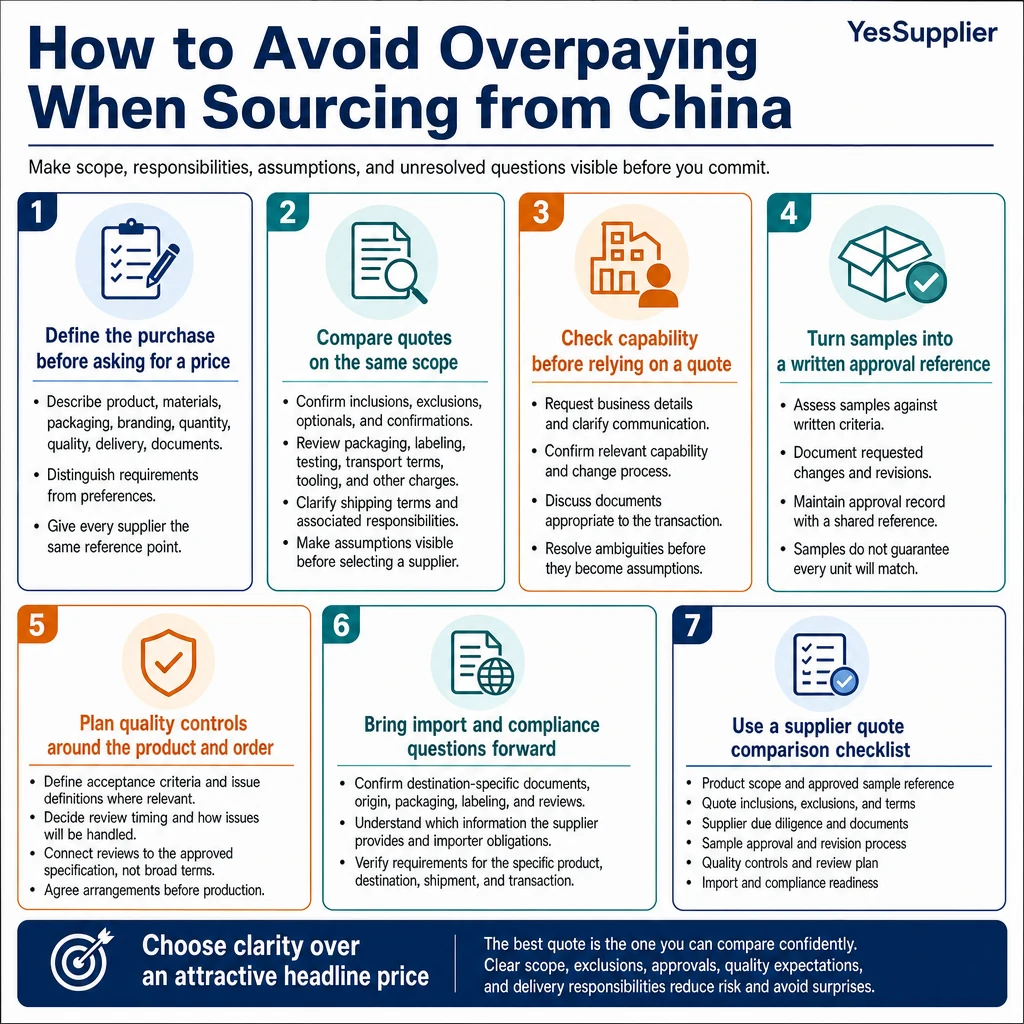
1. Define the purchase before asking for a price
An incomplete brief can lead suppliers to make different assumptions when preparing an offer. One supplier may include a particular material, finish, package, or branded component, while another may assume a simpler version. The resulting offers may appear comparable even though they are not.
Create a written product brief before outreach. It should describe the product as clearly as the category allows, including the following where relevant:
- Product function and intended use
- Materials, finish, colour, dimensions, and construction details
- Packaging format and any branding or artwork requirements
- Expected quantity and whether the quantity may change
- Quality expectations and visible acceptance criteria
- Delivery terms, intended destination, and preferred shipping arrangement
- Information or documents needed for the destination and product
The aim is not to produce an elaborate document. It is to give every prospective supplier the same reference point. A concise brief supported by drawings, photos, artwork files, or a product sample can make questions easier to identify and answer.
It is also helpful to distinguish between requirements and preferences. A requirement is something the product must meet for the order to proceed. A preference is an option you are willing to consider. This distinction reduces the chance that a supplier treats a preference as included when you expected it to be mandatory, or adds a feature that was never requested.
2. Compare quotes on the same scope
You can use a quote only when its basis is clear. Ask suppliers to identify what is included, what is excluded, what is optional, and what may be subject to confirmation. This is not a guarantee that all costs will remain unchanged; it is a practical way to expose differences before selecting a supplier.
Review the product description line by line. Confirm that each offer refers to the same specification, packaging, branding, and approval reference. If suppliers propose alternatives, separate those alternatives from the base scope rather than treating them as equivalent.
Then look beyond the unit price. Ask how the supplier has treated packaging, product preparation, labeling, testing if relevant, inland movement, shipping terms, tooling or setup where applicable, and other charges or exclusions. A buyer should also understand which party is expected to arrange transport, provide documents, and handle steps at the destination.
Terms matter because they allocate work and risk. Do not assume a shipping term means the same thing as a complete delivered cost. Ask the supplier to state the term used and the practical responsibilities that accompany it. If an answer is vague, treat that as an unresolved comparison point rather than silently inserting your own assumption.
Hypothetical example: supplier offers may describe a similar product while treating packaging differently. An offer may refer to plain packaging, while another may refer to retail-ready packaging. Neither offer is automatically better. The buyer needs to establish whether each option meets the actual brief and what work remains outside the supplier’s stated scope.
3. Check capability before treating a quote as dependable
A detailed quote is not, by itself, evidence that a supplier can deliver the documented requirement. Before placing material reliance on an offer, carry out due diligence that is proportionate to the product, order, and consequences of failure. The International Trade Administration notes that China market-entry planning should include due diligence and an understanding of applicable local regulations.
Start with straightforward questions. Request business details, clarify who will manage communication, and ask how the supplier understands the product specification. Discuss the production capability that is relevant to your order, the process for addressing changes, and the documents appropriate to the transaction. Pay attention to the answers and to whether they are consistent with the quote and your brief.
Clear communication has commercial value. A supplier that identifies ambiguities can give you an opportunity to resolve them before they become production assumptions. In contrast, an unaddressed ambiguity may later become a disagreement about scope, quality, or responsibility.
Due diligence does not eliminate risk, and the appropriate review will vary. It does, however, help a buyer make a more informed decision than one based on a price list alone. Review the relevant market-entry guidance from the International Trade Administration.
4. Turn samples into a written approval reference
Where a sample is appropriate, assess it against written criteria rather than relying on a general impression. The criteria should reflect the aspects that matter to the purchase: appearance, construction, materials where relevant, functionality, packaging, branding, and any other agreed characteristics.
Record the review outcome. If changes are requested, describe them clearly and confirm how the revised requirement will be reflected in the production specification. If the sample is approved, maintain an approval record and identify the reference that both parties will use. This creates a shared point of reference for later discussions.
A sample should not be treated as a promise that every production unit will match it. Its practical value is that it gives the buyer and supplier something specific to evaluate, revise, and approve before authorizing production.
5. Plan quality controls around the product and the order
Quality control is most useful when it begins with defined acceptance criteria. Decide what conditions would make goods acceptable, what issues need to be documented, when review should occur, and how questions or nonconformities will be handled. The appropriate approach depends on the product and the commercial risk involved.
This is consistent with the general quality-management principle of controlling externally provided processes, products, and services. It does not mean that a supplier, product, or shipment is automatically compliant. It means buyers should make their expectations concrete and consider how they will assess externally supplied goods.
For example, the buyer may want written clarity on product appearance, packaging condition, labeling accuracy, count or assortment where relevant, and how deviations will be recorded. The key is to connect the review plan to the approved specification instead of relying on broad phrases such as “good quality.” Broad phrases are easy to agree with and difficult to apply consistently.
Review arrangements should also be discussed before production is authorized. Leaving them until goods are ready can restrict the buyer’s options and create avoidable pressure. The point is not to impose a universal inspection method, but to decide which review is appropriate for the particular purchase.
6. Bring import and compliance questions forward
Importing can affect both feasibility and total purchase conditions. Requirements depend on the destination, product, shipment, and transaction details, so they should be verified for the specific order rather than inferred from another buyer’s experience.
For commercial imports into the United States, U.S. Customs and Border Protection states that importers are responsible for exercising reasonable care and for accurate import documentation, packaging, labeling, and origin information. That is a useful reminder that these topics are buyer responsibilities to address early, even where suppliers or service providers assist with parts of the process. Consult the U.S. Customs and Border Protection guidance for the U.S. context.
If you are purchasing consumer products for the United States, applicable product-safety rules may require certification by the manufacturer or importer. Whether that applies depends on the product and the relevant requirements. The U.S. Consumer Product Safety Commission guidance provides further context on general certificates of conformity.
Before selecting a supplier, confirm what destination-specific documentation, origin information, packaging, labeling, and product review may be needed. Also clarify which information the supplier can provide and which obligations remain with the importer. This avoids treating compliance and import readiness as a final shipping task when they may influence the product specification, documentation, or commercial terms.
7. Supplier Quote Comparison Checklist
| Comparison item | What to confirm in writing | Why it matters | Evidence boundary |
|---|---|---|---|
| Product scope | Specification, materials where relevant, finish, packaging, branding, and approved sample reference. | Helps distinguish offers that look similar but cover different deliverables. | Practical recommendation; it does not guarantee matching production. |
| Quote inclusions and exclusions | Unit-price basis, setup where applicable, packaging, labeling, testing, transport terms, and exclusions. | Makes assumptions visible before supplier selection. | Practical recommendation; no typical charges or rates are implied. |
| Supplier due diligence | Business details, relevant capability, communication process, and transaction-appropriate documents. | Supports a more informed selection process. | Due diligence is recommended; it is not a legitimacy guarantee. |
| Sample approval | Evaluation criteria, revision process, and an approval record before production. | Creates a documented reference for both parties. | Samples do not eliminate production risk. |
| Quality controls | Acceptance criteria, issue definitions where relevant, review timing, and issue documentation. | Helps define how supplied goods will be assessed. | General quality-control principle; no compliance claim is made. |
| Import and compliance readiness | Destination-specific documents, origin information, packaging and labeling needs, and product-specific review. | These matters can affect the viability and total cost of an order. | Requirements must be verified for the product, destination, and shipment. |
8. Choose clarity over an attractive headline price
Prefer the quote you can compare item by item: one where scope, exclusions, approval steps, quality standards, and delivery responsibilities are clearly stated. That clarity helps you spot assumptions before they become costs or disputes.
If you want assistance with product sourcing, supplier vetting, quality-control support, inspections, logistics, or customized sourcing help, you can explore sourcing and quality-control support from Yes Supplier.