
Why there’s no single answer
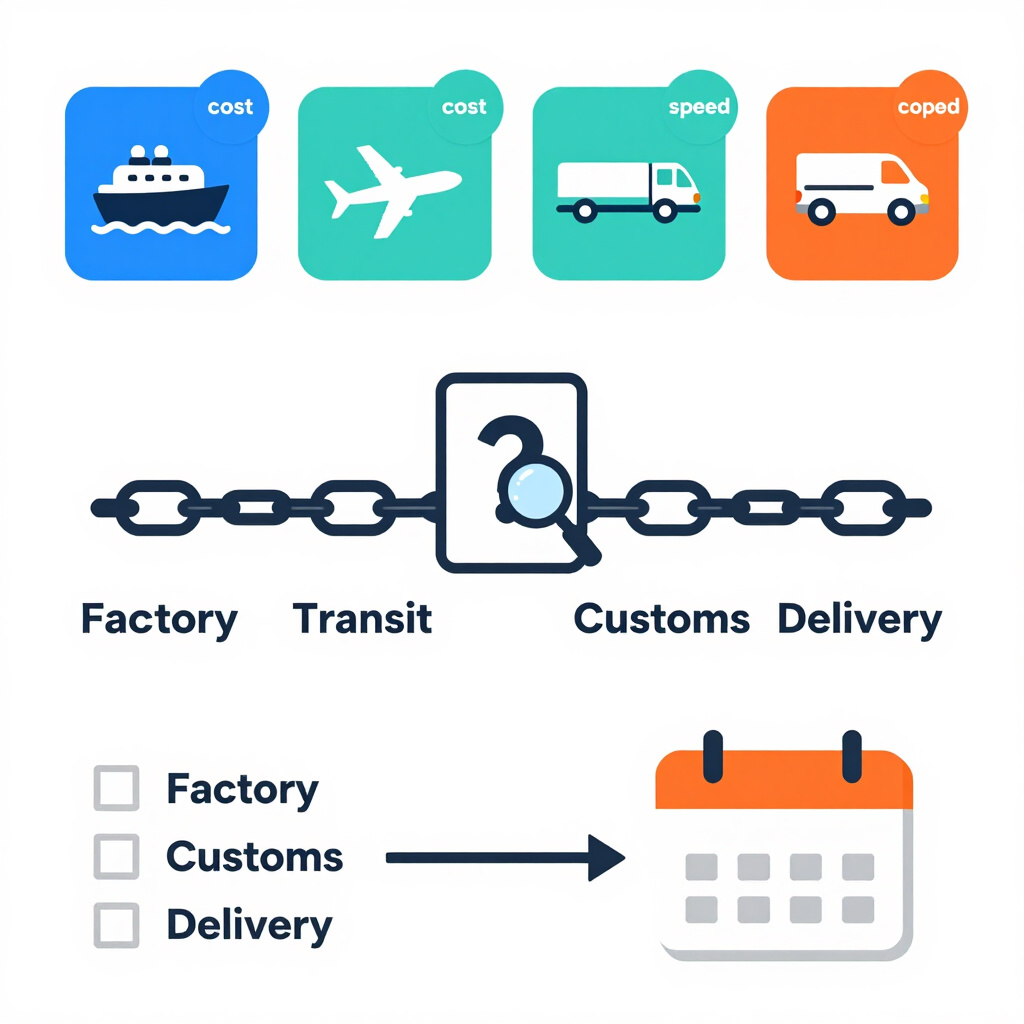
You have paid the deposit, the factory has confirmed your order, and your first customer is asking for a delivery date. Nobody can give you a reliable number yet, because shipping from China is not one number. It is a chain of steps, and the total time depends on the slowest link.
Shipping time from China varies with the shipping mode, the route, the season, port congestion, customs processing, and how long your supplier actually takes to produce the goods. A freight quote gives you a transit estimate, not a delivery promise. Anyone who quotes a fixed day range without asking about those variables is guessing.
To plan properly, you need to understand each link in the chain and where delays actually happen. If you are new to sourcing from China, the Yes Supplier homepage shows how a sourcing partner fits into the process before you commit to a timeline.
The main shipping modes from China
Four modes dominate: sea freight, air freight, rail freight, and express delivery. Each has a different cost profile, capacity, and delay pattern. None has a fixed duration.
Sea freight is the workhorse for large volumes. Your goods go into a container, move to a port, load onto a vessel, and sail to a destination port. Transit is longer than air, but the cost per unit is far lower. Delays usually come from port schedules, vessel congestion, and transshipment at hub ports.
Air freight is the option for high-value or time-sensitive goods. Your goods move on cargo space booked on passenger or freighter aircraft. It is faster, but you pay per kilogram, and cargo space is limited during peak seasons. Delays come from flight schedules, cargo screening, and customs at both ends.
Rail freight is a middle-ground option on routes like China to Europe. It sits between sea and air on both cost and speed, but it runs on fixed schedules and can be held up at border crossings and gauge-change points.
Express delivery is the door-to-door service used for small parcels, samples, and urgent documents. A courier collects, clears customs, and delivers to the final address. It is convenient, but it has size and weight limits, and customs can still hold a parcel.
The table below compares the four modes without pretending any of them has a fixed duration.
| Mode | Best for | Main trade-off | Where delays usually happen |
|---|---|---|---|
| Sea freight | Large volumes, heavy goods, low unit cost | Longest transit; port schedules and congestion | Port loading, transshipment, destination port |
| Air freight | High-value, time-sensitive goods | High cost per kilo; limited cargo space | Flight schedules, cargo screening, customs |
| Rail freight | Mid-size shipments on land routes | Fixed schedules; fewer destination options | Border crossings, gauge changes, terminal handling |
| Express delivery | Small parcels, samples, urgent documents | Higher per-parcel cost; size and weight limits | Customs clearance, local courier handoff |
Your choice of mode sets the outer boundary of your timeline, but it does not determine it. Production and customs can add more time than the transit itself.
Factors that affect shipping time
Total lead time from order to delivery is the sum of several stages:
- Production lead time. This is often the biggest variable. A supplier may quote a production window, but material availability, factory capacity, and quality rework can stretch it. If you have not confirmed the production schedule in writing, your shipping estimate is built on sand.
- Booking and pickup. Once goods are ready, someone has to book space on a vessel, aircraft, or train and arrange pickup from the factory. During peak seasons, space fills up and bookings slip.
- Transit time. The actual journey. It varies by route, carrier, and whether the shipment transships through a hub.
- Port congestion and transshipment. Vessels wait for berths. Containers wait for the next feeder vessel. These waits are outside your control and outside the carrier’s advertised schedule.
- Customs clearance. Both China export clearance and destination import clearance take time. The range is wide, and the main driver is documentation.
- Last-mile delivery. From the destination port or airport to your door, including any inland transport and local courier handoff.
So when someone asks how long shipping from China takes, the honest answer is that it depends on which stage you are asking about. A transit time quote from a freight forwarder covers only one stage.
Customs clearance: the wildcard
Customs is the stage where shipments most often lose days. The processing time depends on the accuracy of your documentation, the product category, the declared value, and whether the shipment is randomly selected for inspection.
Documentation problems include a commercial invoice that does not match the packing list, a missing or incorrect HS code, an inconsistent country of origin, or a certificate that the destination country requires for your product type. Any of these can stop a shipment until the paperwork is corrected.
Different countries also have different import regulations and inspection rates. A product that clears quickly in one market may face additional checks in another. You cannot control the inspection rate, but you can control the paperwork. Preparing documentation carefully and working with a freight forwarder or sourcing agent who understands import requirements can help you avoid documentation-related delays, though no process can guarantee clearance.
How to estimate your shipping timeline
Since no fixed number exists, build your own estimate from the stages above.
- Confirm the production lead time in writing with your supplier, including the date goods will be ready for pickup.
- Choose a shipping mode based on your budget and urgency. If you need goods sooner, air freight costs more but moves faster. If cost matters more, sea freight is the default.
- Request quotes from multiple freight forwarders. Ask each for their estimated transit time, the route, and whether the shipment transships.
- Clarify the Incoterms. Incoterms define who pays for and controls each leg of the journey. Under FOB, your responsibility starts at the port of loading. Under DDP, the supplier or agent handles delivery to your door, including customs. The Incoterm changes who you hold accountable for delays.
- Prepare accurate customs documentation before the goods ship. Confirm the HS code, the commercial invoice, the packing list, and any certificates the destination country requires.
- Add buffer time. Customs, weather, and port congestion are not fully predictable. A buffer of days or weeks, depending on the mode, is part of a realistic plan.
- Track the shipment and stay in contact with your logistics partner. A delay that is caught early can often be fixed early.
Shipping timeline estimation checklist
- Confirm production lead time with your supplier.
- Choose a shipping mode based on your budget and urgency.
- Get transit time estimates from multiple freight forwarders.
- Clarify Incoterms to know who handles each leg.
- Prepare accurate customs documentation.
- Add buffer time for customs and unexpected delays.
- Track your shipment and maintain communication with your logistics partner.
Hypothetical example
This example is hypothetical. It is not real data and does not represent actual shipping times.
Imagine a small ecommerce business orders 500 units of a kitchen gadget from a supplier in Shenzhen. Production might take a few weeks, depending on material availability and factory capacity. Sea freight from a southern China port could take several weeks, including time for the vessel to load, sail, and wait for a berth at the destination port. Customs might add days if the paperwork is complete, or longer if inspectors flag the shipment.
Do not copy these numbers. Instead, combine your own estimates: production window, transit estimate, customs buffer, and last-mile delivery. Add them together, then add contingency. That total gives you a planning number, but it is not a guarantee.
How a sourcing agent can help
A sourcing agent does not control the vessel or the customs officer, but it can provide services that help you manage the parts of the chain that are within your control. Yes Supplier covers the full chain: requirement confirmation, supplier search and vetting, sample coordination, production monitoring, final inspection, product development support, and logistics coordination. For shipping specifically, production monitoring keeps you informed about manufacturing progress, final inspection gives you a quality check before shipment, and logistics coordination handles booking, documentation, and tracking. You can see the full process on the how Yes Supplier works page and the specific logistics coordination services on offer.
Each of those services addresses a potential source of delay, but none can eliminate all delays or guarantee a specific outcome. If you want to see how they fit into real sourcing projects, the case studies page shows examples without promising specific shipping outcomes.
Frequently asked questions
How do I track a shipment from China?
Your freight forwarder or supplier should give you a bill of lading for sea freight, an air waybill for air freight, or a courier tracking number for express delivery. Tracking shows the shipment’s location and status, but it does not predict customs processing time. Check the tracking event history and ask your forwarder to investigate any stop that lasts longer than expected.
What is the difference between FOB and DDP?
FOB (Free On Board) means the seller’s responsibility ends when the goods are loaded onto the vessel. You own the risk and cost from that point, including freight, insurance, and destination customs. DDP (Delivered Duty Paid) means the seller or agent handles delivery to your door, including import duties and taxes. DDP gives you a simpler buying experience, but you pay for that convenience in the price. Choose based on how much control you want over the logistics and how confident you are in handling import procedures.
How can I reduce shipping delays?
Confirm production dates in writing, book freight early, prepare customs documents before the goods ship, and add buffer time to your plan. The most common delays come from late production, missing paperwork, and peak-season capacity shortages. Each is preventable with earlier action.
Should I use a sourcing agent to manage logistics?
If your order is small, your product is simple, and you already have a reliable freight forwarder, you may not need one. If you are managing multiple suppliers, dealing with quality issues, or importing a product with complex documentation, an agent can coordinate production and logistics and help you stay on top of the process. The FAQs page covers more of these decisions.
Shipping from China takes as long as the slowest link in your chain. The mode you choose sets the boundary, but production, customs, and port congestion can add more time than the transit itself. The way to plan is not to search for a universal number. It is to confirm each stage with the people responsible for it, add buffer, and manage the shipment actively.
If you want help reducing the uncertainty, Yes Supplier can coordinate production monitoring, final inspection, and logistics for your order. You can start from the Yes Supplier homepage, read about Yes Supplier, or explore related resources to see how the process works before you commit.