
A supplier in China sends you a quote with “DDP” on the price line. The number looks complete. But what does the term commit the supplier to, and what does it leave for you to handle? The answer depends on the trade rules version named in your contract and the details written into your agreement. If you’re a small business, entrepreneur, startup, ecommerce company, or product designer sourcing from China, answer these questions before you accept a DDP quote: what the term means in your contract, how it compares with the closest alternative, what to confirm in writing, and whether a sourcing agent should coordinate the logistics. If you’re weighing whether to use a sourcing agent, Yes Supplier’s services page lists the full scope of support, including logistics coordination.
What is DDP shipping?
DDP is a term used on international trade quotes. The exact meaning is set by the trade rules version named in your contract and the commercial terms you agree with your supplier. Those terms include the named destination, the point where responsibility passes from the seller to you, the documents the seller must provide, and what happens if customs questions the shipment.
For a small importer, the practical question is whether the supplier’s quote and contract actually state what the term covers. A DDP quote can change the division of logistics tasks. It can also create confusion if the supplier’s understanding differs from yours.
The role of trade terms in international shipping
The trade term named on a quote is part of the contract. When a supplier in China quotes you a price, the term helps define who arranges transport, who bears risk at each stage, and who pays for what.
The version matters. A quote that says “DDP” without naming the version leaves room for different interpretations. The same is true for the named destination. “DDP to your warehouse” is clearer than “DDP to the United States,” but the contract should still name the exact place and what the price includes.
You do not need to become a trade rules expert to import from China. You do need to know which term is on your quote, which version it refers to, and what the supplier understands the term to cover. Those three points are worth confirming before shipment.
DDP meaning: what to confirm in your contract
The words on a quote do not tell you the operational detail. A shipment from China moves from the factory to a port, onto a vessel or plane, into the destination country, through customs, and to the named address. At each step there is a cost and a risk. Under a DDP quote, the division of those costs and risks depends on the contract. The contract must say which steps are inside the price and which are not.
The points to confirm in writing:
- The trade rules version the quote refers to.
- The named destination where delivery is meant to occur.
- Whether the quoted price includes import duty and any related taxes.
- Who handles the import declaration and customs clearance.
- What documents the seller will provide after shipment.
- What happens if customs inspects the shipment or requests additional information.
Each point can become a dispute if left vague. A supplier may assume the buyer will handle the import declaration. A buyer may assume the DDP price covers everything. The contract should remove those assumptions.
DDP vs DAP: questions to ask your supplier
You may see DAP on supplier quotes as well. The difference between DDP and DAP depends on the trade rules version named in your contract and the details written into your agreement. Ask your supplier to explain the difference in writing for your specific shipment.
The practical comparison is not about memorizing the rules. It is about asking the same set of questions for each quote:
| Question | What to confirm |
|---|---|
| Which trade rules version applies? | The edition named in the contract |
| What is the named destination? | The exact place where delivery is meant to occur |
| Does the price include import duty? | Whether duty and related taxes are inside the quote |
| Who handles import clearance? | The party responsible for the import declaration |
| What documents will the seller provide? | The paperwork you need for your records |
A supplier may quote DDP and still ask you to provide information for the import declaration, such as your tax identification number or product details. Confirm what information they need and when they need it, so the shipment does not stall while someone waits for a document.
Benefits and risks of DDP: what to verify
Instead of assuming benefits or risks, work through the following questions with your supplier and logistics provider. The answers determine whether DDP fits your shipment.
- How many logistics tasks will you handle? Confirm which party arranges the freight, the import declaration, and the final delivery.
- How much of the total cost can you see? Confirm which cost components are inside the quoted price and which are separate.
- How much control do you have over the import process? Confirm who communicates with customs and who provides the required information.
- How will the supplier handle customs questions? Confirm what happens if customs inspects the shipment or requests additional information.
Hypothetical example: a startup orders 500 units of a custom product from a supplier in Shenzhen. The supplier quotes a DDP price to the startup’s warehouse in the United States. The startup assumes the price covers everything, including the import duty. The supplier assumes the startup will provide the information needed for the import declaration. Neither assumption is written down. The shipment stalls at customs because the required information was never provided. A written confirmation of the DDP scope could have prevented the delay.
Whether DDP is right for your shipment depends on the written terms, not on the acronym. You can review Yes Supplier’s how-it-works page for more information.
Is DDP shipping right for your import?
There is no universal answer. The right trade term for your shipment depends on your experience, your product, and how much you want to delegate. Work through these questions before you decide:
- How much experience do you have with importing? Consider how much of the process you want to delegate to the seller.
- How much control do you want over customs? Consider whether your product needs specific import documentation or compliance work that you want to keep with a broker you choose.
- How important is cost predictability? Confirm which cost components are inside the quote and which are separate.
- What kind of product are you shipping? Consider whether your product has compliance requirements that need your involvement.
- What is the shipment value? Consider how freight and duty compare with the value of the goods, and confirm how those costs are included in the quote.
The question underneath all of these is simple: what are you comfortable delegating to the seller, and what do you want to keep in your own hands? There is no wrong answer, but there is a wrong way to answer it, leaving the decision unexamined and the terms unconfirmed.
Whatever you decide, confirm the trade rules version and the full responsibility split in writing before the goods leave the factory. A verbal understanding is not a contract term. The Yes Supplier resource page covers more ground.
How a sourcing agent can help with DDP logistics
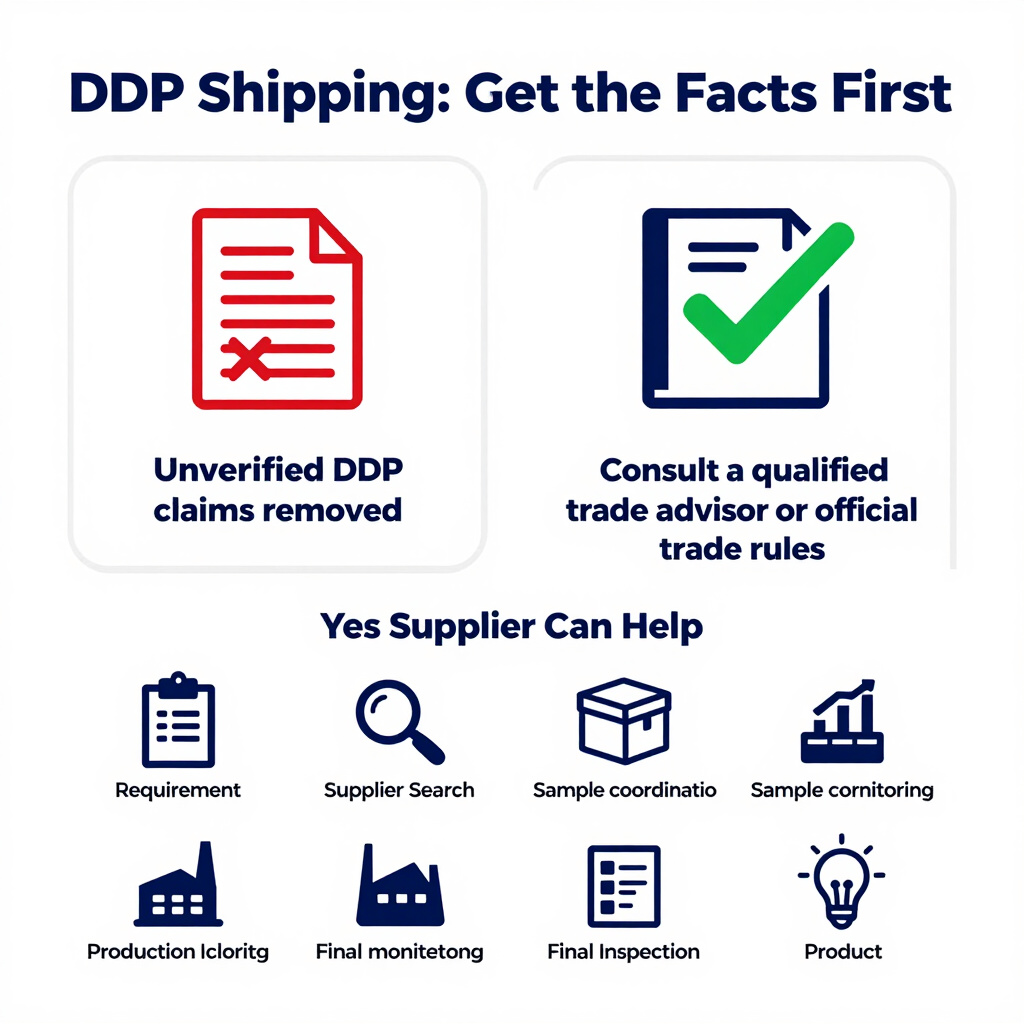
Logistics coordination is one of the services Yes Supplier offers alongside requirement confirmation, supplier search and vetting, sample coordination, production monitoring, final inspection, and product development support. For a small importer, that service can provide a defined point of contact for the shipping process.
A DDP quote can involve many moving parts: carriage, import formalities, duty payment, and final delivery. Confirm in writing which party is responsible for each. If any part is not clearly assigned, the shipment may stall while someone works out who is responsible.
A sourcing agent does not replace your responsibility to confirm the terms of your contract. You still need to know what your supplier has committed to and what your price includes. A logistics coordination service can provide a defined process for the shipping side.
If you are evaluating DDP for your shipment, relevant Yes Supplier pages include the services page, the how-it-works page, the case studies, and the about-us page.
DDP shipping: questions to confirm
What does DDP mean on this quote?
Ask your supplier to state the trade rules version and explain in writing what the term covers for your shipment.
Who pays duties and taxes under DDP?
Confirm in writing whether the quoted price includes import duty and any related taxes for your destination.
How does DDP differ from DAP?
Ask your supplier to explain the difference under the trade rules version named in your contract, and confirm the responsibility split in writing.
Is DDP good for small imports from China?
It depends on your experience, your product, and the written terms. Confirm the scope of the quote before you decide.
What are the main DDP risks?
To manage risk, confirm the trade rules version, the named destination, and the exact scope of the price in writing before the goods ship.
The Yes Supplier FAQ page has more answers.
Importer’s checklist before shipping DDP
Use this checklist as guidance for conversations with your supplier and logistics provider. It is not a legal or customs authority document. It is a list of points to confirm in writing before you commit.
- The trade rules version your contract references.
- The named destination where delivery is meant to occur.
- Who arranges the main carriage.
- Who handles the import declaration and customs clearance.
- Who pays the import duty and any related taxes.
- What the quoted price includes and what it excludes.
- What documents the seller will provide after shipment.
- What information the seller needs from you for the import declaration, and when.
Then revisit the decision questions: your experience level, your need for control over customs, the importance of cost predictability, and the product you are shipping. If the answers point to a DDP quote, make sure the contract reflects the full scope. If they point to more control on your side, a different trade term may fit better.
When the terms are confirmed in writing, you can make an informed decision about whether DDP fits your shipment. When they are not, you are relying on assumptions. The difference is not the acronym. It is the contract behind it.
If you want support with the logistics side of your import, Yes Supplier’s services page includes logistics coordination.