
Introduction
Many first‑time buyers sourcing in China find that a supplier billed as a factory is actually a trading company. That distinction matters because it determines who owns the goods, who controls production, and who is responsible for quality and timing. This article explains the structural differences between trading companies and sourcing agents, when each model is appropriate, and practical steps to verify who you are dealing with. It also includes checks you can perform and mentions YesSupplier’s services for buyers who want a partner.
Core Differences Between a Trading Company and a Sourcing Agent
The following comparison highlights the core distinctions buyers should consider when evaluating potential intermediaries. It reflects common industry practices while keeping in mind that real‑world arrangements can vary by company and product category.
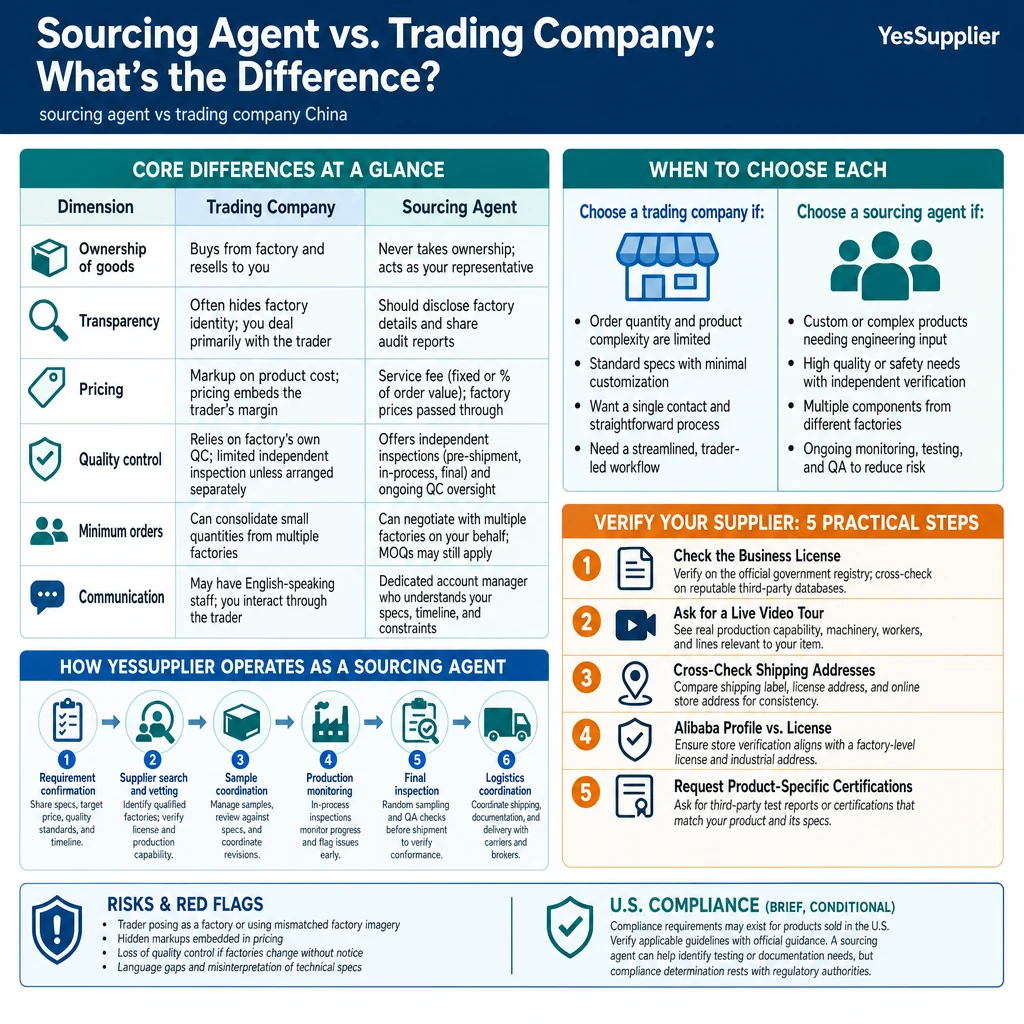
| Dimension | Trading Company | Sourcing Agent |
|---|---|---|
| Ownership of goods | Buys from factory and resells to you | Never takes ownership; acts as your representative |
| Transparency | Often hides factory identity; you deal primarily with the trader | Should disclose factory details and share audit reports |
| Pricing | Markup on product cost; pricing often embeds the trader’s margin | Service fee (fixed or percentage of order value); factory prices passed through |
| Quality control | Relies on the factory’s own QC; limited independent inspection unless arranged separately | Offers independent inspections (pre‑shipment, in‑process, final) and ongoing QC oversight |
| Minimum orders | Can consolidate small quantities from multiple factories | Can negotiate with multiple factories on your behalf; MOQs may still apply |
| Communication | May have English‑speaking staff; you interact through the trader | Dedicated account manager who understands your specs, timeline, and constraints |
The table above is grounded in general industry practice and aligns with what buyers often experience when comparing a trader against a dedicated sourcing service. YesSupplier’s services emphasize a client‑centric approach: you work with a team that coordinates supplier vetting, sample management, production oversight, and logistics without taking ownership of the goods. For more about how YesSupplier positions itself in this space, see the company’s service pages and process overview.
When a Trading Company Makes Sense
Trading companies are not inherently wrong or unreliable. They can be a practical solution for certain product types and purchasing scenarios, especially when buyers want a single point of contact and have simple, low‑risk needs. Consider a trading company in situations such as:
- When order quantities are modest and do not require extensive supplier vetting or engineering input
- For commodity products with standard specifications where branding or customization is minimal
- When you prefer a single consolidated shipment and a straightforward communications channel
- When time for supplier search and ongoing management is limited and you’re comfortable with a more streamlined, trader‑led process
Trading companies typically add a markup and give you less direct visibility into the factory that produces your goods. If a trader changes factories during an order, it can make quality tracking and long‑term consistency harder. In practice, trading companies are best used for straightforward, lower‑risk products when you are comfortable with a consolidated workflow and a single point of contact.
When a Sourcing Agent Adds Value
A sourcing agent is especially valuable when your product requires more careful attention to design, quality, and ongoing production management. Use a sourcing agent if your project involves any of the following characteristics:
- Custom or complex products where engineering input, material selection, or packaging design matters
- High quality or safety requirements that demand independent verification, process monitoring, and documented inspections
- Multiple components sourced from different factories, necessitating coordination and schedule alignment
- A preference for ongoing production monitoring, pre‑shipment testing, and QA checks that reduce risk across runs
A sourcing agent focuses on services such as finding qualified factories, vetting partners, coordinating samples, monitoring production, conducting final inspections, and managing logistics without taking ownership of the goods. YesSupplier emphasizes process transparency and accountability through a dedicated team. The approach is intended to give buyers confidence from concept to delivery, with clear roles and responsibilities described on YesSupplier’s service pages.
How to Verify If Your Supplier Is a Genuine Factory: A Practical, Step‑By‑Step Guide
Regardless of whether you end up working with a trading company or a sourcing agent, a straightforward verification routine helps you understand who is producing your goods and whether the supplier has real manufacturing capabilities. The steps below are practical and commonly used in industry practice. They are designed to be actionable without requiring legal advice or complex audits.
Step 1: Check the Business License
Request the full company name and the registration number. Look up the details on the official government registry, China’s National Enterprise Credit Information Publicity System. It is the official registry and is the primary source of record for a company’s registration. As a supplemental check, you can search the same registration details on reputable third‑party databases to corroborate the legal status and business scope, keeping in mind that those databases are not official in themselves.
Step 2: Ask for a Live Video Tour
A live video walkthrough of the factory floor helps you see the actual production capability. Genuine manufacturers can show machinery that matches your product, along with workers and lines relevant to your item. A trading company may present a polished video of another facility or a staged demonstration. A live video tour provides a much stronger signal about real manufacturing activity than a showroom or a marketing video.
Step 3: Cross‑Check Shipping Addresses
Order a sample and compare the return or shipping label address with the business license address and the address listed on the company’s online store. Inconsistencies between these addresses can indicate that the supplier is a trading company or uses a mix of partners for fulfillment. A factory address closer to an industrial park or industrial zone is often more consistent with true manufacturing activity than a commercial office building used for trading activities.
Step 4: Alibaba Profile vs. License
For buyers who source through marketplaces, check whether the store’s verification badge aligns with the license information. A factory‑level license with a real industrial address should be aligned with a production setting; mismatches can signal a trader or a pass‑through entity. Remember that verification badges may indicate license validity but do not automatically prove manufacturing capability.
Step 5: Request Product‑Specific Certifications
For electronics, toy, or other regulated product categories, request third‑party test reports or certifications that directly relate to your product. A genuine factory can provide documentation that matches the product and its specifications. If a trader provides a certificate that does not align with your item, that is a warning sign. Certification checks are an important part of confirming manufacturing capability and quality control systems.
Risks & Red Flags
- Trading company presenting itself as a factory or offering factory imagery that does not align with the actual production site
- Hidden markups embedded in the pricing that are not transparent to the buyer
- Loss of quality control if the trader switches factories without notice or if the production process lacks independent oversight
- Language gaps and misinterpretation of technical specifications that lead to specification drift
U.S. Compliance (Brief, Conditional)
If the product is intended for the U.S. market, consider whether regulatory compliance applies. Compliance requirements may exist, and it is prudent to verify the applicable guidelines with official guidance. A sourcing agent can help identify whether a product needs testing or documentation, but there are no guarantees of regulatory approval or clearance through any intermediary. For buyers who want a clearer path, YesSupplier can offer guidance as part of its product development and sourcing services, while remaining mindful that compliance determination ultimately rests with the relevant regulatory authorities.
How YesSupplier Operates as a Sourcing Agent
YesSupplier positions itself as a service‑based intermediary that supports buyers from concept to delivery without taking ownership of goods. The typical process emphasizes transparency and controllable oversight:
- Requirement confirmation , the buyer shares product specs, target price, quality standards, and timeline.
- Supplier search and vetting , YesSupplier identifies qualified factories, conducts license checks, and verifies production capacity and capability.
- Sample coordination , YesSupplier manages sample requests, reviews samples against the specs, and coordinates revisions with the factory.
- Production monitoring , in‑process inspections monitor production progress and flag deviations early.
- Final inspection , prior to shipment, random sampling and QA checks help verify conformance to the agreed specs.
- Logistics coordination , YesSupplier coordinates shipping, documentation, and delivery to the destination, coordinating with carriers and brokers as needed.
Crucially, YesSupplier does not take ownership of goods and charges a service fee for the value it provides. This structure is designed to give buyers visibility into who is producing their goods and to facilitate direct communication when necessary. Details about the process, services, and capabilities are described on YesSupplier’s dedicated pages, including those that explain the workflow and the full range of services available to buyers.
Decision Framework: Which Should You Choose?
Use this practical framework to guide your decision, recognizing that every product and situation is unique. A clear understanding of your priorities, cost, control, speed, and risk, helps determine the right intermediary path.
Choose a trading company if:
- Your order quantity and product complexity are limited enough that a single intermediary can manage end‑to‑end with reasonable risk
- You are seeking a streamlined process with a single point of contact and a straightforward workflow
- You are comfortable accepting a price that includes the trader’s margin and you demand relatively quick fulfillment
Choose a sourcing agent if:
- Your product requires customization, engineering input, or ongoing design development
- Quality control is mission‑critical, with in‑process checks and final inspections as a standard part of the program
- You need long‑term supply chain management across multiple suppliers or components
- You are new to China sourcing and want a partner who provides clear, structured guidance and transparent pricing
A sourcing agent is typically more transparent about the service scope and the path from supplier qualification to final delivery, with a focus on reducing risk and providing ongoing oversight. The upfront cost is expressed as a service fee for the value delivered, in contrast to a trading company’s embedded markup. Buyer experience and product risk tolerance are the two most important factors shaping this choice.
Ready to Evaluate Your Sourcing Needs?
If you’re unsure whether a trading company or a sourcing agent best fits your product, a practical next step is to have a professional review your project and provide a transparent plan. YesSupplier can help you assess your product requirements and present a sourcing plan with a clear outline of services and responsibilities. Contact YesSupplier for a free consultation to discuss your next project.
For more guidance on China sourcing, YesSupplier also maintains a guides library and case studies that illustrate how different engagements have worked in practice.