
You finally have a product idea that you believe in. The unit economics look promising, your target customers are real, and you have a rough budget. The only problem is that every factory you reach out to on Alibaba either ignores your request, quotes a price that makes no sense for the quantity you need, or sends you a catalog of products that have nothing to do with what you asked for. You start wondering whether China sourcing is even possible for a small business, or if it is reserved for companies that can fly to Canton Fair and place six-figure orders.
That situation is more common than most guides admit. Chinese suppliers are not a monolith. Some are highly professional export factories that work with startups; others are trading companies posing as manufacturers; many simply won’t respond to a single inquiry from an unknown email address. The difference between a successful first order and a sunk cost often comes down to how you structure the search and what you verify before sending any money.
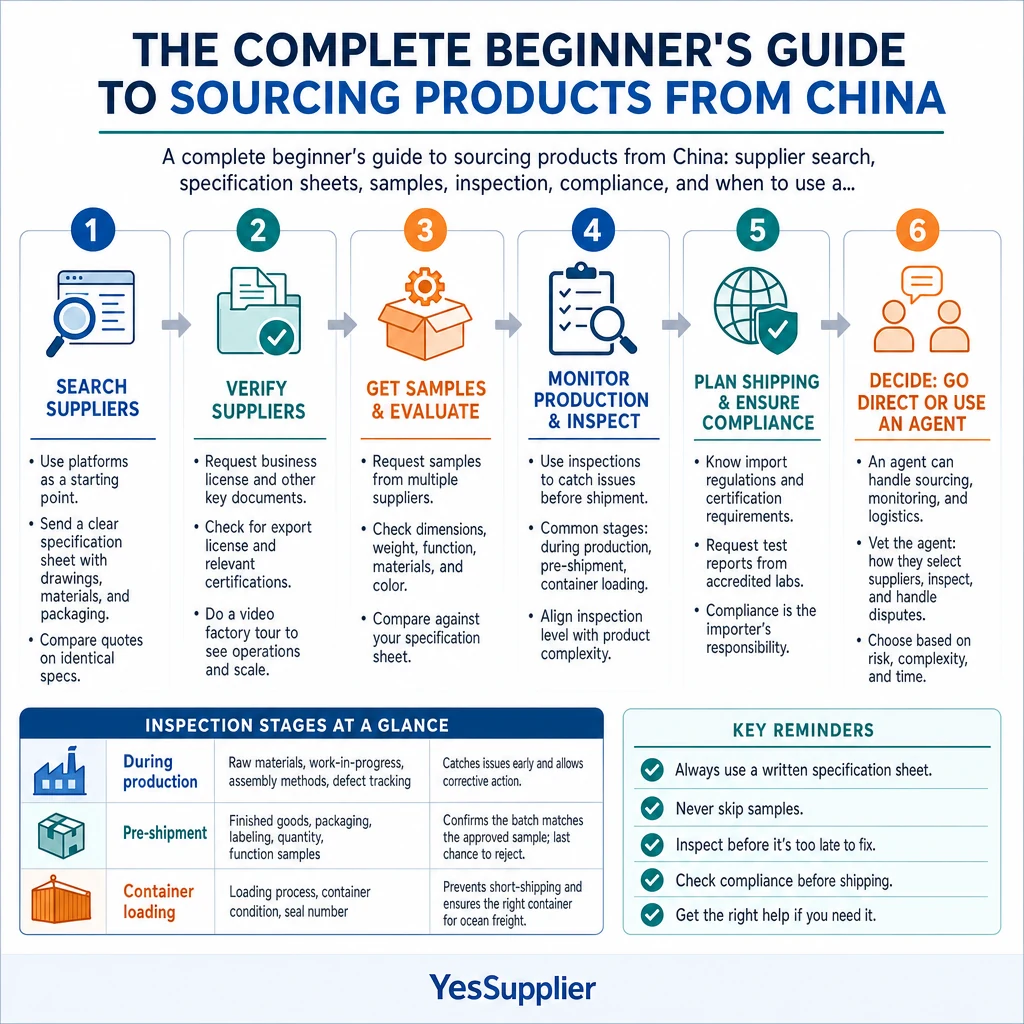
1. Searching for suppliers: the first decision is not which factory to pick
Most beginners default to Alibaba because it is the obvious platform, and it can work. But Alibaba listings are curated by the sellers, not by an independent auditor. A supplier with a gold star and five reviews may be a perfectly good trading company, while a factory with no reviews and a poorly translated page might be exactly what you need. Treat every listing as a starting point, not a final answer.
Once you have a shortlist of potential suppliers, you need to confirm that they actually produce the product you need. This is where the process can go wrong quickly. A common shortcut is to ask for a quote and accept the lowest one. That works only if every supplier is quoting on identical specifications. In practice, suppliers interpret vague requirements differently. One might quote based on virgin material, another on recycled material. One assumes a standard carton pack, another includes a blister pack. If you do not send a clear, written specification sheet with drawings, measurements, materials, and packaging requirements, you are comparing apples to oranges. Without that sheet, you will not know why one quote is half the price of another, and you will not be able to hold anyone accountable when the product arrives wrong.
2. Verification starts with documents
A real manufacturer in China can usually provide a business license, an export license if they export directly, and sometimes third-party certifications such as ISO 9001 or IATF 16949 if they serve automotive or medical clients. These documents are not guarantees of quality, but they show that the company has registered legally and has a track record of meeting certain standards. You do not need to become a certification expert. What you need is to ask for the documents and look at them. If a supplier hesitates to share a business license, that is a red flag.
Beyond documents, the most reliable early signal is a video call with a factory tour. Many suppliers are willing to walk you through their workshop using WeChat video or Zoom. This does not cost anything, and it lets you see the scale of the operation, the equipment in use, and whether the workshop looks organized. A supplier that refuses a video call or sends only pre-recorded videos may be a trading company without its own production line. That is not automatically disqualifying. Many trading companies run production effectively, but it changes how you need to verify quality.
3. Samples are not optional
Every buyer who has been burned by China sourcing has a story about skipping samples to save time or money. The sample phase is where you actually learn whether the factory can produce what you want. You should request at least two or three samples from different shortlisted suppliers, not just the cheapest one. When the samples arrive, you need to evaluate them against your specification sheet. Check dimensions with a caliper. Weigh the product. Test the function. Compare the color to a Pantone reference if that matters. Take photos for your records.
One concrete hypothetical example: a buyer sourcing a portable Bluetooth speaker might receive a sample that sounds fine but weighs more than the specification allowed. That could mean the factory used a heavier battery than quoted, which affects shipping costs and compliance with battery transport regulations. Without checking, that detail gets missed until the first container is already on the water. The business consequence is a customs hold or unexpected freight charges that eat into margin.
4. Production monitoring vs. final inspection
Once you approve a sample and place a production order, you face another set of decisions. Many first-time buyers treat the order like a purchase from a domestic supplier: place the order, pay the deposit, wait for delivery, and inspect upon arrival. That approach works poorly with overseas production because by the time goods arrive, it is too late to fix problems without expensive rework or return shipping.
An alternative is to engage a third-party inspection service to check quality during production (often called during-production inspection or DPI) and again before shipment (pre-shipment inspection or PSI). The during-production check happens when about one-fifth to one-third of the order is complete, so if the factory is using the wrong material or assembling components incorrectly, there is still time to correct it. The pre-shipment inspection happens when the order is fully packed and ready to ship. A typical check includes verifying quantity, visual defects, function testing, and packaging integrity.
| Inspection stage | What is checked | Why it matters for a beginner |
|---|---|---|
| During production | Raw materials, work-in-progress, assembly methods, defect tracking | Catches issues early, allows corrective action before bulk production continues |
| Pre-shipment | Finished goods, packaging, labeling, quantity, function samples | Confirms the batch matches the approved sample; last chance to reject before payment balance |
| Container loading | Loading process, container condition, seal number | Prevents short-shipping and ensures the right container is used for ocean freight |
Not every order needs all three inspection stages. For a simple item such as a plastic kitchen gadget from a supplier with a long track record, a pre-shipment inspection may be sufficient. For an electronic device with a lithium-ion battery, you may want during-production checks, a pre-shipment inspection, and a certification review. Each inspection typically adds several hundred dollars for a basic check, depending on the provider and product complexity. That cost can be significant for a small order, but it is usually lower than the cost of unusable goods.
5. Shipping and the compliance trap
Shipping from China is straightforward once you have a freight forwarder. The trap for first-time importers is compliance. Every country has import regulations around product safety, labeling, and prohibited materials. The United States requires FCC certification for electronic devices that emit radio frequencies. The European Union requires CE marking for many products. Toys, children’s products, kitchenware, and cosmetics all have specific rules that vary by market. These requirements are the responsibility of the importer, not the factory. A Chinese supplier may tell you they have CE certification, but their certification may be issued by a test lab that is not recognized by your country’s authorities. If customs detains your shipment, the supplier is unlikely to refund you.
The safest approach is to identify the compliance requirements for your target market before you start sourcing. The Consumer Product Safety Commission (CPSC) in the US and relevant national authorities in the EU publish guidance documents. You do not need to memorize them, but you need to know which tests apply to your product and ask your supplier for test reports from accredited labs. If the supplier cannot provide reports or offers to help you get certification for an extra fee, consider that a warning that the product may not meet baseline standards.
6. When a sourcing agent makes sense
Managing all of the above (supplier search, specification sheets, sample evaluation, production monitoring, inspection, compliance, shipping) is doable for a single product if you have time and patience. But many small business owners have other responsibilities: running an existing brand, managing customer service, fulfilling orders. The time cost of handling China sourcing alone can be higher than the fee a sourcing agent charges.
Yes Supplier, for example, provides services that cover the workflow from requirement confirmation through logistics coordination. A sourcing agent will not guarantee lower prices or no defects, but they take on monitoring and communication tasks you would otherwise handle. The tradeoff is less direct control over factory conversations. In exchange, you get a single point of contact who manages the back-and-forth and can spot problems earlier than you might.
If you decide to use an agent, the same vetting principles apply. You should ask the agent how they select suppliers, whether they visit factories in person, what their inspection criteria are, and how they handle disputes. A good agent will give you direct access to factory communications and let you approve samples. A bad agent will act as a black box and take a cut from both sides.
The decision to go direct or use an agent comes down to your risk tolerance, product complexity, and how much time you can dedicate to sourcing. For a first order, many buyers find that paying a small fee for guidance is cheaper than making an expensive mistake.
Once your order ships and clears customs, the real work of selling begins. But getting to that point with a product that matches your sample and meets import requirements is the foundation. Without that foundation, marketing, branding, and fulfillment have nothing to stand on.
If you would like to explore how a structured sourcing process could apply to your project, you can review the full scope of services offered by Yes Supplier here. For more detail on how the process works step by step, see the How It Works page, and to understand common questions, visit the FAQs.