
A product sample is only useful if it gives you enough reliable information to choose a supplier, refine a specification, assess presentation, or prepare for a production decision. The supplier’s charge is a secondary detail.
That is why the cost of a product sample from China is not a single fixed number. A quote can vary with the product, whether it already exists, requested changes, required packaging, shipping method, destination, and any optional review work. A low single total is hard to compare if it does not state which product version is included or what happens after feedback.
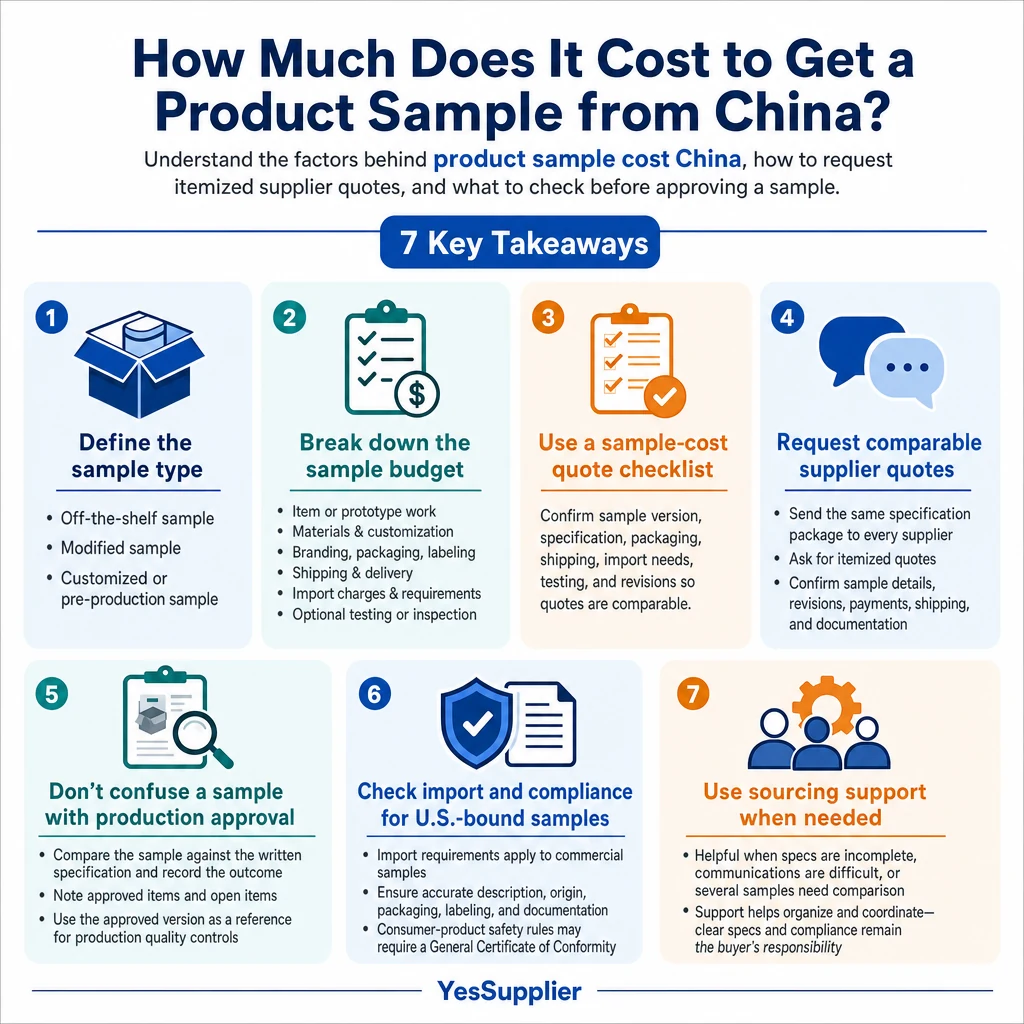
For a small business or product team, the practical step is to build a written sample budget and review plan before paying. Ask suppliers to price the same documented request, separate the relevant line items, and confirm what the sample is meant to prove. This turns a vague purchasing task into a more useful comparison.
Start by identifying the sample type
Before comparing quotes, define the sample you actually need. The label “sample” can describe very different items, and those differences affect both the commercial discussion and the value of what arrives.
Off-the-shelf sample
An off-the-shelf sample is an existing item that the supplier already makes or has available. It is useful when you need to examine basic materials, finish, sizing, construction, handling, or usability. It may help you decide whether the supplier’s current product is a suitable starting point.
However, an existing item may not reflect your intended color, component selection, branding, packaging, or final specification. Treat it as evidence of the specific version received, rather than evidence that every future version will be identical.
Modified sample
A modified sample starts with an existing item but includes requested changes. Those changes might involve the material, finish, color, dimensions, components, or presentation. The key issue is clarity: the supplier should identify which requested features are included in the sample and which are not.
If a requested change is important to product performance or customer experience, put it in writing. A modified sample is only comparable across suppliers when each supplier is responding to the same requirements.
Customized or pre-production sample
A customized or pre-production sample represents a buyer’s particular design or a defined production specification. It may involve prototype work, customized materials, branding, packaging, or other development activity. This type of sample is more relevant when the buyer needs to verify a design before discussing a bulk order.
Its usefulness depends on documentation. Confirm the materials, dimensions, finish, components, packaging, and requested changes that the sample is meant to include. Without that record, it can be difficult to determine whether feedback concerns the agreed design or an assumption that was never included.
What can make up a sample budget
The purchase price of the physical item is only one possible part of a sample budget. Ask for a written quote that separates the relevant components rather than relying on a single unexplained total. Supplier quotes and product specifications are commercial information, so they should be confirmed directly with each supplier.
Sample item or prototype work
The quote may cover an existing product sample, work needed to adapt an existing item, or effort involved in creating a customized version. Ask the supplier to state which of these applies. This helps prevent a basic existing item from being mistaken for a sample that reflects your final design.
Materials and customization
Materials, components, finish, dimensions, color, and requested alterations should be identified separately where possible. A specification that says only “customized” leaves too much room for interpretation. Specify the version of each important feature you want reviewed.
Branding, packaging, and labeling
Logos, labels, inserts, retail packaging, and other presentation elements may change what needs to be prepared for a sample. A plain product sample can still be useful, but it may not show how the final customer-facing item will look or arrive. Confirm whether the quoted sample includes those elements.
Shipping and delivery service
Shipping can be a separate part of the total budget. Confirm the shipping method, destination, the party responsible for freight, and what the shipping quote includes. If delivery is arranged to a different destination than the eventual commercial shipment, keep that distinction visible in your planning.
Destination-country import charges and requirements
Duties, taxes, clearance procedures, and documentation requirements depend on the destination and product. A sample should not be described as automatically exempt from customs obligations merely because it is a sample. For U.S.-bound merchandise, U.S. Customs and Border Protection notes that imported merchandise may be subject to duty and product-specific rules and regulations.
Optional testing, inspection, or third-party review
A buyer may also request inspection, testing, or an independent review. These are distinct activities. Reviewing a supplier sample for appearance or usability is not the same as formal testing against an applicable requirement. Ask what standard or written specification will be used, who will provide the service, what item will be reviewed, and what documentation will be provided.
Sample-cost quote checklist
| Cost area | What to confirm with the supplier | Why it matters |
|---|---|---|
| Sample version | Whether the sample is an existing item, a modified item, or a custom pre-production version. | The level of development work can change the quote and the usefulness of the sample for production approval. |
| Product specification | Materials, finish, dimensions, color, components, and any requested changes. | Suppliers can only provide comparable quotes when they are pricing the same specification. |
| Branding and packaging | Whether logos, labels, inserts, retail packaging, or other customized presentation are included. | A basic product sample may not reflect the final branded or packaged item. |
| Shipping | Shipping method, delivery destination, party responsible for freight, and what is included in the shipping quote. | Freight can be a separate part of the total sample budget. |
| Import requirements | Accurate product description, country-of-origin information, packaging, labeling, and documentation needed for the destination. | Imported merchandise may be subject to duty and product-specific import rules. |
| Testing or inspection | Whether any verification is requested, what standard or specification will be used, and who provides the service. | A supplier sample review and formal compliance testing are different activities. |
| Revisions and next steps | What changes can be requested after review, how approval will be recorded, and whether later production must match the approved specification. | A written approval record reduces ambiguity between sample review and bulk production. |
How to request comparable supplier quotes
Supplier comparison works best when every supplier receives the same specification package. A detailed request does not need to be complicated, but it should be specific enough that the supplier can identify what they are pricing.
Include product drawings, reference images where relevant, material requirements, color references, dimensions, components, finish expectations, branding files, packaging requirements, and the intended delivery destination. If any item is still undecided, label it as undecided rather than allowing each supplier to make a different assumption.
Then ask each supplier for an itemized quote covering the sample item or development work, customization, packaging, shipping method, destination charges where applicable, and any optional testing or inspection service. Ask them to confirm the sample quantity, material version, color, dimensions, packaging, and the limits on revisions or changes after you review the item.
It is also reasonable to ask whether any sample-related payment may be handled differently if a later production order is placed. Do not assume a particular arrangement. Request the supplier’s position in writing and retain it with the quote.
Finally, confirm the shipping method, who pays for freight, the destination, and the product description and documentation that will accompany the shipment. These details help ensure that quotes are being compared on a like-for-like basis rather than as incomplete totals.
Do not confuse a sample with production approval
A sample can support a decision, but receiving it does not automatically mean that later production will match it. The buyer should compare the received item against the written specification and record the outcome.
Create a simple approval record that identifies the approved materials, finish, dimensions, components, color, packaging, and acceptable variations. Note every requested change in a form that can be shared back with the supplier. If the sample does not include final packaging or branding, record that limitation clearly rather than treating it as approved by implication.
A buyer may be satisfied with a product’s material and construction but still need to review final branded packaging. In that situation, the written record should separate the features that have been reviewed from those that remain open. This creates a clearer basis for the next sample, production discussion, or quality-control plan.
The approved version should become a reference point for bulk-production quality controls. It is not a guarantee of future output, supplier performance, delivery, or compliance. It is a documented benchmark against which later work can be checked.
Import and compliance checks for U.S.-bound samples
Import requirements are destination-specific, so buyers should identify the rules that apply where their sample is being sent. For U.S.-bound samples, Customs and Border Protection explains that commercial samples remain subject to U.S. importation requirements. CBP also states that importers are responsible for reasonable care, including accurate documentation, packaging, labeling, and origin information.
These points matter even when the shipment is only intended for review. Confirm that the product description, country-of-origin information, packaging, labeling, and shipment documentation are accurate for the item being sent. The appropriate requirements depend on the product and the circumstances of importation.
Consumer-product compliance is likewise product-specific. For U.S.-bound consumer products subject to applicable consumer-product safety rules, a General Certificate of Conformity may be required, according to the U.S. Consumer Product Safety Commission. A supplier statement or a visual review of a sample alone should not be treated as proof that a product meets an applicable safety rule or is ready for sale.
For products sent to destinations outside the United States, confirm the relevant local import and product requirements with appropriate qualified sources. The U.S. materials cited here should not be generalized to other destinations.
When sourcing support may be useful
Direct supplier communication may be sufficient when the specification is complete, the sample request is straightforward, and the buyer can evaluate the result independently. Support can become more useful when specifications are incomplete, supplier communications are difficult, several samples need to be compared, or the buyer wants help coordinating quality-control, logistics, or verification activities.
A sourcing partner can assist with organizing information and following a defined review process, but it does not remove the need for clear specifications, direct confirmation of commercial terms, or destination-specific compliance checks. Buyers should remain clear about what service is being requested and what evidence will be provided.
If you need help comparing suppliers, coordinating samples, or planning next steps after review, learn how Yes Supplier supports sample coordination.
Build a written decision record before moving forward
When assessing the cost of a product sample from China, look beyond a single headline figure. Ask which sample version is being quoted, what work and presentation are included, how it will be shipped, what import variables may apply, and whether any optional verification work is needed.
Choose between suppliers using itemized, comparable quotes paired with a documented review plan. When the received sample is checked against a written specification and the resulting approval record is retained, the sample shifts from a package to inspect into a practical reference for the next sourcing decision.