
When reviewing a sourcing agent service fee, look beyond the headline charge. The important questions are what work the fee covers, what deliverables you will receive, which costs are outside the fee, and which approvals remain with you as the buyer.
Two proposals can use the same service label while covering different work. One provider might only handle supplier search and communication. Another might also coordinate samples, follow up during production, manage quality tasks, or support shipping communications. Do not assume a phrase like “full service” includes those tasks; require them in the written scope.
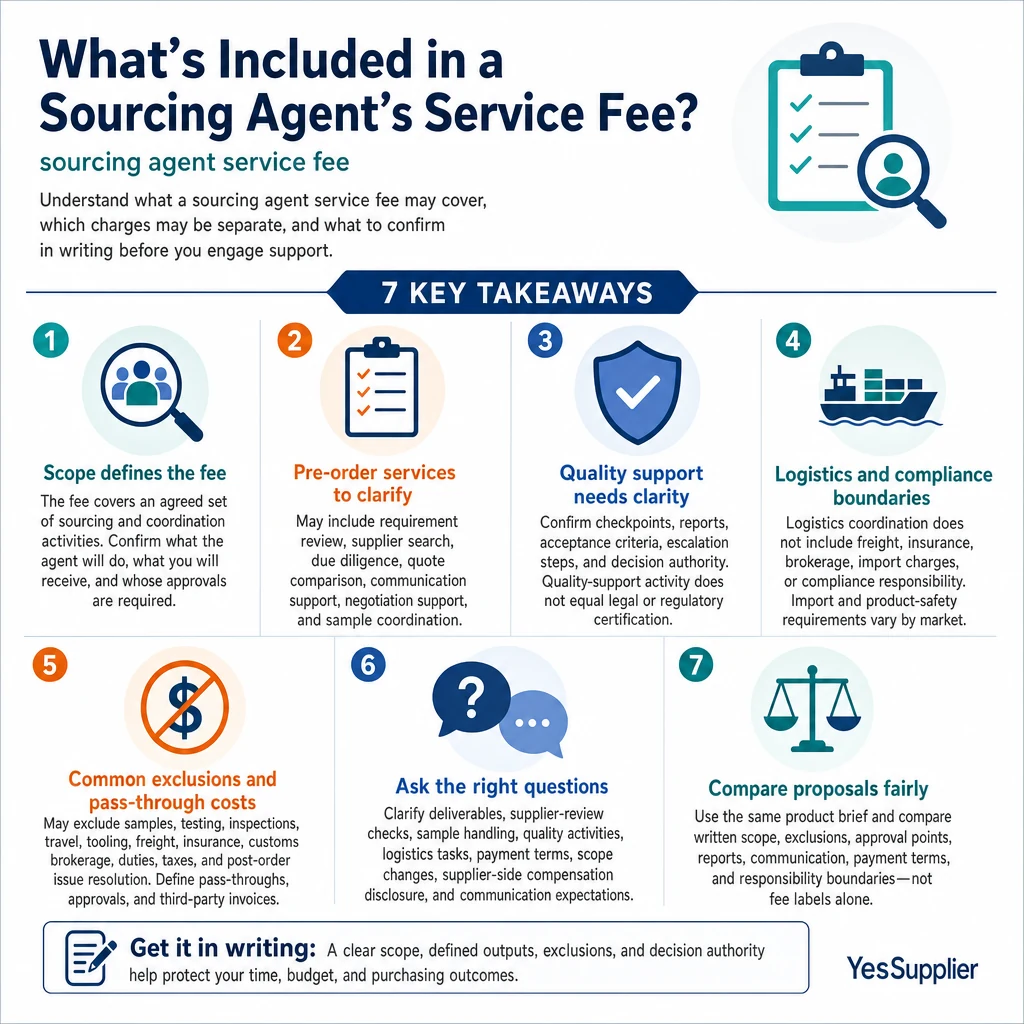
A useful proposal works as a scope-of-work document. It should identify what the agent will do, the information the agent needs from you, the records you can expect, the points at which you must approve a decision, and the third-party services that may be charged separately. This gives you a clearer basis for deciding whether the proposed support fits your product and purchasing process.
What a sourcing agent service fee is paying for
A sourcing agent service fee is compensation for an agreed set of sourcing and coordination activities. The work may start before a supplier is selected and may continue after an order is placed, but the boundary depends on the agreement.
For an early product search, the scope may include translating product requirements into supplier-search criteria, collecting preliminary supplier information, clarifying quotations, and managing communication. For a more involved purchase, it may extend to sample coordination, supplier follow-up, issue escalation, reporting, or shipping-related communication.
Ask for defined outputs rather than relying on general promises. For example, a proposal can state whether you will receive a supplier comparison, written quotation summary, sample feedback record, inspection report, shipment-document checklist, or communication log. It can also identify who is expected to make commercial decisions, approve samples, define acceptance criteria, and authorize additional spending.
Supplier review can support a more informed decision, but it does not make a supplier risk-free or guarantee future performance. The International Trade Administration advises businesses working in China to conduct robust due diligence and understand applicable local regulations. An agent may support parts of that process, while the buyer should still review the information received and retain responsibility for commercial decisions.
Services that may be included in a sourcing quote
Pre-order support may help a buyer organize a product search and compare possible supplier options. The exact activities should be confirmed in writing. Depending on the agreement, a sourcing quote may include:
- Requirement review to clarify specifications, materials, packaging expectations, branding details, intended destination, and other information needed for supplier discussions.
- Supplier search and shortlist preparation, identifying possible suppliers against agreed criteria and presenting options in an agreed format.
- Preliminary supplier due diligence, performing the specific checks listed in the scope and sharing agreed findings or documents.
- Quotation collection and comparison, gathering supplier offers and organizing differences in specifications, packaging, tooling, payment assumptions, and delivery assumptions.
- Communication support to relay questions, clarify product details, and help preserve a written record of material supplier discussions.
- Negotiation support, assisting with discussions of commercial terms without promising a particular result or the lowest available price.
- Sample coordination to arrange communication about samples, feedback, approvals, and shipment details.
These activities work best when the buyer provides a clear product brief. Important details can include product configuration, intended use, materials, branding, packaging, approval criteria, and the market where the product is expected to be sold. If the brief changes after work begins, ask how the change affects the agreed scope and whether additional work requires approval.
For supplier-review work, request a plain-language explanation of what is checked and what is not checked. The term “vetting” can mean different things in different agreements. It should not be treated as a certification, warranty, or substitute for the buyer’s own review of product, commercial, and legal considerations.
Production and quality-support services to clarify
Quality-related support requires particular clarity because “quality control” can describe several different activities. A proposal may include factory review, production follow-up, inspection coordination, issue escalation, reporting, or none of these. Some activities may be optional or quoted separately.
Ask which checkpoint is proposed and what evidence you will receive. A written scope can identify whether the agent will communicate with the supplier during production, coordinate an independent inspection provider, share an inspection report, or help communicate agreed corrective actions. It should also state who defines the acceptance criteria and who has authority to make shipment-related decisions.
Quality-support activity is not the same as legal or regulatory certification. ISO quality-management requirements address the control of externally provided processes, products, and services, but they do not turn an agent’s review or inspection coordination into a compliance determination. Product requirements depend on the product category and destination market.
Sample approval also has limits. It records your assessment of a particular sample under the available conditions. It does not itself guarantee that later production will match. Confirm how sample approval is documented, which specification version controls, and how supplier changes or buyer revisions will be communicated.
| Service area | Confirm in writing | Question for the agent |
|---|---|---|
| Supplier search and shortlist | Search criteria, selection process, format of supplier options, and records provided. | What information will we receive to assess each proposed supplier? |
| Supplier due diligence | Specific checks performed, findings shared, documents requested, and exclusions. | What does your supplier review cover, and what does it not verify? |
| Quotes and negotiation support | Whether specifications, commercial terms, packaging, tooling, and delivery assumptions are compared. | How will differences between supplier offers be documented? |
| Samples | Who arranges samples, who pays related charges, approval records, and the process for rejected samples. | Which sample-related costs are separate from your service fee? |
| Quality support | Checkpoints, report format, acceptance criteria, escalation steps, and decision authority. | What reports will we receive, and what happens if results do not meet agreed criteria? |
| Shipping and import support | Coordination tasks, documents collected, third-party communication, and excluded transport or import costs. | Which logistics tasks are included, and which third-party costs are separate? |
Logistics, import, and compliance boundaries
Logistics coordination should be separated from the underlying cost of freight, insurance, brokerage, storage, and import-related charges. An agent may communicate with the buyer, supplier, freight forwarder, or other providers. That support does not automatically make the agent the carrier, customs broker, importer, or party responsible for customs clearance.
Import obligations depend on both the destination and the product. In the United States, U.S. Customs and Border Protection states that importers must exercise reasonable care regarding accurate import documentation, packaging, and origin labeling. Buyers importing into another market should verify the applicable requirements with qualified customs and compliance professionals.
Product-safety requirements also cannot be assumed from a sourcing quote. The U.S. Consumer Product Safety Commission explains that products subject to applicable consumer product safety rules may require certification. Whether a requirement applies depends on the product and market. An agent may coordinate third-party testing or collect documents when that work is included in the agreement, but the buyer or importer retains responsibility for confirming applicable requirements and making final compliance decisions.
Before placing an order, clarify who selects any testing provider, who pays for its work, what documentation is expected, who reviews the documentation, and who decides whether the product is ready for its intended market. These responsibilities should be settled before production is underway.
Common exclusions and pass-through costs
A transparent proposal identifies costs that are not included in the sourcing agent service fee. The exclusions vary by agreement, but buyers should ask whether the following may be charged separately where applicable:
- product samples and sample shipping;
- third-party testing, inspections, audits, or specialist reviews;
- factory visits or travel-related out-of-pocket expenses;
- tooling, molds, product development, artwork, packaging, or revisions;
- freight, cargo insurance, customs brokerage, storage, and delivery services;
- duties, taxes, destination charges, and other import-related payments;
- rework, replacement, remediation, or issue-resolution work after an order is placed.
Define “pass-through” instead of assuming its meaning. Ask whether third-party invoices will be shared, whether you must approve expenses before they are incurred, whether an administrative charge applies, and how currency conversion and supplier payments are handled. The goal is to understand the cost boundary before work starts, not to eliminate every separate cost.
Questions to ask before accepting a sourcing-agent quote
Proposal review is an opportunity to establish accountability. These questions can help determine whether the scope is clear enough for your needs:
- What exact deliverables will we receive at each stage?
- What product information and approvals do you need before beginning?
- How will supplier options and quotations be documented for comparison?
- What supplier-review checks are included, and what remains outside your review?
- How are samples handled, approved, paid for, and recorded?
- Which production, quality, inspection, or reporting activities are included, optional, or excluded?
- Who sets acceptance criteria and decides how to respond to a reported issue?
- Which logistics tasks are included, and which third-party providers or charges are separate?
- What are the payment triggers, cancellation terms, and terms for scope changes?
- Do you receive compensation from suppliers or other parties connected to this order, and how is that disclosed?
- What communication expectations, records, and post-order support are available?
Supplier-side compensation is not, by itself, a conclusion about service quality. Disclosure is the key issue. You should understand how the agent is paid, what incentives may exist, and whether the arrangement is clearly documented.
How to compare sourcing proposals fairly
Compare proposals line by line rather than comparing fee labels alone. Use the same product brief for each proposal, then compare the written scope, exclusions, approval points, reports, communication expectations, payment terms, and responsibility boundaries.
A lower headline fee may cover a narrower assignment. A broader proposal may include more coordination while still excluding third-party costs. Neither arrangement is automatically better. The suitable choice depends on the support you need, the decisions you want to retain, and the records required for your purchasing process.
Also consider the questions an agent asks before accepting the work. Requests for specifications, intended destination, sample criteria, documentation, and decision authority can help define the assignment. Vague promises are harder to assess and more difficult to manage than clearly stated deliverables and exclusions.
Define your sourcing scope
If you want to discuss a product brief and the support you need, explore sourcing services with Yes Supplier.