
You found a supplier on an online marketplace. The unit price is significantly lower than your domestic cost. The catalog photos look professional. You send an inquiry, and within hours a sales manager replies in fluent English. She sends a Proforma Invoice, asks for a deposit, and promises delivery in a timeframe. You’re ready to pay.
But something stops you. You’ve never been to China. You don’t know if the factory is real, if the materials will match the sample, or what happens if the shipment is late. The supplier says they can handle everything. But can they? You wonder if you need an agent in the middle, adding cost and time, or if you can handle this alone.
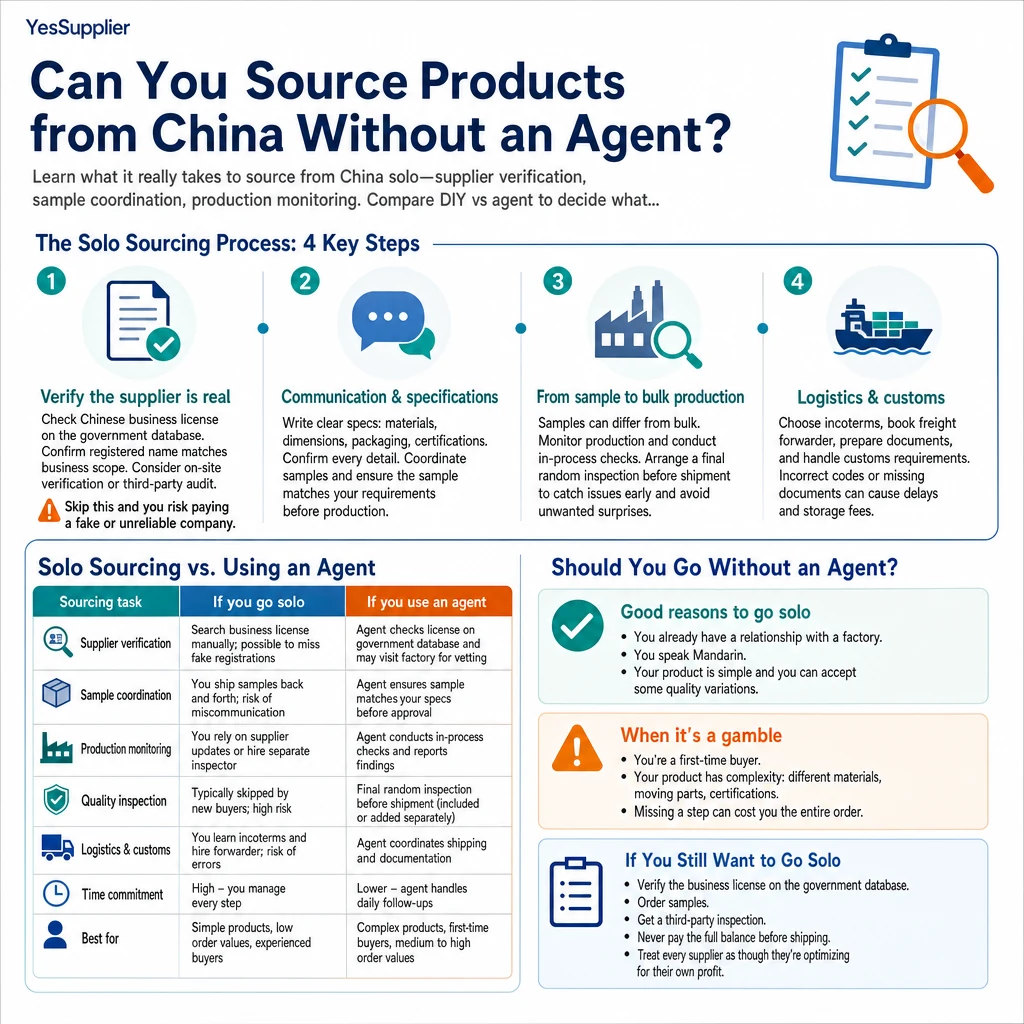
The honest answer is: yes, you can source from China without an agent. People do it every day. The question is whether you should, given your product, budget, and tolerance for surprises. The answer depends on how much unpaid work you’re willing to do and how much risk you can absorb.
Below are the practical steps involved in sourcing on your own.
Step 1: Verifying the supplier is real
The first thing you need to do is confirm that the company you’re talking to is a legally registered manufacturer, not a trading company posing as a factory, and not a scam.
If you do it alone, you start with the Chinese business license. You ask the supplier to send a copy, then you look up the registration number on the National Enterprise Credit Information Publicity System (the official government database). This is free, but the site is in Chinese. You’ll need to use a browser translation tool or ask a Chinese-speaking friend. You check that the company’s registered name matches its business scope, and that it hasn’t been flagged for irregularities.
Some suppliers offer a live video call. Others send photos. Neither is reliable. A trading company can film inside any factory. To verify capability you need someone on the ground, such as an agent or a third-party audit service, to confirm the equipment, headcount, and production lines.
Having an independent check on the ground can add confidence, and some buyers rely on a sourcing partner to perform this vetting. The platform protects the marketplace, but it does not guarantee the factory’s true capability.
What happens if you skip this step? You might wire a deposit to a company that doesn’t exist, or one that subcontracts your order to a workshop you’ve never approved. When the product arrives late or defective, you have no recourse.
Step 2: Communication and specifications
Even with good English, details get lost. You might specify “waterproof” in an email, but the supplier interprets that as “splash-resistant” for indoor use only. The first sample looks fine, but the bulk order arrives with a different zipper or a thinner fabric because the supplier optimized cost without telling you.
When you work alone, you are the one writing every specification, confirming every point, and following up on every email. The supplier has a dozen other buyers; you have one product. If you miss a detail, you own the mistake.
A professional agent handles this by taking your product requirements, including materials, dimensions, packaging, and certifications, and writing them into a clear, enforceable document that the supplier must sign. They then coordinate sample selection and approval and make sure the sample matches your requirements before production starts.
Step 3: From sample to bulk production
Samples can be misleading. A supplier can hand-build a perfect sample, while the bulk order may be rushed, use cheaper materials, or be made by different workers. That gap between sample and bulk often causes quality problems.
If you’re going solo, you have two options: trust the supplier to replicate the sample, or hire a third-party inspection company to check during production. Many small buyers skip inspection to save money. Then they receive a container of goods that don’t match the sample.
If you use a sourcing partner, they do pre-production checks: they confirm raw materials, visit the factory while your order is running, and conduct a final random inspection before shipment. Production monitoring and final inspection services are designed exactly for this, to catch a problem before the container leaves the port.
Concrete hypothetical example: Imagine you’re sourcing a custom-branded product. The sample has a smooth matte finish, crisp sound, and a reliable charging option. You approve it. For the bulk order, the supplier decides to use a cheaper paint to save money, it arrives with a noticeable texture. The component doesn’t meet the advertised capacity. You now have a large batch of items that you can’t sell at your target price. An agent would have inspected the paint application mid-production and flagged the substitution.
A good sample is meant to reveal what the bulk will be, not to be mistaken for the final result.
Step 4: Logistics and customs
After production, you need to move goods from the factory to your warehouse. This means choosing between common incoterms, booking a freight forwarder, filling out customs documentation, and paying duties. If you’re importing into your country, you’ll need any necessary approvals or power of attorney.
If you do this alone, you either learn the paperwork or outsource to a freight forwarder you find online. The risk: incorrect codes, missing certificates, or insufficient documentation that delays your shipment and triggers storage fees.
A sourcing partner can coordinate logistics for you, from confirming packaging for sea or air to preparing commercial invoices and packing lists. They can also recommend the best shipping method based on your timeline and budget, which you might not know simply from an online search.
The real cost of going solo
Many buyers think an agent adds a direct cost to their product and decide to skip it. But that’s not the full picture. The real cost of going solo includes your own time: researching suppliers, translating requests, chasing samples, managing inspections, and handling delays. If your time has value, a single sourcing mistake can cost you a lot of hours of wasted effort.
Moreover, the agent’s fee often pays for itself by preventing the worst-case scenario: a full container of rejected goods. If your order is large enough, you only need to avoid one bad shipment to break even on the agent’s fee.
Agents are not a solution that eliminates every problem. They cannot guarantee zero defects, frictionless customs, or lower prices. A good agent will tell you when your requirements are unrealistic or when a supplier is a poor fit. Their work focuses on confirming requirements, searching and vetting suppliers, and ongoing quality control rather than promising cheap goods.
Table: Solo sourcing vs. using an agent
| Sourcing task | If you go solo | If you use an agent |
|---|---|---|
| Supplier verification | Search business license manually; possible to miss fake registrations | Agent checks license on government database and may visit factory for vetting |
| Sample coordination | You ship samples back and forth; risk of miscommunication | Agent ensures sample matches your specs before approval |
| Production monitoring | You rely on supplier updates or hire separate inspector | Agent conducts in-process checks and reports findings |
| Quality inspection | Typically skipped by new buyers; high risk | Final random inspection before shipment (included or added separately) |
| Logistics & customs | You learn incoterms and hire forwarder; risk of errors | Agent coordinates shipping and documentation |
| Time commitment | High to you manage every step | Lower to agent handles daily follow-ups |
| Best for | Simple products, low order values, experienced buyers | Complex products, first-time buyers, medium to high order values |
If you still want to go without an agent
There are good reasons to source solo. You already have a relationship with a factory. You speak Mandarin. Your product is simple, like non-woven bags, and you can accept a few quality variations. In those cases, an agent is optional.
But if you’re a first-time buyer or your product has any complexity, such as different materials, moving parts, or certifications, the solo route carries higher risk. The steps above are not exhaustive. Missing one can cost you the entire order. Most small businesses underestimate the time and judgment required.
Your next decision
Now that you understand what’s involved, you can decide based on your situation. If you decide to use an agent, the next step is to clarify your product requirements and get a feel for how the agent operates. Visit the how it works page to see the exact process: requirement confirmation, supplier search, sample coordination, production monitoring, final inspection, and logistics. Their case studies show real examples of how these steps play out.
If you choose to go solo, at least use the same checklist: verify the business license on the government database, order samples, get a third-party inspection, and never pay the full balance before shipping. Treat every supplier as though they’re optimizing for their own profit, because they are.
The question is not whether you can source without an agent but whether you can afford the consequences of doing it wrong.