
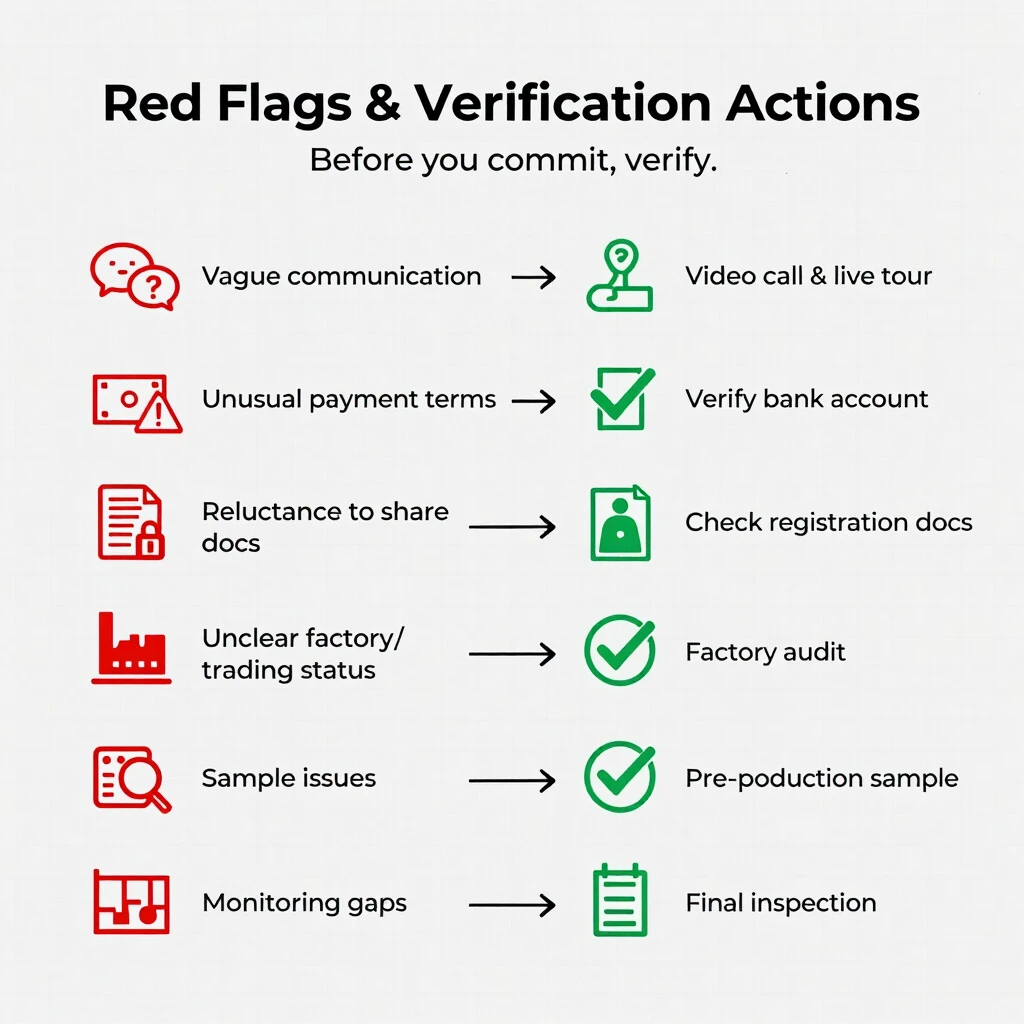
Supplier vetting starts with warning signs
Here is a hypothetical situation. You find a supplier on a B2B marketplace, the prices look right, the catalog matches your product, and replies arrive within minutes. Then the details start to blur. The contact person changes mid-conversation, the factory address does not match the business registration, and payment would land in a personal bank account. A warning sign is not proof of fraud. It is a signal to stop and verify before you commit money or production. The scenarios in this guide are hypothetical, and no statistics or frequency data are cited.
Vague or evasive communication
How a supplier answers questions tells you how it operates. If product questions get vague answers, if the conversation shifts whenever you ask about production capacity, or if the contact person refuses a video call, treat those as prompts to verify before you commit. Inconsistent contact details are another warning sign. Ask why the email signature name does not match the business registration, or who handles sales, production, and export when different people answer for the same role without explanation.
Start by requesting a video call and a live tour of the production floor. Ask to see the machines, the line, and the people working. If the supplier refuses or offers only recorded videos, dig deeper. Confirm the contact person’s role and ask for a company email domain rather than a personal address.
Hypothetical example: a supplier who communicates only through a chat app, refuses video calls, and gives a different name in every email may be a trading company presenting itself as a factory. That is not automatically a deal-breaker, but it changes how you should verify quality and pricing.
Unusual payment terms
Payment terms turn risk into real money. A supplier who demands full payment before production starts is asking you to carry most of the risk. If the order does not ship or quality fails, recovering funds across borders can be complicated. A more balanced structure is a partial deposit to start production and the balance before shipment, after you have seen the goods or an inspection report. The right split depends on the order and the relationship.
A request to pay a personal account rather than the company account is a stronger warning sign. A personal account makes it harder to connect the payment to the entity you approved and complicates contracts, refunds, and recourse.
Before sending any money, confirm that the bank account name matches the supplier’s registered company name. Use payment methods that offer some form of dispute protection or traceability. Be cautious with payment requests that change after the quote is signed, or that add fees not in the original terms.
Hypothetical example: a supplier quotes a price, then asks for the full amount to a personal account to speed up the exchange rate. That is a request to route the payment outside the company’s own financial controls, and it should be treated as a warning sign.
Reluctance to share documentation
A supplier who is reluctant to share a clear, complete copy of its business registration is not giving you a way to verify who you are dealing with. Request the document before signing anything, and ask for a version you can read in full.
Documentation goes beyond the registration. For export orders, you may also want export registration, product certifications, and test reports. You need to confirm that the entity you are paying is the entity that will produce and ship your goods.
Request a clear, complete copy of the business registration and cross-check the company name and address against the details in your contract and invoice. If the supplier operates under a different trade name, ask how that name relates to the registered entity. A sourcing agent with local presence can do this verification as part of supplier search and vetting services.
If a supplier hesitates to share basic registration documents, treat that as a reason to verify the supplier’s legal status before paying.
Unclear factory vs. trading company status
Some buyers prefer to work directly with a factory, while others work with trading companies. Both can be legitimate, but you need to know which type you are dealing with. If a trading company is presented as a factory, your price comparison and quality expectations may be based on the wrong model.
Possible signs to investigate: no production floor to show, product answers that stay shallow when you ask about materials or manufacturing steps, or a catalog spanning unrelated categories that no single factory would produce. None of these signs is proof of deception on its own, but each justifies a closer look.
Ask for a live video tour of the production line and request specific details about the machines, capacity, and lead time for your product. Compare the supplier’s stated factory address with the address on the business registration. If the addresses do not match, ask why. A third-party factory audit is a reliable way to confirm. If you cannot audit in person, a sourcing agent can verify factory status as part of supplier vetting. The goal is not to eliminate trading companies but to know which type you are dealing with, because that changes how you evaluate price, quality, and communication.
Sample quality and consistency issues
Samples should tell you what the factory can actually produce. Evaluate a sample beyond appearance: check dimensions, materials, function, packaging, and how the sample was made. Inconsistent sample quality is a warning sign because the sample is meant to represent the bulk order.
A supplier who avoids sending samples, or who charges a sample fee that is unusually high without a clear breakdown, should be asked to explain the fee structure. Sample fees may apply for custom products, but the supplier should explain what the fee covers and whether it is deducted from the order value.
Order a pre-production sample before committing to bulk production. Test it the way your end customer would use it. Keep the sample and compare it against the first batch of production goods. If the production batch differs in material, finish, or dimensions, stop and ask for an explanation before the goods ship. A sourcing agent can coordinate sample handling and check the sample against the specification.
Hypothetical example: a supplier sends a polished sample with premium packaging, then produces a bulk order with thinner material and no packaging. Without a pre-production sample and a final inspection, that difference is easy to miss until the goods arrive.
Production monitoring and inspection gaps
Once production starts, a supplier who resists third-party inspections, delays production updates, or gives vague answers about progress may be hiding problems. Production monitoring is not about distrust; it is about catching issues while they can still be fixed. Fix problems before shipment instead of after arrival.
Check whether the supplier provides a production schedule, progress photos, and access to inspection. A missing schedule, no progress photos, no response to inspection requests, or a final inspection scheduled only after the goods are packed reduces your ability to correct problems before the container ships.
Agree on production checkpoints before the order starts. Confirm when materials arrive, when production begins, when the first batch is complete, and when the goods are packed. Schedule a final inspection before shipment and make clear that the balance payment depends on the inspection result. If the supplier refuses to allow an inspection, that refusal is itself a warning sign. When you cannot be on site, production monitoring and final inspection services can act as your eyes on the ground. The cost of skipping these checkpoints is not just a bad batch but the time and money spent on returns, rework, or a customer who receives a product that does not match what you promised.
Red flag verification checklist
| Red flag | Verification action |
|---|---|
| Vague or evasive communication | Request a video call and a live tour of the production floor; confirm the contact person’s role and email domain. |
| Unusual payment terms | Confirm the bank account name matches the registered company name; negotiate a partial deposit with the balance before shipment; use traceable payment methods. |
| Reluctance to share documentation | Request a clear copy of business registration; cross-check company name and address against the contract. |
| Unclear factory vs. trading company status | Ask for a live video tour, compare the factory address with the registration, or arrange a third-party audit. |
| Sample quality and consistency issues | Order a pre-production sample, test it as the end customer would, and compare it against the first production batch. |
| Poor production monitoring and inspection gaps | Agree on production checkpoints and schedule a final inspection before shipment. |
These are general recommendations, not guarantees. A supplier who passes these checks can still disappoint, and one who shows a red flag can still deliver. What matters is information before money changes hands.
Frequently asked questions
How can I verify a Chinese supplier’s business registration?
Ask for a clear, complete copy and cross-check the company name and registered address against your contract and invoice. Ask the supplier to explain the registration number and any trade names it uses. If you cannot verify the registration yourself, a sourcing agent can do it as part of supplier vetting.
What payment terms are safer for first orders?
Avoid paying the full amount before production. A partial deposit to start production, with the balance before shipment after you have seen the goods or an inspection report, gives you more leverage. Confirm the bank account name matches the company name before sending any money.
How do I tell if a supplier is a trading company?
Ask for a live video tour of the production floor and specific details about machines and capacity. Compare the factory address with the business registration. A trading company is not automatically a bad partner, but you should know which type you are dealing with to evaluate price and quality correctly.
What should I do if a supplier avoids video calls?
Treat it as a reason to verify more, not less. Ask for alternative proof: export records, third-party audit reports, or a visit by a sourcing agent. If the supplier cannot provide verifiable evidence, consider whether the risk is acceptable.
How can I monitor production and final quality?
Agree on production checkpoints before the order starts and schedule a final inspection before shipment. If you cannot be on site, monitoring and inspection services can act as your eyes on the ground. For more answers, see the sourcing FAQs or browse the sourcing resources.
Take a structured approach to supplier vetting
Red flags are warning signs, not proof of fraud. A supplier who avoids video calls, demands full payment upfront, or refuses to share a business registration may still deliver, but you would be making that bet without the information you need. Each red flag deserves a verification action: a video call, a document check, a pre-production sample, a production checkpoint, a final inspection.
If you do not have the time or local presence to run these checks yourself, a sourcing agent can take on part of the work. Yes Supplier offers requirement confirmation, supplier search and vetting, sample coordination, production monitoring, final inspection, product development support, and logistics coordination. You can see how Yes Supplier works, review the supplier search and vetting services, or read more about Yes Supplier. No process removes all risk. The point is to make sure the risk you take is calculated.