
You have a product idea, a rough budget, and a list of supplier names from a B2B platform. Somewhere in the back of your mind is the question that comes up for first-time importers: How many of these should I actually contact before I pick one?
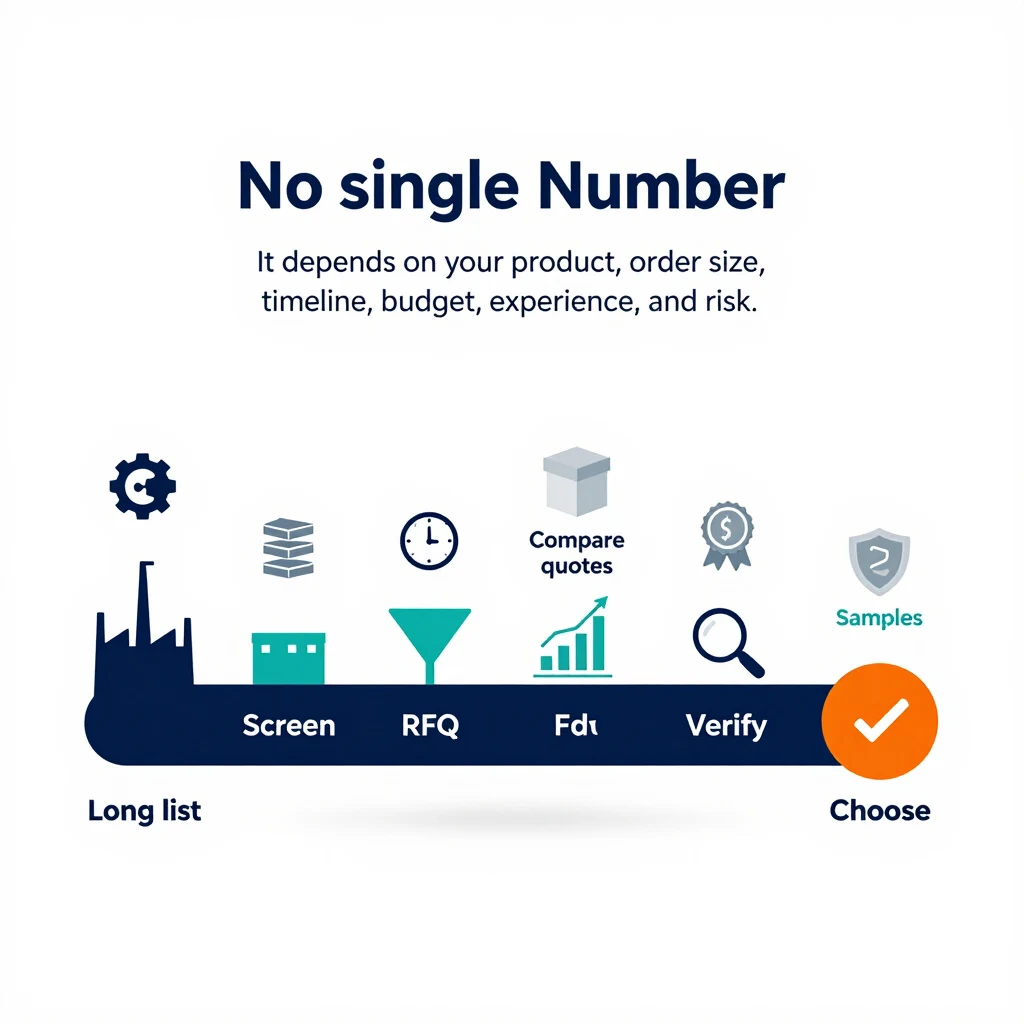
The honest answer is that there is no single right number. A fixed figure would ignore too much: what you are sourcing, how much you are ordering, when you need it, and what you already know about manufacturing. The useful question is not “how many suppliers should I contact” but “how do I structure a search that gives me enough options without drowning me in quotes, samples, and follow-up emails?” This guide walks through the factors that determine a sensible evaluation scope, a process for narrowing a long list, and where a sourcing partner can take over the heavy lifting.
1. Why There’s No Single “Right” Number
Anyone who gives you a fixed number is guessing. The right number comes out of your product, your order size, your timeline, and your tolerance for risk. A simple, off-the-shelf item with a low order quantity may not justify an extensive search. A custom product with tight tolerances, multiple components, or regulartory requirements almost certainly does.
Contact too few suppliers and you may settle for a vendor who is merely adequate. Contact too many and you will spend so much time answering messages and comparing quotes that you lose focus. The goal is not to maximize or minimize the count. The goal is to find a reliable partner, which means balancing thoroughness against efficiency.
2. Key Factors That Determine How Many Suppliers to Evaluate
Before you open a B2B platform or start sending messages, think through the following factors. They will point you toward a sensible range.
A custom electronic device with a PCB, enclosure, battery, and firmware is a different sourcing problem than a plain tote bag. Complex products involve more failure points, more specification details, and more communication risk. You need more candidates to compare because the likelihood that any single factory will get everything right is lower.
A small first order does not justify the same diligence as a large production run. If you are ordering 200 units to test the market, you can afford to work with a shorter list. If you are committing to 20,000 units, the cost of a bad supplier multiplies quickly. Larger orders justify more vetting, more samples, and possibly a factory audit.
A tight deadline narrows your options. You may not have time to run an extended sourcing process with multiple rounds of samples. That is a real constraint, not an excuse to skip diligence. Work with the number of suppliers you can meaningfully evaluate in the time available, and accept the tradeoff between thoroughness and speed.
Samples, factory audits, and shipping samples from different factories all have costs. A limited budget may mean you request samples from fewer suppliers. That is a reasonable tradeoff as long as you name it as a tradeoff.
If you have imported similar products before and know a factory that has performed well, you can evaluate fewer new candidates. If you are a first-time importer, you need more comparisons because you do not yet know which questions to ask or which warning signs to trust.
Products that sit on a shelf, get used daily, or carry safety liability deserve more scrutiny. If a failure would be merely annoying, you can move faster. If a failure would put you out of business, slow down and widen your search.
3. The Narrowing Process: From Long List to Shortlist
- Start broad. Build a long list of candidates from B2B platforms, trade shows, industry directories, or referrals. At this stage, you are collecting names, not judging quality.
- Screen on basic criteria. Look at location, stated capabilities, years in business, certifications, and response quality. Remove factories that clearly do not match your product type or that communicate in a way you cannot work with.
- Send a request for quotation (RFQ) to a shortlist. A shortlist is simply the candidates who passed your screening. Your RFQ should include your product specification, target quantity, target timeline, and any packaging, compliance, or labeling requirements.
- Compare quotes on more than price. When the quotes come back, look at lead time, payment terms, Incoterms, minimum order quantity, and how the supplier handled your questions. A cheap quote with vague terms is not a bargain.
- Request samples from the most promising candidates. Sample testing is where a lot of problems surface. Test the product as you would actually use it, not just as a shelf display. Check dimensions, materials, finish, and function.
- Verify the factory before committing. If the order is large enough to justify it, arrange a factory audit or a virtual inspection. If you cannot visit, ask for a video walkthrough and review business documents.
- Choose one primary supplier and keep an alternative in reserve. Having a second supplier who has already quoted and sent a sample gives you leverage and a fallback if the primary supplier slips.
This process does not force you to contact a random number of factories. It forces you to make decisions at each stage, and each stage shrinks the list based on evidence.
4. A Hypothetical Example: How One Buyer Narrowed It Down
To show how this works in practice, here is a clearly labeled hypothetal example. The names, numbers, and details are invented for illustration only and are not a recommendation.
Imagine a small ecommerce business sourcing a custom electronic gadget: a rechargeable device with a simple PCB, a plastic housing, and custom packaging. The fictional buyer starts with a long list of about 20 candidates from a B2B platform. They screen out factories that specialize in other product categories or that do not respond in English within a few days, leaving about 8.
They send an RFQ to those 8 and receive 6 replies. Two quotes are clearly outside the budget range. One supplier asks a series of sharp questions about specifications, which the buyer reads as a good sign. Another gives a price but no lead time, which the buyer reads as a warning. That leaves 3 suppliers who receive a sample request.
The buyer tests the 3 samples and builds a simple comparison:
| Supplier | Relative price | Relative lead time | Communication | Sample quality |
|---|---|---|---|---|
| A | Mid | Mid | Prompt, specific | Good, one cosmetic flaw |
| B | Lower | Longer | Slow, vague | Acceptable, loose fit |
| C | Higher | Shorter | Prompt, proactive | Best, no issues |
The fictional buyer chooses Supplier A because of clear communication and a sample that caught a small defect, and keeps Supplier C as a backup even though C is more expensive. The point is not to copy this example. The point is that the decision came from comparing candidates against the buyer’s own priorities.
5. Common Mistakes When Contacting Suppliers
Contacting too few suppliers and settling for the first option. If you message only one factory, you have no basis for comparison. The first quote you receive may be fine, but you cannot know that without some reference points.
A large number of active conversations produces a flood of messages, many of them asking the same questions. You cannot give each supplier the attention they need, and you end up making comparisons based on incomplete information.
If one quote includes the product, packaging, and freight, and another quote is just the product, the comparison is meaningless. Make sure every RFQ you send includes the same specification, so the quotes you receive are actually comparable.
Vague answers, pressure to pay in full upfront, promises that sound too good to be true, and a refusal to answer questions about quality control are all warning signs. They do not automatically disqualify a supplier, but they should be investigated, not dismissed.
The sample is your first real evidence that a factory can produce what you want. Skipping it to save time can cost you far more in defective goods, missed launch dates, and customer complaints.
6. How a Sourcing Partner Can Redduce the Workload
If you are reading this and thinking that the process looks like a part-time job, you are right. A proper supplier search means confirming your requirements, finding candidates, vetting them, coordinating samples, and eventually monitoring production and inspecting the finished goods. That is a lot of work, especially if you are running a business at the same time.
A sourcing partner like Yes Supplier can handle the time-intensive parts of that process. Their services cover requirement confirmation, supplier search and vetting, sample coordination, production monitoring, final inspection, product development support, and logistics coordination. That means you do not have to personally manage an unwieldy number of supplier contacts. You can work with a smaller, clearer list of vetted options while the partner manages the back-and-forth.
Relevant pages include the services page, the how-it-works page, and the case studies page.
7. Frequently Asked Questions
How many suppliers should I contact?
There is no one-size-fits-all answer. It depends on your product complexity, order size, timeline, budget, prior experience, and risk tolerance. The right number is the smallest number that still gives you enough comparison points to make a confident decision.
How many quotes should I request?
Request quotes from every supplier who passes your initial screening, but manage the number so you can actually compare the responses. If you receive so many quotes that you cannot analyze them, you are past the point of useful comparison.
Should I contact suppliers directly or use an agent?
Direct contact gives you full control and avoids the cost of a middleman. An agent can save time, help with vetting, and handle coordination, especially when sourcing in a country where you do not speak the language. The tradeoff is cost and less direct visibility into every conversation.
How long should the selection process take?
There is no fixed estimate. Send clear RFQs, review quotes, request and test samples, and verify the factory before committing. If you have a launch date, work backward from that date and build in time for sample iterations.
What if I only have one supplier?
A single supplier leaves no backup if they cannot meet your timeline, quality, or price targets. Even if you plan to use just one, it is wise to have an alternative.
For more answers, see the Yes Supplier FAQs.
8. Conclusion: Find the Right Balance for Your Business
There is no magic number of suppliers to contact. What matters is a structured process that gives you enough options to make a confident choice without burning all your time and energy. Start with a broad list, screen it down to a shortlist, compare quotes on the same basis, test samples, and verify the factory before you commit.
If that process feels like more than you can handle on your own, you do not have to do it alone. Yes Supplier exists to take on the time-intensive parts of supplier selection and production management. You can learn more about the company here and return to the main site when you are ready to share your requirements.