
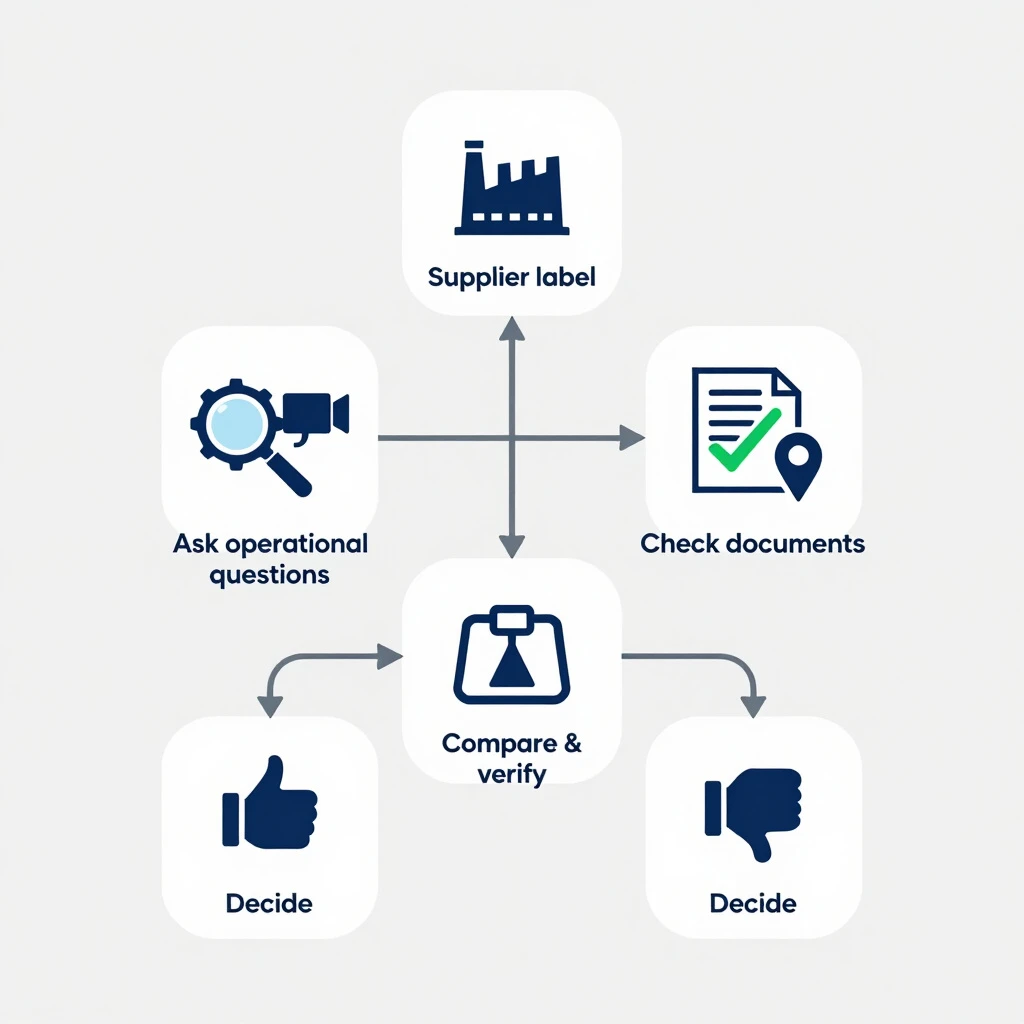
You found a supplier on Alibaba or through a referral, the price looks right, and you are about to send a deposit. Before you do, it is worth knowing whether the company on the other end actually makes your product or is buying it from someone who does. The answer changes how you negotiate, how you inspect, and how much risk you carry. A trading company can be a perfectly good partner. The problem is not that middlemen exist. The problem is paying factory prices to a middleman, or trusting a factory’s quality promise to a trader who has no control over the production line.
Here is the direct answer: you cannot reliably tell from a website, a catalog, or a friendly sales chat. You can tell from the business license, the factory audit, the quote structure, the sample behavior, and the documents. Each check narrows the gap, and none of them alone settles it.
1. Why the distinction matters before you commit money
A factory owns the machines, the tooling, and the workers who make your product. A trading company owns none of that. It sources from factories, marks up the price, and handles communication, export, and often quality coordination. Both can deliver a good product. The difference shows up when something goes wrong.
If a defect appears in a container, a factory can rework or replace from its own line. A trading company has to go back to the factory it used, and it may not have the leverage or the technical staff to push a fix through. If you need a material change mid-production, a factory can often adjust on the spot. A trader has to relay the request and hope the factory cooperates. None of this means traders are dishonest. It means their control over the outcome is indirect, and you should price and inspect accordingly.
There is also a real chance the supplier is a hybrid: a factory that also trades other factories’ goods, or a trader that has a small workshop. Most Chinese suppliers sit somewhere on that spectrum. So treat this as a range, not a clean either-or.
2. The business license check: what the registration scope tells you
Every registered Chinese company has a business license issued by the local Administration for Market Regulation. Ask the supplier to send a clear photo of it, and check the registered scope of business. A manufacturer’s scope typically lists production, processing, or manufacturing of specific goods. A pure trading company’s scope lists sales, import and export, or wholesale. If the scope says only sales and trade, the company is not registered as a manufacturer, whatever its website claims.
You can verify the license yourself through the National Enterprise Credit Information Publicity System, the official registry run by the State Administration for Market Regulation. It is the authoritative source for a company’s registration status, legal representative, and business scope. Search by the company’s Chinese name, which the supplier should provide. If they will not give you the registered Chinese name, treat that as a warning sign.
Check the license date too. A company registered last month that claims twenty years of manufacturing experience is either lying or has changed its legal entity. Neither is disqualifying on its own, but it changes how much history you can rely on.
3. Factory audit and verification: what to look for on site and remotely
The license tells you what the company is registered to do. The audit tells you whether it actually does it. A real factory can show you its production floor, its equipment, and its workers. A trading company can show you an office and a showroom.
If you can visit, look for the specific machines that make your product, not just a general workshop. Ask to see the production line for the exact item you are buying. A factory that makes your product will have the tooling and the process in place. A trader that shows you a factory will often show you a different one each visit, because it is borrowing someone else’s floor.
If you cannot travel, do a live video call and ask the supplier to walk the floor with the camera. A genuine factory can do this on short notice. A trader will hesitate, reschedule, or offer a pre-recorded video instead. A pre-recorded video proves nothing, because it could be any factory.
Third-party factory audits are the standard tool here. An audit report from an independent inspection company documents the facility, the equipment, the headcount, and the production capacity. It is not proof of ownership, but it is strong evidence of what the supplier actually controls. If a supplier refuses an audit or will only accept one arranged by themselves, that is a reason to slow down.
Hypothetical example: imagine you are sourcing a custom electronic gadget. A factory audit shows injection molding machines, an SMT line, and a testing bench. That is a manufacturer. A different supplier’s audit shows a small office, a warehouse, and no production equipment. That supplier is a trader, and you should plan your inspection and your price expectations around that.
4. Quote and document signals that separate a manufacturer from a trader
The quote itself carries clues. A manufacturer usually quotes from its own cost structure: materials, labor, tooling, and overhead. A trader quotes a factory price plus a margin, and often cannot explain the line items. Ask for a breakdown. A factory can usually walk you through why each cost is what it is. A trader will give you a lump sum and deflect questions about materials and labor.
Tooling is a strong signal. If your product needs a mold or custom tooling, a factory will quote the tooling cost separately and will own the tooling. A trader will often quote tooling as a pass-through from an unnamed factory, and may not be able to tell you where the mold is held. Ownership of the tooling matters because it determines who can make your product and who controls future orders.
Ask for the export documents. A manufacturer that exports directly holds its own export license and issues its own commercial invoice and packing list. A trading company also exports, but its documents will show the trader as the seller, and the actual factory may appear nowhere on the paperwork. If you want to know who really made the goods, the documents are where the answer hides.
Watch the salesperson’s technical depth. A factory’s sales team can usually answer questions about materials, tolerances, and production constraints. A trader’s sales team is often strong on price and shipping but vague on manufacturing details. That is not a guarantee either way, but combined with the other checks it is useful.
5. Sample behavior and production monitoring as evidence
How a supplier handles samples tells you a lot. A factory can produce a sample from its own line and can usually make adjustments quickly, because it controls the process. A trader has to go back to the factory for every change, so sample iterations tend to be slower and the trader may push back on modifications it cannot easily relay.
Ask for a sample that matches your exact specification, not a generic version of the product. A factory can do this. A trader may send a stock sample from a catalog and call it close enough. If the sample does not match your spec, that is a signal about how much control the supplier has over production.
During production, the same logic applies. A factory can show you photos and video from its own floor at any stage. A trader can only show you what the factory sends it. If you arrange a mid-production inspection, a factory inspection happens at the factory. A trader inspection happens at a warehouse, where the goods have already been packed and you can no longer see the line.
This is why production monitoring and final inspection matter more when you work with a trader. You are compensating for the fact that you have no direct line to the people making the goods. A final inspection before shipment catches defects before they reach your container, which is where a middleman relationship most often goes wrong.
6. Payment terms and risk control
Payment terms are a risk lever, not a proof of who makes the goods. A factory that has invested in equipment and tooling may be more willing to accept a deposit plus balance on inspection, because it has a real asset base. A thinly capitalized trader may push for a larger deposit or full payment before shipment, because it has less to lose if the deal falls apart.
That said, do not over-read this. Many legitimate factories also ask for standard deposits, and many traders are honest. The point is to keep your exposure proportional to what you can verify. If you have not audited the supplier and cannot confirm it is the manufacturer, do not send a large deposit on trust alone.
Use payment terms that protect you: a deposit to start, a balance tied to inspection results, and no full payment before you have seen the goods pass inspection. Escrow and letter of credit options exist, but for most small buyers a deposit plus inspection-gated balance is the practical structure.
7. Factory versus trading company: a comparison
| Signal | Likely a factory | Likely a middleman |
|---|---|---|
| Business license scope | Lists production or manufacturing | Lists sales, trade, or import/export only |
| Factory audit | Own equipment and production line | Office, warehouse, no production floor |
| Quote structure | Itemized costs, explains materials and labor | Lump sum, vague on cost drivers |
| Tooling | Owns the mold, quotes it separately | Pass-through from an unnamed factory |
| Sample iteration | Fast, matches your spec | Slower, may send stock samples |
| Production visibility | Shows its own floor live | Relays what the factory sends |
| Export documents | Its own name as seller | Trader as seller, factory absent |
No single row settles the question. A supplier that looks like a factory on the license but cannot pass an audit is a red flag. A supplier that looks like a trader but has a strong, audited factory relationship can still deliver. Read the rows together.
8. When a middleman is the reasonable choice
None of this means you should automatically reject a trading company. For small orders, a trader can be the better option. Many factories set high minimum order quantities and will not work with a buyer ordering a few hundred units. A trading company aggregates demand across many small buyers and can get you a factory price you could not reach alone. It also handles export, documentation, and communication, which is real value if you are new to importing.
A trader can also be the right call when you need a range of products from different factories. A single factory makes one category well. A trader can source across categories and coordinate multiple suppliers for you. If you are building a catalog with many SKUs, that coordination is worth the margin.
The honest framing is this: a middleman is not a problem, but it is a different relationship with different risks. You pay a margin, you lose direct control over production, and you rely on the trader’s relationship with the factory. If you price for that and inspect at the end, a trader can be a sound choice. The mistake is assuming you are dealing with a factory when you are not, and then being surprised when the control you expected is not there.
9. What to verify, who is responsible, and what can go wrong
Before you commit, run the checks in order. Get the business license and confirm the scope through the official registry. Arrange a factory audit, in person or through an independent inspection company. Ask for an itemized quote and a separate tooling line. Request a spec-matching sample and time the iterations. Confirm who appears on the export documents. Then set payment terms that gate the balance on inspection.
Responsibility for verification sits with you. No supplier, factory or trader, is obligated to prove its own honesty beyond what you ask for. If you skip the audit and send a deposit, you have accepted the risk. An agent or sourcing service can run these checks for you, which is often the practical route for a small buyer who cannot travel. That is a legitimate use of a sourcing partner: not to replace your judgment, but to gather the evidence you need to decide.
What can go wrong if you skip the checks? You pay a factory price to a trader and overpay. You trust a trader’s quality promise and receive a container that fails inspection, with no factory to hold accountable. You send a large deposit to a company that is not registered as a manufacturer and lose leverage when problems surface. None of these are guaranteed outcomes, but they are the failure modes this verification is designed to catch.
The distinction between a factory and a middleman is not about which is better. It is about knowing which one you are actually dealing with, so your price, your inspection, and your payment terms match the real relationship. Run the checks, price for what you find, and keep your exposure proportional to what you have verified.