
You found a factory on an online marketplace. The samples look right, the price could work, and the next step is sending a deposit to a company you have never seen, in a country you are not in. For small businesses that cannot fly to China for a factory visit, a sourcing agent such as Yes Supplier can stand on the factory floor for you, but only if you tell the agent what to verify and what evidence to bring back.
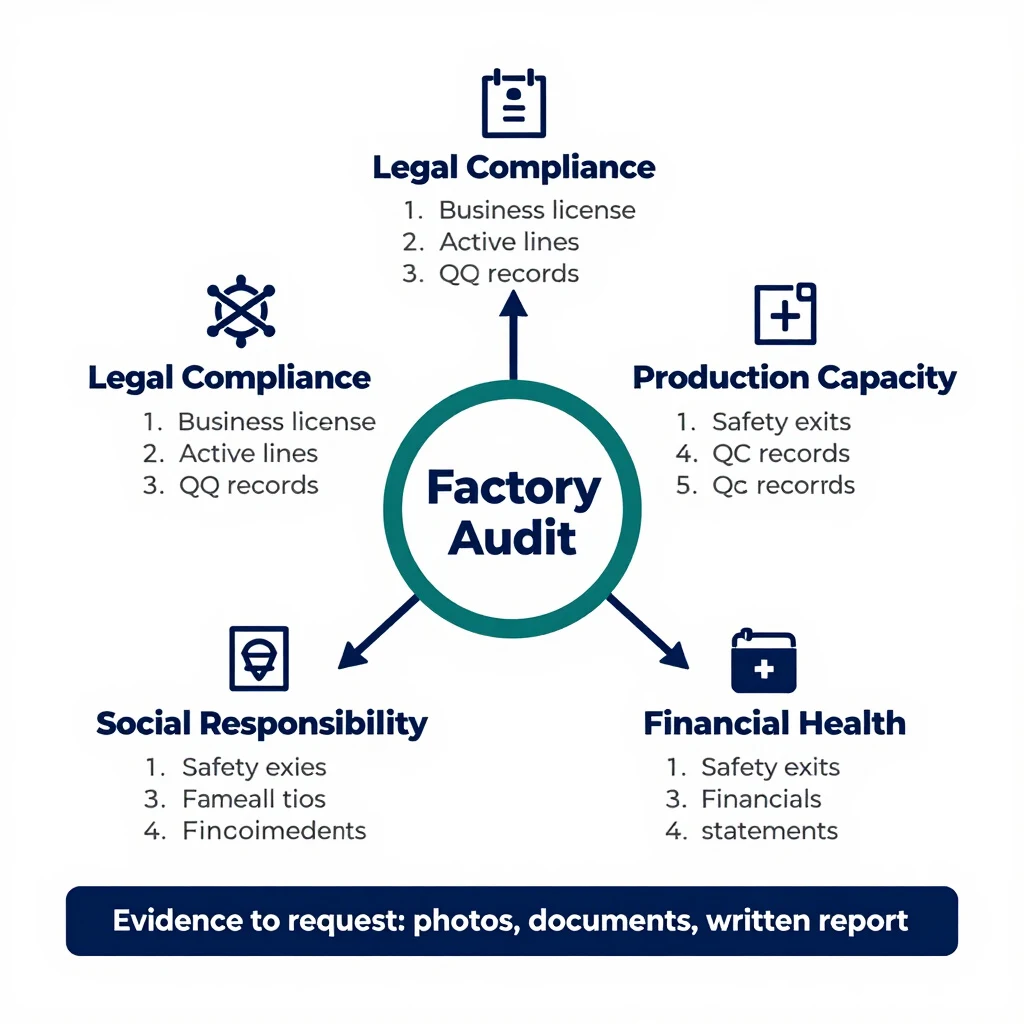
That is what this checklist is for. It is a practical guide, not an official audit standard. It covers legal compliance, production capacity, quality systems, social responsibility, and financial health. Give it to your sourcing agent, ask for photos, documents, and a written report against each item, and you will have a decision document you can actually use.
1. Why Factory Audits Matter
A factory audit is a snapshot, not a guarantee. It tells you whether the company on the other end of the order appears to be what it claims: a registered business with working equipment, real orders, and some kind of quality process. For a first order, that snapshot can reduce the chances of the most expensive mistakes: paying a broker who has no factory behind the catalog, or committing to a workshop that cannot physically make your volume in your time window.
Audits also cover risks that are easy to ignore when you are buying commodity parts, such as labor conditions and environmental compliance. A sourcing agent looking at contracts, working conditions, and environmental paperwork is checking things a Western customer might ask you about later.
Stay honest about the limits. A remote audit conducted by an agent is not the same as a multi-day, unannounced visit by your own team. The agent can photograph the floor, count workers, copy documents, and ask pointed questions, but cannot judge how the factory behaves when no one is watching. Treat the audit as a high-value screen, not as certification that the factory will never change.
A written checklist also keeps audits comparable. When you weigh two factories, you want the same questions in the same order, not whatever each person felt like looking at that day.
2. Legal Compliance Audit Checklist
Start with paperwork, because everything else sits on top of it. In China, the core document is the business license. Ask your agent to photograph the original license, not a photocopy, and to confirm that the name on the license matches the factory gate, the contract, and the bank account you are asked to pay into.
Then work down the rest:
- Export and import rights, if the factory sells overseas directly or sources materials from abroad.
- Tax registration and evidence that the factory files and pays as a normal business.
- Product-specific certifications or permits relevant to what you are buying and where you plan to sell it.
- Any licenses linked to the product itself, such as trademarks, if the factory claims ownership.
The value of an agent here is verification, not collection. A document can be real and still belong to a different company. The agent can check that the license belongs to the factory in front of them and that the legal representative is the person willing to sign your contract. If the factory hesitates to show the original license, treat that as a serious red flag.
3. Production Capacity Audit Checklist
The question is simple: can this factory make your order in your time window, on top of everyone else’s? Capacity is not a number on a website. It is the working lines, equipment, headcount, and orders already on the floor.
Ask your agent to count the factory in real terms: how many production lines are running on the day of the visit, how many operators are on each line, and how many shifts the factory runs. A spotless showroom with an empty workshop is a factory that may outsource your order to another shop, or may not have the work at all.
Then ask for the production schedule. A factory that has a plan showing current orders, lead times, and bottleneck processes is easier to evaluate. If they claim they can take your order on top of a full schedule, ask how. The agent should also confirm the equipment matches the product. As a hypothetical example: if you are ordering plastic housings, the visit should show injection-molding machines with the right capacity, not just assembly benches.
Finally, compare headcount with claimed output. When the two do not line up, the factory is either exaggerating what it can do or already stretching itself thin. Either way, you want to know before you send a deposit.
4. Quality Systems Audit Checklist
A factory can look busy and still ship bad product. The quality audit checks whether the factory has a system for catching problems before they reach you, and evidence that the system is actually used rather than just described.
Request these, roughly in this order:
- Quality management system documentation. If the factory claims a certification such as ISO 9001, ask to see the certificate and the supporting records: audit minutes, internal inspection sheets, corrective action reports.
- Incoming material checks. How are raw materials inspected before production, and can they show records from the last few lots?
- In-process and final inspection. What does the line check, at what point, and who decides an item fails?
- Test equipment and calibration records. Uncalibrated measuring tools produce confident wrong answers.
- Traceability. Can the factory trace a finished item back to its material lot and production date?
Do not stop at paperwork. The most useful step is to pick a finished product at random and ask the factory to walk through its inspection. If they cannot reconstruct the trail, the quality system exists on paper, not on the floor.
You may also ask about defect rates and corrective actions. Treat the answers as context, not verified numbers, unless the factory shows records you can check.
5. Social Responsibility Audit Checklist
Social responsibility is easy to skip when you are buying simple parts, and hard to explain later if a customer asks where the product came from. The checks are practical:
- Employment contracts and identity records. The agent can ask to see sample contracts and compare wage records with working hours. A workforce that appears underage, or ID checks that are waved away, is a finding.
- Working time and overtime records. If output is far higher than the visible workforce could produce, ask how.
- Health and safety basics: accessible fire exits, extinguishers, clear walkways, and protective equipment where the process needs it.
- Environmental permits and waste handling. A factory that cannot explain how it disposes of waste is taking a risk with somebody’s money, possibly yours.
- Voluntary social audit reports. Some factories may hold reports from voluntary programs such as BSCI or SMETA. These are not government licenses; they are third-party audit results with their own scope and date. Ask to see the report and treat it as input, not proof.
The honest caveat: labor conditions change week to week, and one visit cannot prove a factory is always compliant. What a visit can show is whether the factory is willing to be looked at.
6. Financial Health Audit Checklist
A factory that makes beautiful samples can still run out of money before your order ships. Financial health matters most when you are committing a deposit, because a deposit is short-term financing you are giving the factory.
Ask for what any reasonable business would show a customer:
- Recent financial statements, even simplified ones, and a willingness to explain them.
- A bank reference confirming the account is in the factory’s legal name and has normal activity.
- Payment history with material suppliers. A factory that pays its own suppliers late will likely be slow with you too, and your agent can often pick this up around the local supply base.
- Ownership and management structure. Who signs the contract, who owns the factory, and who actually runs it are not always the same person. It matters if you need recourse.
- Credit and registration records. Ask the agent to check the factory’s registration and credit records where available. Look for recent changes in legal representative, pledged shares, or outstanding debt.
None of this is hard to provide if the factory is healthy and treats you as a serious buyer. Reluctance is itself a finding.
7. How to Use the Checklist with a Sourcing Agent
Handing this checklist to an agent is easy. The hard part is insisting that every line comes back with evidence attached, and reading the report as a decision document.
Start with a one-page version. Print the table below, hand it to your agent, and require a status and evidence for each line.
| Area | What to verify | Evidence to request |
|---|---|---|
| Legal compliance | Business license, export and import rights, tax registration, product certifications | Photos of original documents and registration records |
| Production capacity | Active lines, equipment match, headcount, shifts, order backlog | Floor video, production schedule, equipment photos |
| Quality systems | Quality control documentation, inspection records, calibration, traceability | Quality control checklists, calibration records, lot trace logs |
| Social responsibility | Contracts, working hours, safety basics, environmental permits | Sample contracts, safety photos, permit copies |
| Financial health | Ownership, financial statements, bank references, signs of distress | Registration records, bank letter, ownership documents |
What evidence should you ask for?
Work down the checklist and ask for the same kind of evidence every time: a photo with context, a copy of the document, or a written reason why an item is not available. A photo of a business license is not the same as a photo of the license next to the factory gate sign. A video of the production floor is not the same as a photo of an empty workshop. Ask for photos taken during the audit, not photos the factory selected.
What should the report contain?
Ask for a written report that assigns a status to every checklist item: verified, requires follow-up, or not available. If something cannot be verified, the report should say why: a refusal, a missing document, or a visit on a day when nothing was running. A good report also separates what was seen during the visit from what can only be confirmed during production. Quality records can be reviewed on the spot, but defect rates and corrective actions prove themselves while your goods are being made.
Splitting the work between you and the agent
A sourcing agent such as Yes Supplier provides sourcing services including supplier search and vetting, sample coordination, production monitoring, final inspection, product development support, and logistics coordination, the natural sequence around a sourcing project. For a one-time audit, agree in writing on the checklist, the visit time, and the evidence to be delivered. For a longer project, read how Yes Supplier works before committing so you know where the audit sits in the process.
When can you skip the audit?
If you are buying a low-risk commodity in small volume and the supplier has strong references, a full factory audit may be overkill. Paying an agent to travel across a province to inspect a single small order is rarely rational. A lighter verification, such as a live video call showing the floor, the business license, and a reference from another buyer, may be enough. The checklist still helps; you are simply applying fewer lines of it.
8. Red Flags to Watch For
Most red flags are not dramatic. They are hesitations and inconsistencies: the license that does not match the gate sign, the QC checklist that lives in the office but not on the line, the empty production floor on a normal working day.
- Documentation that is photocopied, blurred, or missing pages when originals were requested.
- A factory that answers audit requests with photos it selected itself, and only those photos.
- Refusal to let the agent into certain areas, such as the warehouse, the finishing line, or the “other building.”
- Capacity claims that do not match what a visitor can count.
- Quality records that are too clean. A factory that has never issued a corrective action is usually one that does not document problems, not one without problems.
- Managers who answer technical questions with “we can make anything.” Flexibility is good; a total absence of process limits is how defects and delays creep in.
- Signs of financial distress, such as suppliers waiting at the gate for payment, or a factory pushing unusual payment terms on a new customer.
A red flag does not prove the factory is dishonest; it tells you which questions to ask again. A single red flag can have a reasonable explanation. Several in combination usually mean the factory is showing you a version of itself, not the whole company.
9. Conclusion
You will never fully know a factory you have not worked with, on either side of the planet. What a checklist does is turn trust from a feeling into something you can inspect. Give your sourcing agent the list, ask for evidence against every line, and read the gaps as carefully as you read the passes.
The same discipline applies after the audit. A factory that looks strong on paper can drift during production, which is why a first audit is best followed by production monitoring and a final inspection before shipment. When a factory comes through a first order reasonably clean, the next audit is cheaper and faster because you already know where to look.
If you are sourcing from China and want this checklist executed on your behalf, contact the Yes Supplier team. Start with the services page, see case studies, and check the FAQs about factory audits before you commit.