
You found a supplier on Alibaba. Price looked good, English seemed fine, and they promised delivery in four weeks. You sent the deposit. No update comes. You message them , “factory is busy.” More time passes. Now you’re worried. This happens every day to small businesses sourcing from China without local support.
Working with a China sourcing agent can prevent that spiral. But is it worth it in 2026? The answer depends on your product, your budget, and your tolerance for risk.
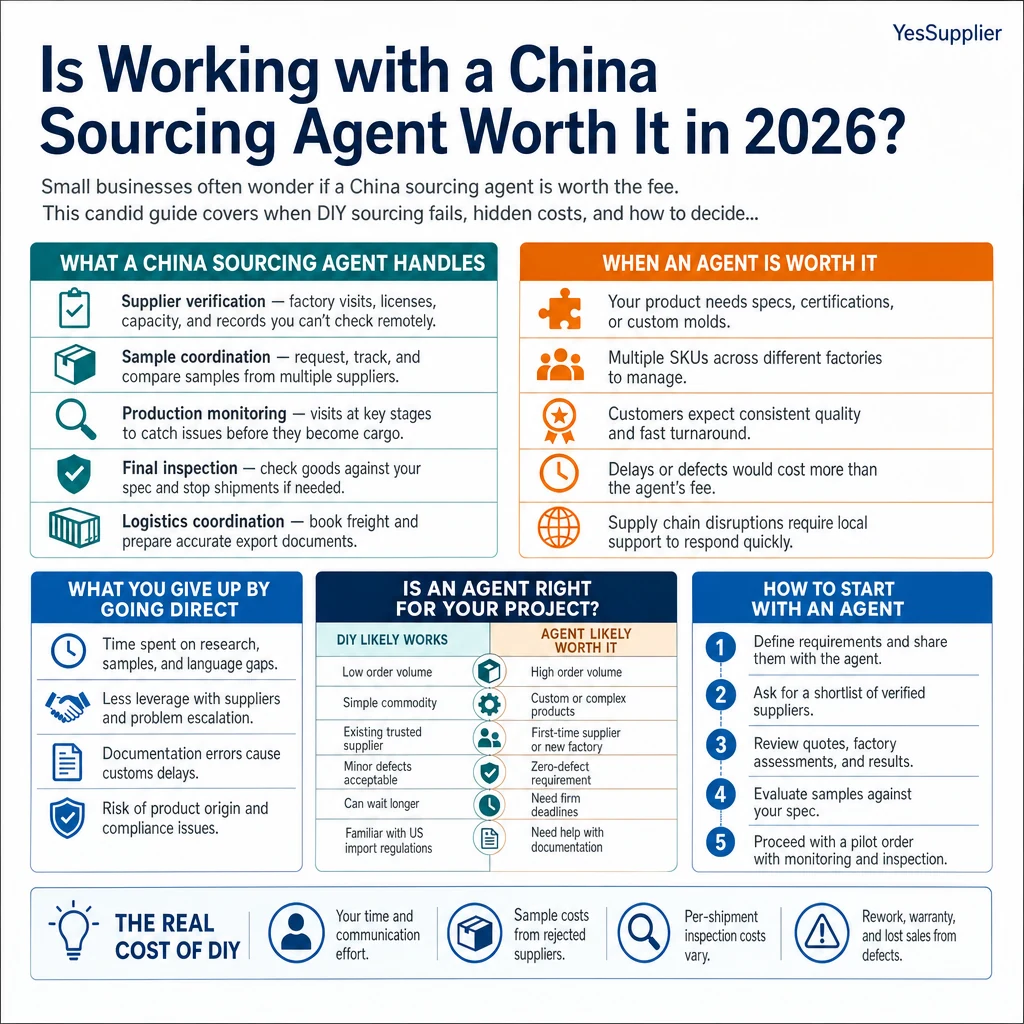
What a China Sourcing Agent Actually Handles
An agent doesn’t just find factories. They handle the operational tasks that are difficult from 7,000 miles away:
- Supplier verification , checking business licenses, factory premises, and production capacity beyond what Alibaba shows. An agent will physically visit the factory, take photos of the production line, and cross-check government records. You can’t do that from your laptop.
- Sample coordination , requesting, tracking, and organizing samples from multiple suppliers so you can compare. You might need samples from three factories to check material quality, color, and durability. The agent tracks each shipment, creates a comparison report, and flags inconsistencies , like a thread count that doesn’t match the spec , before you even see the sample.
- Production monitoring , visiting the factory during production to catch issues before they become cargo. The agent will visit multiple times: at raw material arrival, mid-production, and just before final inspection. They’ll verify that the materials match the approved sample and that the production line isn’t being swapped to a different product without your knowledge.
- Final inspection. The agent examines goods against your specifications before shipping. They test dimensions, weight, color, and functionality using a checklist tailored to your product. If defect rates exceed your acceptable limit, the agent can halt shipment and negotiate a rework or a discount for you.
- Logistics coordination , arranging LCL or FCL containers, booking freight, and preparing export documents. The commercial invoice, packing list, bill of lading, and certificate of origin must be accurate or your goods get stuck at customs. An agent handles that, often through a partnered freight forwarder.
Yes Supplier offers all of these services, from requirement confirmation to logistics. The question is whether you need them for your specific project.
The Break-Even Point: When DIY Stops Working
If you import a single container per year of a simple product , say, plastic kitchen tools , you might manage alone. You can email a few suppliers, ask for samples, and hope for the best. The risk is low because a bad container won’t destroy your business. But as you scale, the math changes.
A China sourcing agent becomes worth it when:
- Your product requires material specifications, certifications, or custom molds. For example, electronic components with FCC or CE compliance need someone who can verify those documents in Chinese.
- You have multiple SKUs across different factories. Coordinating production schedules and quality standards across factories without a local agent is a recipe for delays.
- Your customer base expects consistent quality and fast turnaround. A single defective shipment can lose you a retail account.
- A delayed or defective shipment would cost you more than the agent’s fee. If your margin depends on hitting a seasonal window, the cost of missing it far exceeds what an agent charges.
In 2026, supply chain disruptions are still common, including raw material price swings, factory closures, and customs delays. An agent on the ground can redirect production or renegotiate terms faster than remote communication allows.
Where Agents Fall Short
Not every agent delivers. Some are former factory salespeople who lack quality control skills. Others take shortcuts: they use a standard inspection checklist that doesn’t match your product, or they recommend a supplier who gives them a kickback. That’s why vetting the agent matters as much as vetting the supplier.
Look for an agency that publishes its process and shares case studies. Yes Supplier provides case studies on its website, which gives you a concrete look at how they handle different product types. Also, check their FAQ page , if they’re transparent about limitations, that’s a good sign. Finally, learn about the team behind the agency. Real people with sourcing backgrounds are more reliable than a generic call center.
What You Give Up by Going Direct
Going direct to a Chinese factory seems like the cheaper route. But consider what you trade:
- Time. You’ll spend hours evaluating suppliers, chasing samples, and deciphering inspection reports in a language you don’t speak. That time has a cost , even if you don’t bill it.
- Quality leverage. A single buyer ordering $10,000 has little power. An agent who manages multiple clients can negotiate better terms and hold suppliers accountable. When you have a problem, the agent can escalate to the factory owner directly.
- Documentation. Customs compliance requires accurate product descriptions, tariff codes, and certificates. Errors cause delays. The CBP’s Basic Importing and Exporting page lists the core documents you need , but an agent ensures they are correct before your goods leave the factory.
- Product origin claims. If you label your product “Made in China” incorrectly or fail to meet FTC standards, you risk enforcement. The FTC’s Made in USA standard applies to any product marketed in the U.S. , an agent can help verify where materials and assembly actually happen, so you don’t accidentally mislead customers.
Checklist: Is an Agent Right for Your Project?
| Criterion | DIY likely works | Agent likely worth it |
|---|---|---|
| Order volume | Less than $5,000 per shipment | Over $10,000 per shipment |
| Product complexity | Simple commodity (e.g., disposable cups) | Custom parts, electronics, or soft goods |
| Supplier relationship | Existing trusted supplier | First-time supplier or new factory |
| Quality tolerance | Minor defects acceptable | Zero-defect requirement |
| Time flexibility | Can wait 8 to 12 weeks for delivery | Need firm deadlines |
| Customs/compliance knowledge | Familiar with US import regulations | Need help with documentation |
This table is a starting point. The real decision hinges on how much risk you can absorb. A single container of defective goods can wipe out a year’s profit.
The Buyer’s Real Cost of DIY Sourcing
One common mistake is comparing the agent’s fee only to the product price. The true cost of DIY includes:
- Your hours spent on research and communication , that time has real value, even if you don’t pay yourself a wage.
- Sample costs from suppliers you eventually reject. Those expenses add up quickly when you test multiple factories.
- Inspection costs if you hire random QC firms per shipment. The cost can vary and you have no control over consistency.
- Rework or warranty costs from defects discovered after arrival. A container of misbuilt products can cost thousands in storage, labor, and lost sales.
Many small businesses find that using a sourcing agent lowers total cost of ownership by removing these hidden expenses. An agent does more than match buyers and suppliers; they handle the quality, coordination, and risk tasks that would otherwise fall to you.
How to Start with an Agent Without Overcommitting
You don’t need to sign a long-term contract. Start with a single project using these steps:
- Define your product requirements. Write down material, dimensions, quantity, packaging, and any certifications needed. Share this with the agent.
- Ask for a shortlist. Request three verified suppliers that match your requirements.
- Review the findings. Compare the quotes, factory assessments, and any sample results the agent coordinates.
- Evaluate the samples. The agent will ship samples to you or hold them for inspection. Check them against your spec.
- Proceed with a pilot order. If the process feels transparent and the samples are solid, place a small order with production monitoring and final inspection included.
Yes Supplier outlines its process on the How It Works page. You’ll see the steps: requirement confirmation, supplier search, sample coordination, production monitoring, final inspection, logistics. No mystery fees , just a clear workflow.
Final Practical Decision
Before you send that next deposit to a factory you found on your own, ask yourself: if something goes wrong, do you have a plan to fix it remotely? If not, test a sourcing agent with one project. The cost of learning is far less than the cost of a bad shipment. Outline your product requirements and contact a sourcing agent for a qualified supplier shortlist. See how Yes Supplier works , it takes one call to find out if it’s worth it for your business.