
You’ve received a quote from a sourcing agent who claims to have “worked with your competitors” and knows your product category inside out. The price is noticeably lower than other options you’ve seen. The only catch: the agent demands a sizable upfront payment and refuses to share the factory name until after payment. “It’s a long-term relationship,” they say. “You don’t need to talk to the factory directly.” The deadline is approaching. Your deposit sits in your bank account, waiting for a decision. Do you pay or pause?
The quote that hides too much
A proper quote from a sourcing agent is a document you can verify. It itemises unit price, minimum order quantity, tooling costs (if any), inspection fees, logistics charges, and the currency with a validity period. The agent can explain each line and provide the basis for the numbers. When you see a single lump sum labelled “total cost” with no breakdown, you lose the ability to compare or audit. The World Bank’s Fraud and Corruption Awareness Handbook flags vague or insufficient scope of work as a procurement red flag, and the same logic applies to agent quotes. Without a line-by-line breakdown, an agent can pad one item to offset another, or simply disappear after receiving the lump sum.
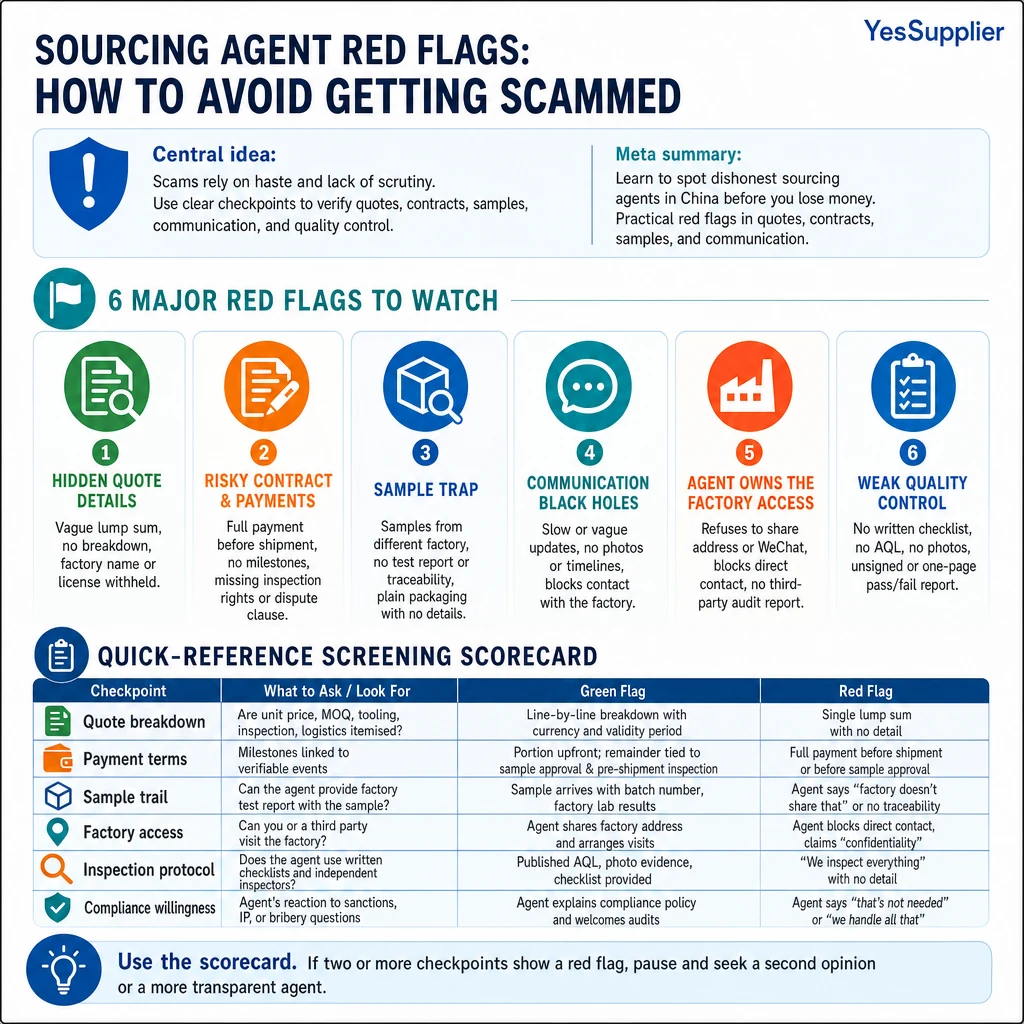
Another signal: an agent who says “factory direct pricing” but won’t name the factory or provide its business license. Legitimate agents working with real factories can share a factory profile or at least a region and industry certification. If the agent claims the factory forbids disclosure, ask yourself why a manufacturer would hide from potential buyers. A reputable factory wants visibility, it builds trust.
Contract gaps and payment demands
The contract is where many scams unfold. The U.S. Department of Justice and SEC’s FCPA Resource Guide highlights unusual payment structures as a red flag for third-party intermediaries, such as full payment before delivery or payment to a bank account in a third country unrelated to the transaction. For sourcing agents, the risks are similar. You need payment milestones tied to verifiable events: a portion upon sample approval, a portion after pre-shipment inspection passes, and the balance only when goods are shipped or delivered.
What should be in the contract:
- Payment milestones with clear triggers (e.g., “portion after buyer approves pre-production sample”).
- A dispute resolution clause specifying arbitration or court jurisdiction. If the agent leaves it blank, you have no recourse.
- An IP protection clause if you’re sharing designs or molds.
- A clause allowing you or a third party to inspect the goods before shipment.
Red flags include an agent who insists on full payment before shipment, refuses to include inspection rights, or cannot explain the governing law. Another red flag: the contract says “inspection deemed accepted upon delivery to carrier” without giving you a chance to reject before loading.
Honest trade-off. Some agents will ask for a large upfront payment because their factories demand it, especially for custom tooling. That can be legitimate if the tooling cost is high. But the contract should still link payment to a specific milestone, like completion of first article. If the agent cannot show a factory invoice for the tooling, the request is suspect.
The sample trap
A sample arrives at your office. It looks perfect, materials, finish, dimensions all match your specification. You approve it and order full production. When the container arrives, the goods are different: wrong color, thinner plastic, missing features. What happened? The agent sent you a sample from a different factory, one with better capability, but then produced the order at a cheaper, unqualified workshop.
You can avoid this by demanding traceability with every sample. Ask for the factory’s test report that matches the batch number printed on the sample. A reliable agent can provide this. If the agent says “the factory doesn’t share that information,” treat it as a red flag. Also check whether the sample packaging includes the factory’s contact details. If it’s a plain box with no return address, the agent may be hiding the source.
Practical decision. If you accept a reference sample without factory traceability, plan to inspect the first production batch using a third-party inspector who visits the actual factory floor. That way you catch discrepancies before shipping.
Communication black holes
After the initial order is placed, the agent becomes less responsive. You ask for production photos and hear “everything is fine, don’t worry.” When you press for specific updates, the agent blames delays on “the factory” without providing evidence, no email from the factory, no production schedule update.
The OFAC Compliance FAQs stress that businesses must know their transaction counterparties and ensure they are not dealing with sanctioned entities. An agent who dismisses compliance questions, such as “can you provide the factory’s business license and export license?”, is a red flag. A professional agent has nothing to hide and can share documents that confirm the factory’s legitimacy.
Patterns that indicate trouble:
- No response to a request for production photos within a reasonable timeframe.
- Reports that contain only vague statements (e.g., “partially done”) without photos or timelines.
- Agent refuses to include you in communication with the factory, claiming “language barrier” or “they prefer to deal only with me.”
Language barriers are real. A good agent translates and includes you in key emails. If the agent blocks direct contact, they control the information flow and can manipulate what you know.
When the agent owns the factory relationship
Some agents position themselves as the sole conduit between you and the factory. They insist you never contact the factory directly, even for simple questions. They may say, “I handle everything, you don’t need to talk to them. If you do, they’ll be confused.” This is often a sign that the agent is either a middleman with no real authority or is working with a factory that doesn’t know your order is being represented by someone else.
Red flags.
- Agent refuses to share the factory’s address or WeChat ID.
- Agent requires all communication to go through them, even routine production updates.
- Agent cannot provide a factory audit report from a third-party firm.
For very small orders, many factories will only deal through an agent. In those cases it is reasonable for the agent to be the primary contact. The agent should still share the factory name and let you verify it by a quick online check or phone call. If they refuse, treat it as a deal breaker.
Inspection and quality control red flags
An agent who offers “free inspection” or “guaranteed QC” without specifying criteria is likely cutting corners. The World Bank handbook notes that missing documentation, such as inspection reports without signatures or dates, is a corruption red flag. In sourcing, the same applies: an inspection without a written checklist, defined acceptable quality limit (AQL), and photo evidence is worthless.
What to look for in an inspection report:
- Clearly stated acceptable quality limit (e.g., a specific level for critical defects).
- Photographs of the production line, packaging, and random samples.
- Signed report by the inspector, with the inspector’s credentials.
- If the agent commissions a third-party inspector, the report should come directly from that firm, not rewritten by the agent.
If the agent provides a one-page report with only a pass/fail result and no photos, ask for details. A common trick is to show stock photos of a factory floor that is not the one producing your goods. Reverse-image search can catch this.
Quick-Reference Screening Scorecard
Use this table when evaluating a sourcing agent during initial conversations. If two or more checkpoints show a red flag, pause and seek a second opinion or a more transparent agent.
| Checkpoint | What to Ask / Look For | Green Flag | Red Flag |
|---|---|---|---|
| Quote breakdown | Are unit price, MOQ, tooling, inspection, logistics itemised? | Line-by-line breakdown with currency and validity period | Single lump sum with no detail |
| Payment terms | Milestones linked to verifiable events | A reasonable portion upfront; remainder tied to sample approval and pre-shipment inspection | Full payment before shipment or before sample approval |
| Sample trail | Can the agent provide factory test report with the sample? | Sample arrives with batch number, factory lab results | Agent says “factory doesn’t share that” or sample has no traceability |
| Factory access | Can you or a third party visit the factory? | Agent shares factory address and arranges visits | Agent blocks direct contact, claims “confidentiality” |
| Inspection protocol | Does the agent use written checklists and independent inspectors? | Published acceptable quality limit, photo evidence, checklist provided | “We inspect everything” with no detail |
| Compliance willingness | Agent’s reaction to sanctions, IP, or bribery questions | Agent explains their compliance policy and welcomes audits | Agent says “that’s not needed” or “we handle all that” without specifics |
The scorecard is not a guarantee; no system can prevent every scam. It reduces risk by encouraging more scrutiny. Scams rely on haste and lack of oversight. If you slow down and ask for specifics, you are less likely to be targeted.
Next step: Run the scorecard against your candidates
Take the checkpoints above and apply them to the agent you’re considering, or to a small set of candidates. If you find red flags, consider whether the agent can address them with documentation and transparency. If they cannot, move on. Sourcing from China involves enough complexity without adding a middleman whose incentives are not aligned with yours.
If you’d prefer to start with an agent whose processes are transparent from the first call, you can review how Yes Supplier structures its quote and inspection milestones on the How It Works page.