
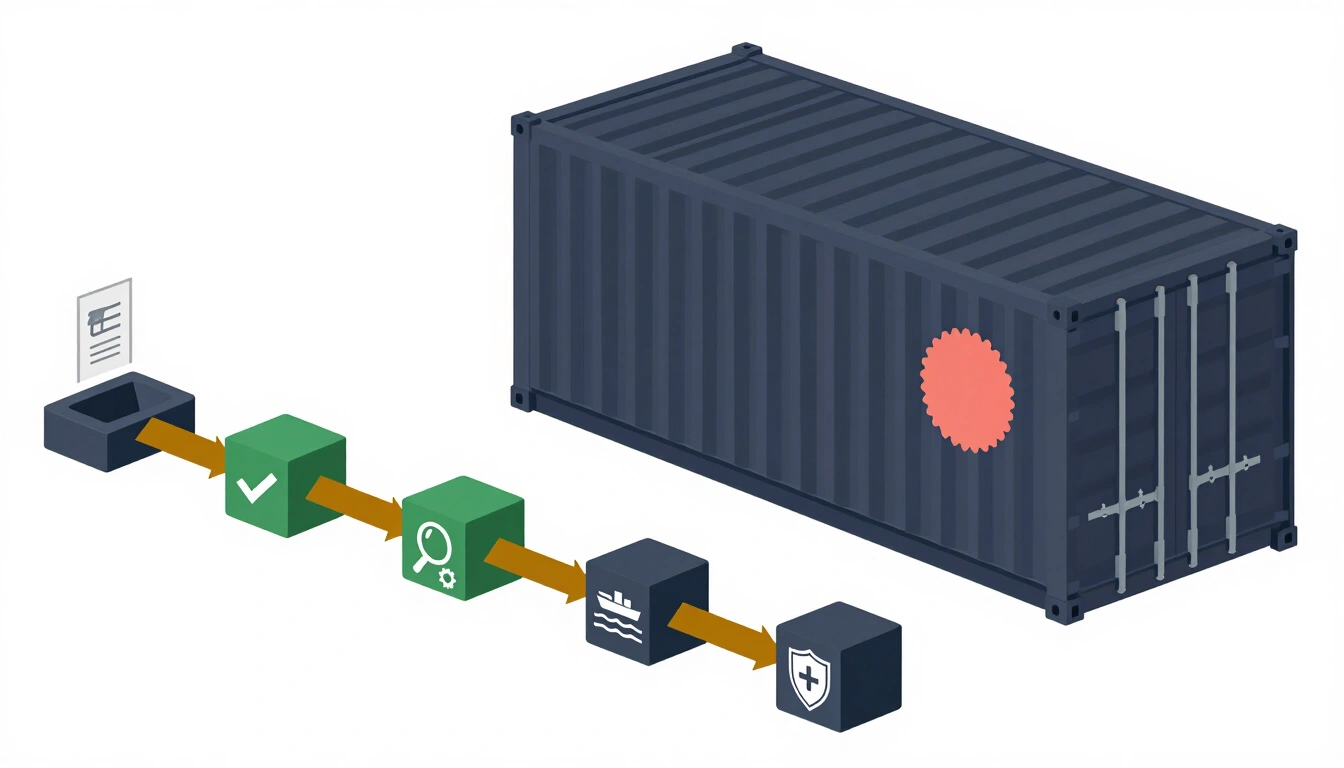
By the time you receive a supplier quote, the budgeting question can feel answered. The quote has a number, a currency, a quantity, and an Incoterm, and it looks complete. Then the project moves forward and the other invoices arrive: mold, samples, courier, inspection, freight, duties, local delivery. None of these were hidden. They were simply outside the unit price.
The real budgeting problem is not which supplier offers the lowest per-unit price. It is what you are paying for at each step, and how much cash you need before you hold sellable inventory. A supplier quote is a statement about a unit price at a stated quantity under a set of assumptions. It does not tell you what it costs to make the initial sellable unit, what happens if the product changes, or what the shipment costs after it leaves the factory.
First, read the quote as a statement, not a budget
Most China supplier quotes carry an Incoterm: Ex Works, FOB, or DDP are the terms buyers see most. Ex Works means the supplier’s responsibility stops at the factory gate. Trucking, port handling, ocean freight, insurance, terminal fees, duties, and local delivery are all on your side of the line. FOB moves that line to the seaport after export procedures. DDP pushes more of the transport and import costs into the supplier’s price, which looks simpler, but it does not move the quality risk. The shipment can still be late, damaged, or off-spec.
Duties are set by your country, not by the factory. The amount depends on the tariff classification of the product, the country of origin, and the rules your customs authority applies. Ask the supplier for the export HS code they use, then ask your broker to verify whether the import classification is the same. A wrong code changes the duty and can hold the shipment at arrival.
Set aside the unit price briefly and map the costs that appear between the factory gate and your warehouse. That map is the budget.
The charges that sit outside the unit price
Most China sourcing budgets are made of charges that arrive separately from the unit price:
| Budget line | What it covers | Question to answer before you pay |
|---|---|---|
| Unit price | Materials, labor, standard packaging, factory margin. | Does it include the packaging your retail channel requires? |
| Tooling | Molds, fixtures, test equipment. | Do you own the tool after the invoice is paid? |
| Samples | Prototype and pre-production samples, plus courier costs. | How many rounds are included before you pay again? |
| Inspection | Checking the finished batch before shipment. | At which point can the shipment be stopped? |
| Certification and testing | Laboratory reports, compliance documentation, retests. | Who owns the report and who pays if the test fails? |
| Freight and insurance | Transport from the factory to your door. | What happens if the shipment misses the booked sailing? |
| Duties and taxes | Import charges at your border. | Who calculated the rate and did anyone verify the classification? |
| Payment and exchange rate | Bank fees, card fees, currency conversion. | Does the quoted price hold if rates move before you pay? |
Use the table as a review list, not as an average. The amount behind each line depends on the product, not on an industry benchmark. A sewn product has no tooling; a molded part has a steel mold; a battery-powered device has testing and shipping rules that a textile product does not.
Build the budget from your requirement sheet, not from a benchmark
If you search for a standard sourcing budget percentage, you will find figures that assume your product behaves like everyone else’s. Your product does not. The useful way to budget is to write a requirement sheet before asking for quotes. Include at least this much:
- Drawings or a reference sample
- Materials and finish
- Dimensions and tolerances
- Packaging dimensions and retail packaging requirements
- Labeling languages
- Compliance and testing requirements
- Order quantity and delivery dates
- Quality checks you expect at the factory
That document lets suppliers quote on the same product, lets you compare quotes line by line, and gives the sample something to prove. When the supplier asks a specification question you cannot answer, that question has a cost attached. Answering it before production is cheaper than answering it after.
Compare hypothetical product categories: a molded plastic housing and a battery-powered device. The housing may require a mold and limited sample rounds but no laboratory testing. The device may not need a large mold, but it will need certification, battery transport review, and a deeper final inspection. Their budgets are not comparable, and no single benchmark will make them comparable.
Tooling and samples: where the early cash goes
Tooling is usually the largest early payment for a manufactured product. The terms matter more than the amount. If the tooling cost is folded into the unit price, the supplier may own the mold. That can be fine while you keep ordering, but it becomes expensive if you want to move production, because leaving means paying for the tool again. If you pay a separate tooling invoice, put tool ownership and mold drawings in writing.
Samples are the second place where cash moves faster than expected. A prototype proves the concept; a pre-production sample proves the production line. Suppliers may include sample rounds and charge for later rounds. Before approving a sample, confirm exactly how many rounds are included and who pays the courier. The sample that is free still has production time and freight attached to it.
Quality control is a budget line, not an afterthought
An inspection fee is a separate line, and it is often worth paying. But not every product needs the same depth of inspection. A simple, standard product may need a lighter check than a complicated device with electronics and moving parts. The value is in what the inspection actually checks: production quantity, workmanship against the approved sample, packaging, loading, and the point at which you would hold the shipment. A final inspection before the balance payment gives you a decision point before the goods are sealed in a container. It does not guarantee a defect-free shipment, but it makes the risk visible while you can still act.
Freight, customs, and costs that arrive after production
A freight quote should state the port pair and the consignment size for sea freight, or the weight and volume for air freight. Ask what happens if the factory misses the planned sailing date. A late shipment does not remove the booking cost.
Customs duties and taxes are due even when the shipment goes smoothly. They are separate charges that arrive after the goods are on the water. If you have not reserved cash for them, they will be paid from cash you needed for the next order. Put freight, insurance, duties, and local transport into the budget as separate lines, and check the tariff classification before production rather than after the invoice is issued.
Payment terms and currency risk
China suppliers commonly ask for a deposit before production and the balance before shipment. The exact split varies by supplier and product. Attach each payment to something you can verify: the deposit after the requirement sheet is final, the balance after inspection or against the final shipping documents.
Quotes are frequently written in USD. Between the quote date and the payment date, the exchange rate can move, and banks charge for conversion. Ask how long the price holds and what happens if the payment is delayed. A supplier that absorbs currency movement may have built that cost into the unit price; a supplier that excludes it should state that in the quote before you transfer money.
Build a buffer into the budget, and track it
However carefully you plan, some costs will move in directions you did not predict: an extra sample round, a freight rate that rises, a laboratory that requires another test, or a production batch that fails inspection and needs rework. Leave room for that. Track the buffer separately, so that if it is consumed, you know which part of the project took it.
A buffer does not replace supplier verification. It covers surprises; it does not justify skipping a final inspection or paying the full balance before production is confirmed.
When the quote matches the requirement sheet
At some point the amount you can pay and the amount the project needs will come together, or you will see clearly where they do not. The project side only becomes clear when the requirement sheet, the quotes, the sample results, and the shipping terms are in front of you. At that point, the remaining budget question is verification: whether the delivered goods will match the approved sample and the agreed schedule.
If you want an independent read on that before transferring the balance, a sourcing service like Yes Supplier can review the supplier’s documents, coordinate samples, and monitor production. That check is a line item in the budget, and it can be planned like any other.