
China sourcing agent fees are not just about which proposal looks cheaper. The comparison should focus on whether the fee structure gives you a clear way to manage supplier selection, product requirements, approvals, order documentation, and changes to the work. A commission-based arrangement and a flat-rate arrangement can both be appropriate to evaluate. Neither fee structure, on its own, shows how thoroughly work will be performed or which costs may arise outside the agent’s service fee.
For a small business or product team, the useful comparison begins with the sourcing workflow. Are you seeking support through an agreed purchasing process, or do you need a defined task with specific deliverables? How much supplier information does your team need? Who approves samples and specifications? What happens if the product brief changes? Reflect the answers in a written scope before you approve the arrangement.
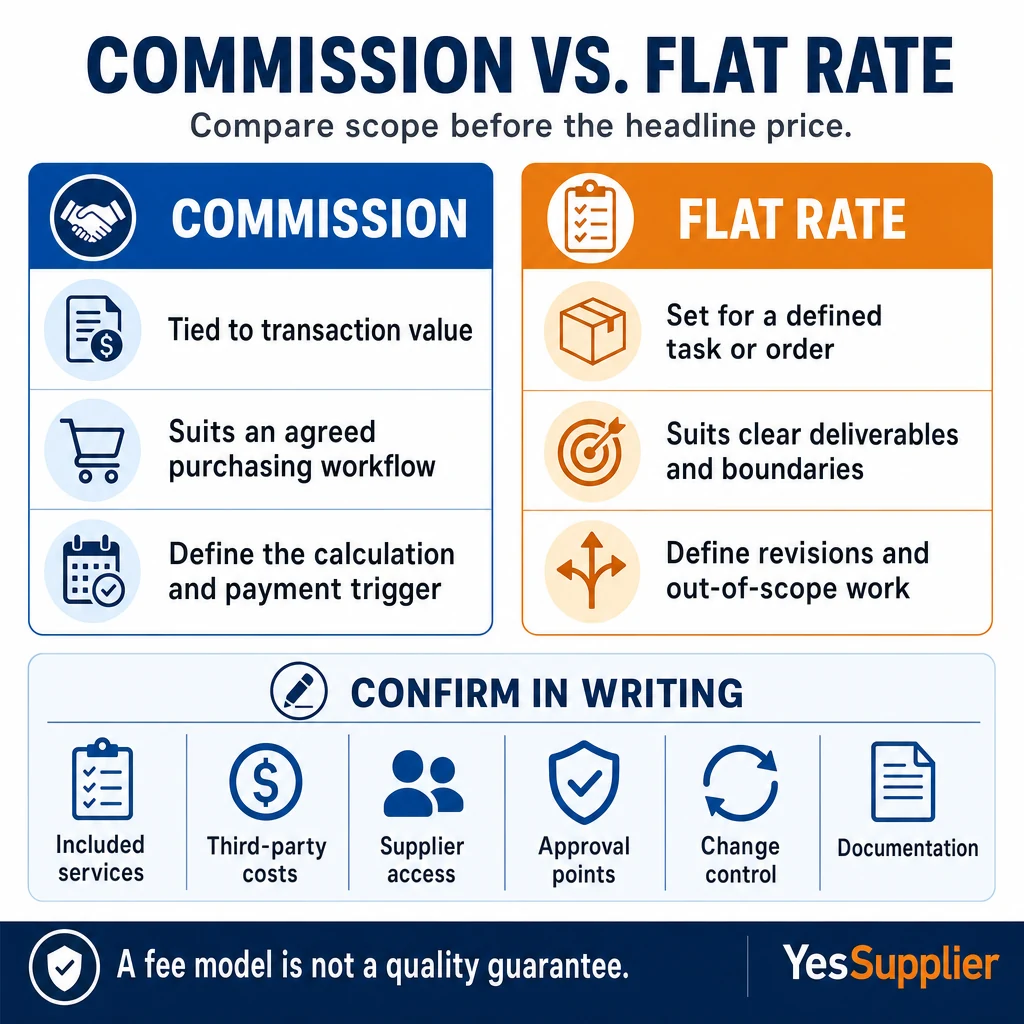
What a sourcing-agent fee is paying for
A sourcing engagement can involve more than identifying a supplier. Depending on the agreement, an agent may assist with supplier selection, negotiation, quality-control coordination, and logistics coordination. The exact scope varies by provider and by engagement.
These services should not be assumed from a fee label alone. For example, quality-control support may involve coordinating an inspection activity, arranging an outside provider, reviewing agreed documentation, or another activity set out in the agreement. Similarly, logistics support may mean coordination rather than responsibility for freight, customs processes, or delivery outcomes.
Ask for deliverables to be described in practical terms. A useful scope identifies what the agent will do, what information the buyer must provide, which approvals are required, and what records or reports will be delivered. It should also identify work outside the engagement. This creates a more meaningful comparison between proposals that use different fee models.
Commission-based China sourcing agent fees
In a commission-based arrangement, the agent’s fee is tied to an agreed transaction-value basis. The agreement should define that basis carefully. Buyers should not assume that every commission proposal uses the same inputs or covers the same purchasing activities.
Before accepting this model, clarify what transaction value is used for the calculation, when the fee becomes due, and whether payment is linked to a supplier payment, order confirmation, shipment stage, or another agreed trigger. Also establish whether the arrangement covers one order, repeat orders, a supplier-search stage, or ongoing support.
This structure can work when the agent stays involved in an agreed purchasing process. It does not guarantee the arrangement will be cheaper, more transparent, or in the buyer’s interest. Its value depends on written controls such as clear specifications, buyer approval points, supplier-disclosure terms, quotation records, and a defined change process.
Supplier access deserves particular attention. If supplier details, quotations, sample records, purchase documentation, or quality reports are important to your team, state that requirement before work begins. Supplier visibility is a contract question, not an automatic feature of a commission arrangement.
Flat-rate sourcing fees
A flat-rate arrangement sets a fee for a defined task, project, or order. Some China sourcing companies use flat fees per task or per order rather than a commission model. This approach works best when the work can be described with clear boundaries, such as a supplier-search assignment or a defined order-coordination task.
Scope control is the main issue in a flat-rate engagement. Define the product brief, requested outputs, communication process, approval stages, and what constitutes completion. If the buyer later changes materials, specifications, supplier criteria, packaging requirements, or requested support, the agreement should explain whether the work remains within scope or requires a revised agreement.
Revision limits and change-control procedures deserve attention even where the assignment appears straightforward. Product requirements may develop after supplier feedback or sample review. A written procedure for approving changes helps both parties distinguish routine coordination from a materially different assignment.
A flat rate is not a promise that every related expense is covered. Third-party charges may be separate from the agent’s service fee. The written quote should distinguish the agent’s work from costs payable to suppliers, inspection providers, laboratories, freight providers, payment services, or other parties.
Commission vs. flat rate: compare the scope before the headline price
Compare proposals by the operating details that affect your sourcing process. Assess like-for-like scope rather than relying on the fee label alone.
| Comparison point | Commission-based arrangement | Flat-rate arrangement | What to confirm in writing |
|---|---|---|---|
| How the fee is calculated | Tied to an agreed transaction-value basis. | Set for a defined task, project, or order. | Define the fee formula or fixed deliverable and the payment trigger. |
| Best fit to evaluate | Consider when the work is expected to follow an agreed purchasing process. | Consider when deliverables and boundaries can be clearly specified. | Match the model to the expected workflow, not only the headline fee. |
| Scope control | Scope needs separate detail even when the fee is transaction-linked. | Scope boundaries are especially important because added work may require a revised agreement. | List supplier search, negotiation, sample coordination, quality-control coordination, logistics coordination, and reporting separately where relevant. |
| Third-party charges | May be separate from the agent’s own fee. | May also be separate from the stated project fee. | Identify who pays for samples, inspections, tests, freight, customs-related services, tooling, packaging, and other external costs. |
| Supplier access and documentation | The buyer should clarify what supplier details and order documents will be shared. | The buyer should clarify the same information before work begins. | Specify supplier disclosure, quotation records, sample approvals, quality reports, and order documentation. |
| Changes and issue handling | Confirm how specification changes, replacement requests, and dispute support are handled. | Confirm whether changes fall inside the agreed scope or require a new agreement. | Set approval stages, escalation contacts, change-control steps, and limits of post-order support. |
Costs and responsibilities to clarify in writing
A sourcing proposal is easier to assess when it separates the service scope from third-party costs and buyer responsibilities. Do not presume that an item is included or excluded because a proposal uses commission or flat-rate language. Request a written list of inclusions, exclusions, payment triggers, and approval requirements instead.
Items worth clarifying may include samples, supplier charges, inspection activity, laboratory testing, freight, customs-related services, tooling, packaging, payment handling, bank charges, taxes, certification work, and support after an order is placed. Which items are relevant depends on the product, destination, supplier arrangement, and services requested.
For each item, ask who selects the provider, who authorizes the work, who pays the charge, how the cost is documented, and whether prior buyer approval is required. If an agent coordinates an outside provider, clarify whether the agent is arranging the service, reviewing its output, or performing another specifically defined role. Coordination should not be treated as a guarantee of an outside provider’s performance.
Payment terms should be equally clear. Record payment milestones, accepted payment methods, documentation associated with each payment, treatment of cancelled work, and the process for disputed charges. If supplier payments are involved, establish what order documents and approvals the buyer will receive before funds are released.
Supplier quality and import compliance are separate questions
Choosing a fee structure does not replace supplier controls. Supplier vetting, factory audits, inspections, and testing may help buyers gather information and manage a sourcing process, but they do not eliminate the possibility of defects, delays, fraud, or compliance issues. The buyer still needs to define product requirements, review approvals, retain relevant documents, and determine what evidence is necessary for the product and destination market.
ISO quality-management requirements address control of externally provided processes, products, and services. In practical sourcing terms, that supports setting expectations for specifications, acceptance criteria, records, approvals, and issue escalation rather than relying on a fee model as a proxy for quality control.
Import and product-compliance obligations require separate review because requirements can vary by destination and product category. For importers bringing goods into the United States, U.S. Customs and Border Protection states that commercial importers must exercise reasonable care regarding accurate documentation, packaging, labeling, and product origin. For consumer products subject to applicable U.S. safety rules, the U.S. Consumer Product Safety Commission explains that a General Certificate of Conformity concerns certification that products comply with those rules.
These U.S. references provide general context rather than advice for every product or destination. Verify requirements applicable to your product and destination with appropriate qualified support. An agent can assist only within the agreed scope; sourcing assistance does not transfer the importer’s obligations.
Questions to ask before you sign
- What exactly is the fee based on, and what event triggers payment?
- Which services are included, such as supplier identification, supplier vetting, negotiation, sample coordination, quality-control coordination, logistics coordination, reporting, or another task?
- Which costs may be charged separately, and when must the buyer approve them?
- Will supplier names, quotations, sample records, order documents, and quality reports be shared with the buyer?
- What specifications, reference materials, and approvals must the buyer provide before supplier contact or order placement?
- How are product changes, packaging changes, supplier substitutions, and replacement requests managed?
- What documentation will be retained and delivered at each stage?
- How are problems escalated, and what post-order support is within the agreed scope?
- What are the termination terms, and how are incomplete tasks or outstanding third-party costs handled?
A useful contract test is to consider a possible change before it occurs. For example, if a buyer revises product specifications after reviewing sample feedback, a workable agreement should identify who approves the revised brief, whether the revised work changes the scope, what supplier communication may occur, and how any additional external costs must be authorized.
Choose the structure that matches your sourcing process
Commission and flat-rate China sourcing agent fees are payment mechanisms, not quality guarantees. A transaction-linked arrangement may suit an agreed purchasing workflow. A flat-rate arrangement may suit an assignment with well-defined deliverables and boundaries. In either case, compare the complete written scope, fee basis, payment triggers, exclusions, supplier-access terms, approval points, and process for changes.
The right choice is the arrangement that makes responsibilities visible before money is committed. If you need support defining a sourcing scope, Yes Supplier describes China sourcing and quality-control services including product sourcing, supplier vetting, quality control and inspection, and logistics and shipping support.