
A quoted commission percentage tells you very little on its own. What matters is whether you can trace what the fee covers, what stays your responsibility, and how the arrangement shifts the total cost of your order.
This matters for small businesses sourcing from China. A service fee can sit alongside product payments, sample charges, inspection services, freight, insurance, testing, payment fees, duties, taxes, and other third-party costs. Without clear separation, comparing one proposal to another gets hard fast.
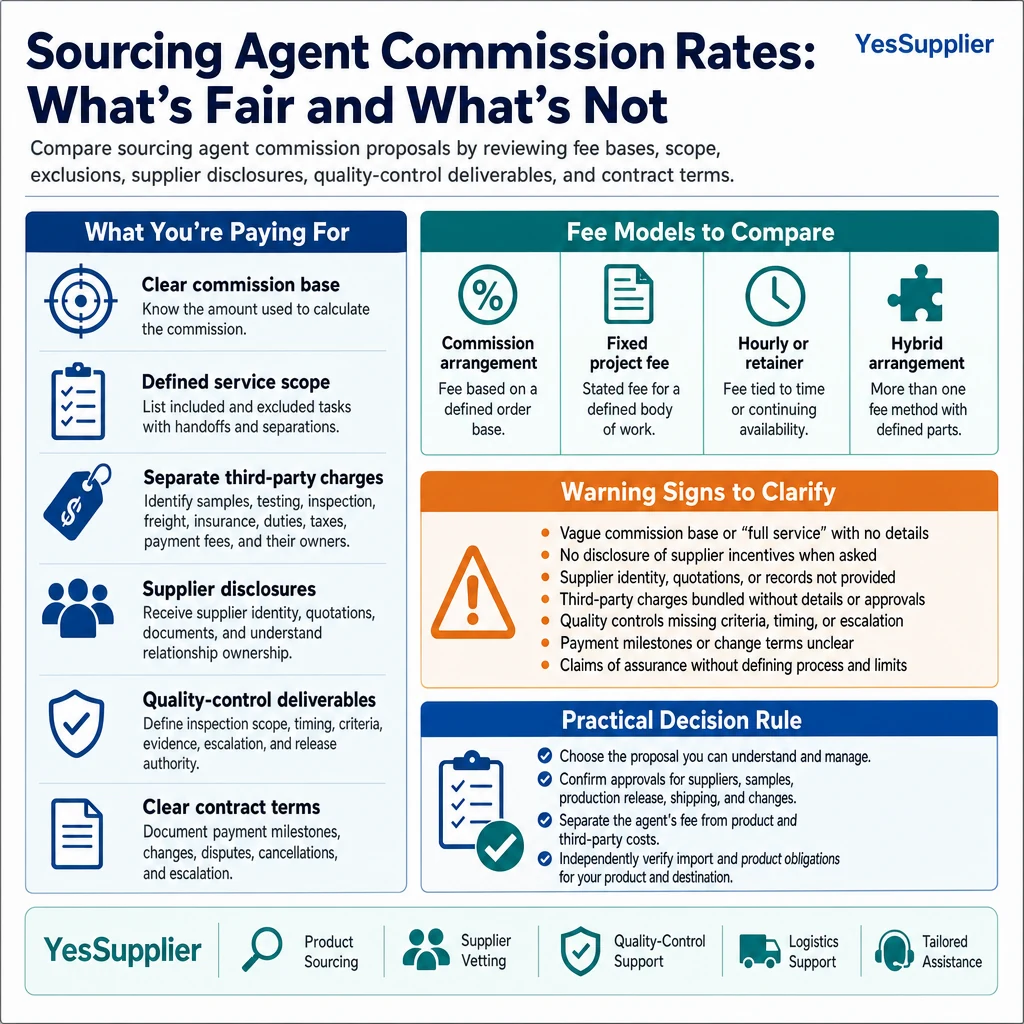
No single commission rate makes a sourcing arrangement fair. What matters is a written calculation method, a defined service scope, disclosed incentives, documented deliverables, and terms that let the buyer see the full commercial picture. That approach matches the due diligence recommended for China market-entry and sourcing decisions by the International Trade Administration.
What sourcing agent commission rates actually cover
A sourcing-agent commission is a service fee tied to an agreed calculation base. Before deciding whether a proposal works for your business, find out what that base is. It could be product value, a broader order value, or some other defined amount. Do not guess. Ask for the calculation method in writing.
Then examine the work attached to the fee. Sourcing support can include supplier research, supplier vetting, communication support, sample coordination, production follow-up, inspection coordination, logistics coordination, and help with final-delivery arrangements. A proposal may cover some of these tasks and leave others out. The fee only becomes comparable when the included work is spelled out with equal clarity.
Take a proposal that covers supplier research and sample coordination but not production monitoring, arranging an inspection, managing shipping documents, or addressing a quality concern after delivery. That does not make the proposal bad. It means the buyer needs a written list of inclusions, exclusions, handoffs, and separately charged services before committing.
Keep the agent’s fee separate from the underlying product cost. Keep it separate from costs charged by outside parties too, unless the quote says otherwise. Samples, laboratory testing, inspection services, freight, insurance, customs-related charges, taxes, and payment processing can each reshape the commercial picture. A clear proposal names which party charges each item, who must approve it, and when it becomes payable.
Why there is no single fair commission rate
There is no responsible universal answer to the question “What commission is fair?” Different sourcing projects need different levels of coordination and carry different practical responsibilities.
Product complexity is one factor. A buyer may need help interpreting specifications, comparing material options, coordinating samples, or documenting changes during production. Another product may have a simpler specification but demand careful attention to packaging, labeling, or document collection for its intended market. The work involved can differ a lot even when the purchase value looks similar.
Order structure matters too. A project may involve one supplier or several, a single production run or repeat purchasing, standard goods or custom development, straightforward shipment coordination or multiple logistics handoffs. Comparing commissions only makes sense when you also compare the expected scope of work against the stated fee basis.
Quality-control expectations can shape a proposal as well. Define the checks you expect, when they occur, which acceptance criteria apply, what evidence will be provided, and who can approve production release. ISO 9001:2015 is a quality-management standard that addresses control of externally provided processes, products, and services. The idea behind it applies directly to sourcing: external work benefits from clearly defined controls. But the standard does not confirm that a particular supplier or agent holds certification, and it does not make any inspection process mandatory for every purchase.
The same caution applies to shipping and compliance support. An agent may coordinate information or third-party services, but coordination alone does not confirm that customs, product-safety, testing, labeling, certification, or other destination-market obligations have been met. Those requirements depend on the product and the destination.
The fee models to compare before choosing an agent
Commission-based pricing is only one way to pay for sourcing support. Each model can work when its scope, payment triggers, and incentives are spelled out.
- Commission arrangement: The service fee is calculated from a defined order-related base. Ask exactly what amount is used and whether shipping, third-party services, or other charges affect the calculation.
- Fixed project fee: The buyer and agent agree on a stated fee for a defined body of work. The agreement should explain how changes in product requirements, supplier count, order timing, or additional tasks get handled.
- Hourly or retainer arrangement: The fee is tied to time or continuing availability. Ask what reporting will show the work performed, which activities fall within scope, and what happens when the original assignment expands.
- Hybrid arrangement: More than one fee method may apply to different parts of an engagement. This can work when each component has its own scope, trigger, calculation method, and exclusions.
No model is automatically better, cheaper, or more aligned with the buyer’s interests. A commission arrangement works when its basis and services are documented. A project fee is easier to compare when the project boundaries hold steady. A retainer can suit continuing coordination where reporting and approval rules are clear. The right choice depends on the work you need done and the terms you can actually verify.
Questions that make a commission quote comparable
Ask every prospective agent for the same information in writing. A consistent request cuts down on ambiguity and lets you compare proposals on their actual commercial terms, not on a headline fee alone.
| Quote-review item | What to request in writing | Why it matters | Evidence boundary |
|---|---|---|---|
| Commission base | State the amount used to calculate the commission and whether product value, shipping, third-party services, or other charges are included. | A percentage cannot be compared meaningfully without a clear calculation base. | Do not assume any calculation base is standard. |
| Service scope | List sourcing, supplier vetting, negotiation support, sample coordination, production follow-up, inspection coordination, logistics coordination, and post-order support that are included or excluded. | A lower quoted commission may cover fewer tasks. | Do not assume any service is included. |
| Third-party charges | Identify possible sample, testing, inspection, freight, insurance, customs, tax, and payment-related charges separately from the agent fee. | Separated costs provide a clearer view of the full commercial commitment. | Costs cannot be estimated responsibly without product and destination details. |
| Supplier incentives | Ask whether the agent receives supplier commissions, rebates, referral payments, or other compensation connected to supplier selection. | Disclosure lets the buyer assess potential incentive conflicts. | Do not assume such payments exist. |
| Quality-control deliverables | Define inspection scope, timing, acceptance criteria, report format, photo evidence, escalation steps, and production-release authority. | Defined controls make responsibilities and approvals more visible. | Inspection does not guarantee quality or compliance. |
| Compliance responsibilities | Assign responsibility for collecting product documents and clarify that the buyer must verify destination-specific import and product requirements. | Importers retain responsibilities for accurate import information, while some applicable consumer-product rules may require certification documentation. | Requirements depend on the product and destination. |
| Payment and dispute terms | Document payment milestones, cancellation terms, change-order handling, defect or delay escalation, and applicable contract terms. | Written terms reduce uncertainty if the project changes or an issue arises. | No remedy should be treated as guaranteed. |
Supplier disclosure deserves particular attention. Ask whether you will receive the supplier’s legal identity, contact information, quotation details, and relevant product documents. Also clarify who owns the supplier relationship and whether direct communication with the supplier is allowed. These are commercial questions, not signs of bad practice. Clear answers help you gauge how much your business depends on an intermediary.
Ask about payment timing as well. The agreement should draw a line between payments to the agent and payments to suppliers and third parties. It should explain approval points, cancellation treatment, order changes, and the process for escalating defects, delays, or document gaps.
Warning signs in a sourcing-agent commission proposal
A commission proposal should not leave you guessing about important terms. The following are reasons to ask for clarification before moving forward:
- The commission basis is described generally but not defined precisely.
- The scope uses broad language such as “full service” without listing deliverables, exclusions, or approval points.
- Supplier-related compensation is not addressed when you ask about it.
- Supplier identity, quotations, or product records are unavailable without a stated reason and process.
- Third-party charges are rolled into a single total without identifying the provider, purpose, or approval requirement.
- Quality-control language does not name criteria, timing, evidence, escalation, or release authority.
- Payment milestones and change-order terms are missing or hard to reconcile with the stated work.
- The proposal claims that compliance, quality, or supplier reliability will be assured without laying out the specific process and its limits.
Protecting quality and compliance while evaluating fees
Fee evaluation and quality planning belong together. Define product requirements, acceptance criteria, packaging expectations, and document needs before asking an agent to source or manage production. If requirements change, record the change and confirm any effect on scope, timing, and charges.
For imports into the United States, U.S. Customs and Border Protection states that importers must exercise reasonable care and ensure accurate import documentation, packaging, labeling, and origin information. That responsibility does not disappear because an agent or supplier helps gather information. Buyers should independently verify the obligations that apply to their product and destination market.
Some consumer products may require certification documentation under applicable product-safety rules. The U.S. Consumer Product Safety Commission explains the role of a General Certificate of Conformity for applicable consumer products. This does not mean the document applies to every product or every destination. Ask the agent what documents can be collected, then independently verify whether those documents meet the requirements relevant to your product and market.
A useful written quality-control scope identifies the inspection stage, the product specification being checked, the evidence expected, the recipient of the report, the process for reporting nonconformities, and the buyer’s decision rights. A report, sample, factory visit, certificate, or test document can provide information, but none of it should be treated as a guarantee of defect-free or compliant goods.
A practical decision rule for small buyers
Choose the proposal you can understand and manage, not the one with the smallest headline commission. The more clearly a proposal spells out its fee base, work scope, excluded costs, supplier disclosures, quality-control deliverables, payment triggers, and issue-resolution process, the better you can compare it with alternatives.
Before you engage, request a written scope and quote that separates the agent’s service fee from product and third-party costs. Confirm who approves suppliers, samples, production release, shipping decisions, and changes to the original requirements. Then independently verify destination-specific import and product obligations.
Yes Supplier states that it provides product sourcing, supplier vetting, quality-control support, logistics support, and tailored assistance. Buyers can review its stated workflow and request a written scope suited to their sourcing requirements.