
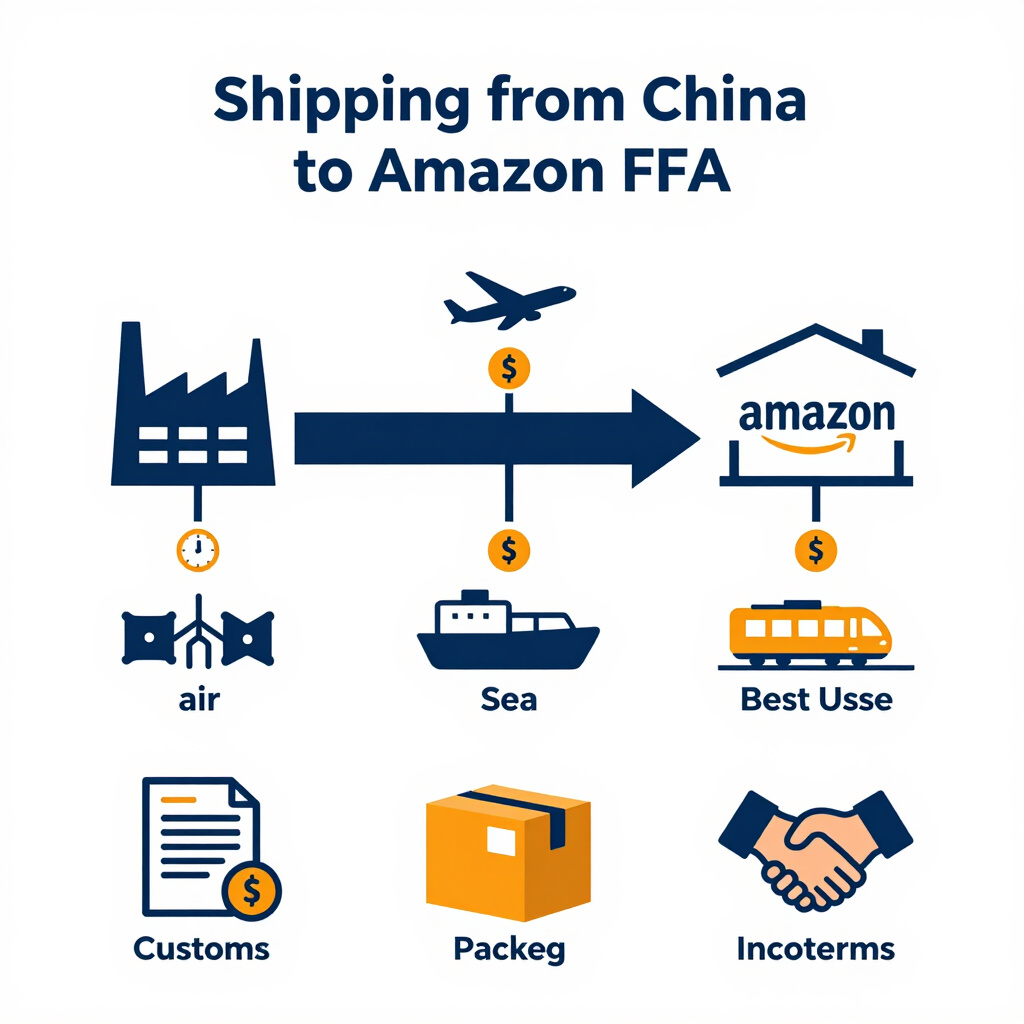
You’ve found a supplier in China, approved the sample, and watched production finish. Now the product has to cross an ocean and land at an Amazon fulfillment center in sellable condition. That last stage is where many sourcing projects go sideways: the freight quote was built on the wrong incoterm, the invoice didn’t match the cartons, or a box arrived without the label Amazon’s receiving team expected. Shipping from China to Amazon FBA is not a single event. It is a sequence of decisions, and the practical route is to make them before the goods leave the factory. Choose the freight mode that fits your shipment size, budget, and target date; prepare the documents your destination customs authority requires; package and label to Amazon’s current rules; and agree on an incoterm before production ends. Verify rates and requirements with a licensed forwarder, customs broker, or Amazon Seller Central. If you would rather have one partner manage the supplier side while you coordinate carriage, Yes Supplier offers logistics coordination alongside sourcing services.
What this guide covers
The shipping stage is where good supplier work can be undone fast. A product that passes inspection can still miss a launch because the freight choice was wrong, the commercial invoice described the goods differently than the packing list, or the boxes were rejected on arrival. This guide walks through the decisions in order: which freight mode fits which situation, what documents to prepare, how packaging and labeling fit into the process, how incoterms allocate responsibility, and where a sourcing agent can help. It deliberately avoids quoting current freight rates, customs duty numbers, or Amazon’s exact box specifications, because they change and vary by route, product, and destination. Treat those numbers as verification items. Each section tells you what to check and who to ask.
Yes Supplier is a China sourcing partner whose scope includes requirement confirmation, supplier search and vetting, sample coordination, production monitoring, final inspection, product development support, and logistics coordination. The homepage is the easiest place to see how the company positions itself.
The Amazon FBA shipping journey at a glance
From factory floor to fulfillment center, most shipments pass through several stages: production, final inspection, freight booking, export customs clearance, the ocean or air leg, import customs clearance, and delivery to the Amazon fulfillment center. The exact sequence can vary. Some shipments move through a freight forwarder’s consolidation warehouse. Others are booked direct with a carrier. If you are new to the process, start by looking at how the sourcing process works so you can see where shipping fits relative to production and inspection.
Choosing a shipping method: air, sea, or rail
There is no universal best option. The answer depends on shipment weight, volume, cash flow, product fragility, and how firm the target arrival date is.
| Mode | What to think about |
|---|---|
| Air freight | Makes sense for small, high-value, or time-sensitive goods. The cost per kilogram is higher, but the speed can protect a launch date or a reorder window. |
| Sea freight | Fits larger, heavier, or less time-sensitive orders. The per-unit cost is lower, but the longer transit time means you need to plan further ahead. |
| Rail freight | A middle option for shipments from China to Europe. It can be slower than air and cheaper than air, but faster than sea, with its own scheduling constraints. |
Faster and cheaper are not fixed labels. A sea quote may look attractive until you add the cost of missed shelf time or a second shipment to cover stockouts.
Hypothetical example: a startup has 20,000 units of a kitchen tool ready for a launch promotion. Air freight would land the goods in time but eat into the margin. Sea freight would preserve margin but push arrival close to the promotion date. The right call depends on how much buffer the promotion can absorb and what a delay would cost in sales. This is a business judgment call, not a formula.
Decision checklist before you book freight
Use this as general guidance, not a substitute for a freight forwarder’s advice. Answer each question before you ask for quotes.
- How many units are you shipping, and what is the total weight and outer carton volume?
- What is the target arrival date at the fulfillment center, and how firm is that date?
- What per-unit freight cost can your pricing support?
- Are the goods fragile, hazardous, or dimensionally large enough to change the freight class?
- Has the order passed final inspection, and does the shipment need to arrive in time for a specific Amazon delivery appointment?
- What happens to stock if the shipment arrives late?
Customs documentation: what to prepare
The exact documentation requirements vary by country, product, and importer. Your forwarder or customs broker will tell you what the destination authority needs. You will also need to consider product classification. If your supplier suggests a code, do not assume it is correct. Duties, taxes, de minimis thresholds, and tariff treatments are outside the scope of this guide. Ask your freight forwarder or customs broker for the current treatment, and check the official customs authority page for the destination country. For a new product, ask: what documents do you need from me, what information must appear on the invoice, and who will be named as importer of record? Get the answers in writing.
Packaging and labeling considerations for Amazon FBA
Packaging and labeling are important for Amazon FBA shipments. The general categories you will likely encounter are product labels with barcodes, shipping labels on outer cartons, and delivery appointment labels. This description is generic, not an official specification. Before you book freight, open Amazon Seller Central and search for FBA packaging requirements and shipping and routing requirements. If the supplier or a third-party labeller will handle the labels, confirm they are working from the current specification. Yes Supplier offers logistics coordination. Do not rely on a friend’s old checklist.
Incoterms: defining responsibility in your shipment
Incoterms are an important part of international shipping. You will need to agree on an incoterm with your supplier and forwarder. The incoterm defines who pays for what, where the goods transfer responsibility, and who controls the freight booking. Make sure the quotation includes an incoterm.
How a sourcing agent can simplify your shipping process
Yes Supplier offers requirement confirmation, supplier search and vetting, sample coordination, production monitoring, final inspection, product development support, and logistics coordination. If you want to see how the pieces fit, look at Yes Supplier’s services and the how it works page before you decide.
Common pitfalls to avoid when shipping to Amazon FBA
- Booking freight before the goods are ready. If production slips, the carrier still has your money or the schedule does.
- Leaving the incoterm vague. It may be fine, but you should know what it costs and who controls the booking.
- Waiting to verify product classification until after shipment. Ask your freight forwarder, customs broker, and sourcing agent questions before you commit. If you are new to sourcing, the frequently asked questions page covers some of the basics.
Your next steps for shipping from China to Amazon FBA
Before you message a forwarder, write down the finished carton dimensions and weight, the target arrival date, the incoterm you intend to use, and the origin port or airport. Then verify the two things that change: Amazon’s current FBA receiving requirements and the destination customs rules.
Yes Supplier offers logistics coordination as part of its services. If that is the support you want, look at Yes Supplier, read the case studies, or learn more about Yes Supplier. The frequently asked questions page may be a useful starting point as well. No article can guarantee a smooth shipment, but the decisions above are the ones that make it more likely.