
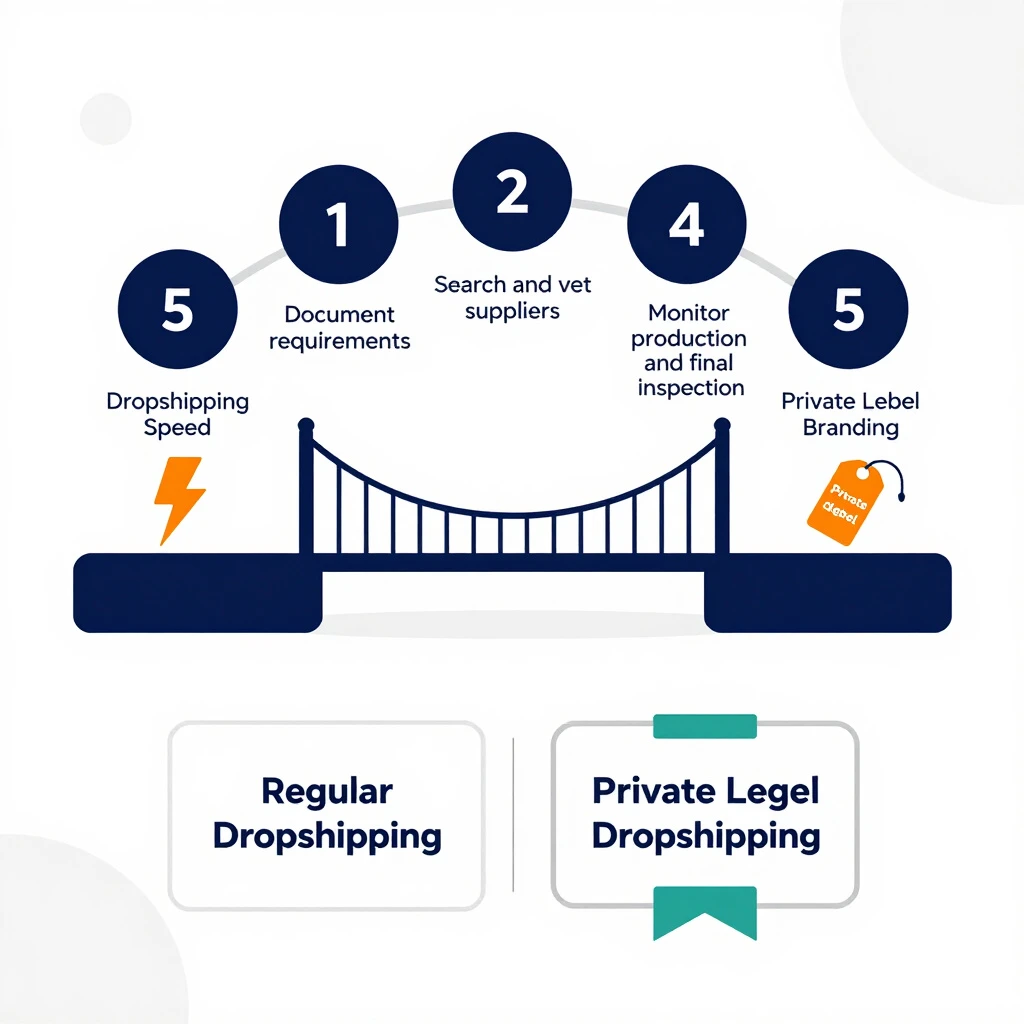
The trade-off between dropshipping speed and branding
You have a product idea with your name on it, but you do not want to buy inventory before you know whether it sells. Dropshipping removes the inventory problem: the supplier ships directly to your customer. It creates a second problem, because a generic catalog product arrives under your brand with whatever quality, packaging, and delivery experience the supplier chooses.
Private label dropshipping is the middle path. You specify the product, brand it, and the supplier manufactures and ships each order. You get a branded customer experience without a warehouse. What you give up is simplicity: requirements, supplier selection, samples, production checks, and logistics all become your responsibility. A sourcing partner such as Yes Supplier can carry part of that load, but the accountability stays with you.
Treat this as a decision framework, because the model succeeds or fails at specific operational points. A sourcing partner can help at those points; it cannot guarantee the outcome.
What private label dropshipping means
Private label means a third-party manufacturer makes the product and you sell it under your brand. The label, packaging, and listing are yours. Dropshipping means the supplier ships the product directly to the end customer, so you never hold inventory or handle the goods.
Private label dropshipping combines the two. You decide what the product is, how it looks, what it is called, and how it is packed. The supplier produces it and sends it to the customer after each order. You operate like a brand owner without a warehouse.
The catch is accountability. The moment you put your name on a product, you answer to the customer for what the supplier does. Defects, delays, and packaging mistakes are your problem even when they happen on the supplier’s side. That part of the model cannot be delegated away.
How private label dropshipping differs from regular dropshipping
Regular dropshipping starts with a product that already exists in a supplier’s catalog. You list it, a customer orders it, and the supplier ships it. Private label starts with a specification you define. The difference sounds small and changes almost everything downstream.
| Regular dropshipping | Private label dropshipping | |
|---|---|---|
| Branding | Supplier’s generic product, little or no branding | Your name, logo, packaging, and design |
| Product differentiation | Low, many stores sell the same item | Higher, the product can be tailored to your customers |
| Supplier relationship | Transactional, order-to-ship | Closer, the supplier follows your specifications |
| Sampling | Usually not needed | Needed before mass production |
| Quality control | Little or none | Production monitoring and final inspection |
| Customer experience | Limited control | More control if specs and packaging are enforced |
| Startup effort | Fast, low coordination | More coordination before the first order |
The table helps you compare the two models. It is not a performance guarantee: a supplier can fail you in either model, and a branded product still needs real demand.
Is private label dropshipping right for your business?
Ask yourself three questions. Do you want a recognizable brand, or do you just want to move units? Can you spend time on product development, or do you need a ready-made item this month? Are you willing to vet suppliers and review samples, or would you rather accept whatever a catalog supplier sends? If you want the brand but are not prepared for the coordination, this model will frustrate you.
As a hypothetical example, a startup wants to sell insulated bottles under its own brand. The founder knows the bottle should hold 500 ml and fit a car cup holder, but has never specified materials, lid design, or branding. The product will not exist until requirements are written, a supplier is found, and a sample is approved. None of that is unusual, but it takes time and decisions.
Start with one product, learn the process, then decide whether to scale. Profitability depends on demand and margins, not on the model itself.
Step 1: Confirm your product requirements
Requirement confirmation is where private label succeeds or stalls. Before contacting any supplier, write down materials, dimensions, colors, packaging, labeling, and quality expectations. The document does not need to be formal, but it needs to be specific. Saying “good quality bottle” invites the supplier to interpret “good” however they want. Saying “food-grade stainless steel, 500 ml capacity, screw lid with silicone seal, logo printed on the front” gives the supplier something they can price and build.
Product development support can help here. If your idea is not yet manufacturable, someone with sourcing experience can flag issues before you commit money. A design that works on screen may need adjustment for the actual production method. Fixing it on paper is cheap. Fixing it after production is not.
Share the requirement sheet with every supplier you approach. It becomes the reference point for samples, production, and inspection later.
Step 2: Search and vet suppliers in China
Supplier search finds candidates. Supplier vetting decides which candidates deserve your order. Search is easy, because every platform is full of factories. Vetting is the step people skip and regret.
Use practical criteria. Business credentials and registration. Production capabilities that match your product. Communication quality and response time. Willingness to follow your specification instead of substituting their own. And sample quality, because a supplier who cannot produce one good unit will not produce a thousand good ones.
A supplier who pushes back on your requirements is not automatically bad. They may know the manufacturing limits. But you need them to explain the trade-off, not quietly decide for you.
A sourcing partner can run search and vetting on your behalf, which helps when you lack time or language access. That reduces risk, but the residual risk stays with you.
Step 3: Coordinate samples before committing
Sampling is where your requirement sheet meets reality. Request a sample, compare it against the document, and decide whether it matches. Look at dimensions, materials, weight, color, logo placement, and packaging. Also look at how it feels in hand and whether the label is straight.
If the sample does not match, request a revision. This is normal. In a hypothetical case, a buyer orders a sample of a branded water bottle and the logo is printed crooked and lower than specified. The supplier fixes it on the next sample. The buyer approves the revised sample and only then moves to production. Skipping that step means the defect appears on every unit shipped to customers.
Sample coordination is one of Yes Supplier’s listed services. Sampling lowers the chance of defects, but it cannot make them impossible.
Step 4: Monitor production and arrange final inspection
Production monitoring means checking progress against your specification and timeline while goods are being made. The point is to catch deviations early, before the whole batch is finished.
Final inspection happens after production and before shipment. The findings give you a decision point. You can reject, rework, or accept the goods based on what the inspection found.
Yes Supplier includes both production monitoring and final inspection in its services. The limit is honest: inspections sample and check, they do not guarantee that every unit is perfect. What they give you is information before the goods leave the factory.
Step 5: Plan logistics and dropshipping fulfillment
Logistics in dropshipping is not the usual import process. Goods are not going to your warehouse. The supplier or a fulfillment partner ships directly to your customer after each order, so you need to confirm different things before launch.
Ask about shipping timelines, tracking availability, and packaging for direct-to-customer delivery. Your customer judges the delivery experience by the box, the speed, and the tracking updates. A good product in a damaged or unbranded box undermines the brand you are building.
Logistics coordination is one of Yes Supplier’s listed services. Stay realistic about what can go wrong, and build buffers into your delivery promises.
How a sourcing partner can support each stage
Map the services against the steps and the pattern is clear. Requirement confirmation covers the first step. Supplier search and vetting covers the second. Sample coordination covers the third. Production monitoring and final inspection cover the fourth. Logistics coordination covers the fifth.
A sourcing partner is an operational bridge. They convert your product idea into specifications, find and check suppliers, manage samples and production checks, and handle the shipping side. They are not a guarantee. No sourcing partner can promise that every unit is perfect, every shipment arrives on time, or every product sells. The value is that someone with sourcing experience does the coordination and checking instead of you doing it alone.
For the process details, see how Yes Supplier works. For the service list, see the sourcing services page.
Questions to ask a sourcing partner before hiring
How do you confirm product requirements, and what do you need from me? How do you search and vet suppliers for a product like mine? How do you coordinate samples, and how many rounds are typical? How do you monitor production, and what evidence do I receive? What does final inspection include, and how are findings reported? How do you handle logistics for dropshipped orders?
Also ask about communication during production, how often they report, and what happens when a problem appears. A sourcing partner should be able to describe their process clearly. Ask for examples of their work, and treat any outcome figures as claims to verify rather than facts to accept. See the case studies page for more information. For answers on process, see the frequently asked questions page.
Checklist: Key actions for private label dropshipping
- Define product requirements in writing.
- Search for suppliers that match the product type.
- Vet suppliers on credentials, capabilities, communication, and sample quality.
- Request and review samples against the requirement sheet.
- Approve or revise samples before production.
- Monitor production against specifications and timeline.
- Arrange final inspection of finished goods.
- Confirm shipping timelines, tracking, and packaging for direct delivery.
- Document decisions and share them with every supplier and partner.
Use this as a starting point, not a guarantee. If you work with a sourcing partner, ask which tasks they handle and what they need from you. If you work alone, the checklist is your quality system.
Frequently asked questions
What is private label dropshipping?
A supplier manufactures a product under your brand and ships it directly to your customer. You define the product and the brand; the supplier handles production and fulfillment.
Can I build a recognizable brand if suppliers ship directly to customers?
Yes, if you control packaging, labeling, and the customer experience. The supplier handles fulfillment, but the brand is defined by what you specify and check.
How do I find and vet suppliers in China?
Search for candidates, then vet them on credentials, production capability, communication, and sample quality. Vetting is the step to not skip.
Why are samples important?
A sample is the only proof that the supplier understood your requirements before mass production. Fixing one sample is cheaper than fixing a thousand units.
What should I ask a sourcing agent?
Ask how they confirm requirements, vet suppliers, coordinate samples, monitor production, inspect final goods, and handle logistics. Use the question list above.
For answers about the process, see the frequently asked questions page.
Final thoughts: Building a brand without slowing down
Private label dropshipping asks you to hold two things at once: the speed of a model that ships orders without inventory, and the discipline of a model where you define and check the product. The speed comes from dropshipping. The brand comes from private label. The discipline is yours, or the responsibility of a sourcing partner you choose.
The steps are not exotic: confirm requirements, vet suppliers, approve samples, monitor production, inspect, plan logistics. Each is a chance to catch a problem before it reaches a customer. The buyer who treats these steps as a burden will cut corners. The buyer who treats them as the actual work will have a product they can defend.
Yes Supplier serves buyers who want the branded route without running the entire China sourcing process on their own. Read about how Yes Supplier works, review the sourcing services, or learn about Yes Supplier. Whatever you decide, start with the requirements. A brand is built on a product that does what you promised it would.