
When you place an order with a supplier in China, one of the first decisions you face is how much inspection to commission. Should you check every unit, or is a random sample enough? There is no universal answer. The right approach depends on your order size, product complexity, supplier history, and what a defect would actually cost your business. This guide walks you through the tradeoffs so you can make a call that fits your specific order.
The Real Question: Risk vs. Cost
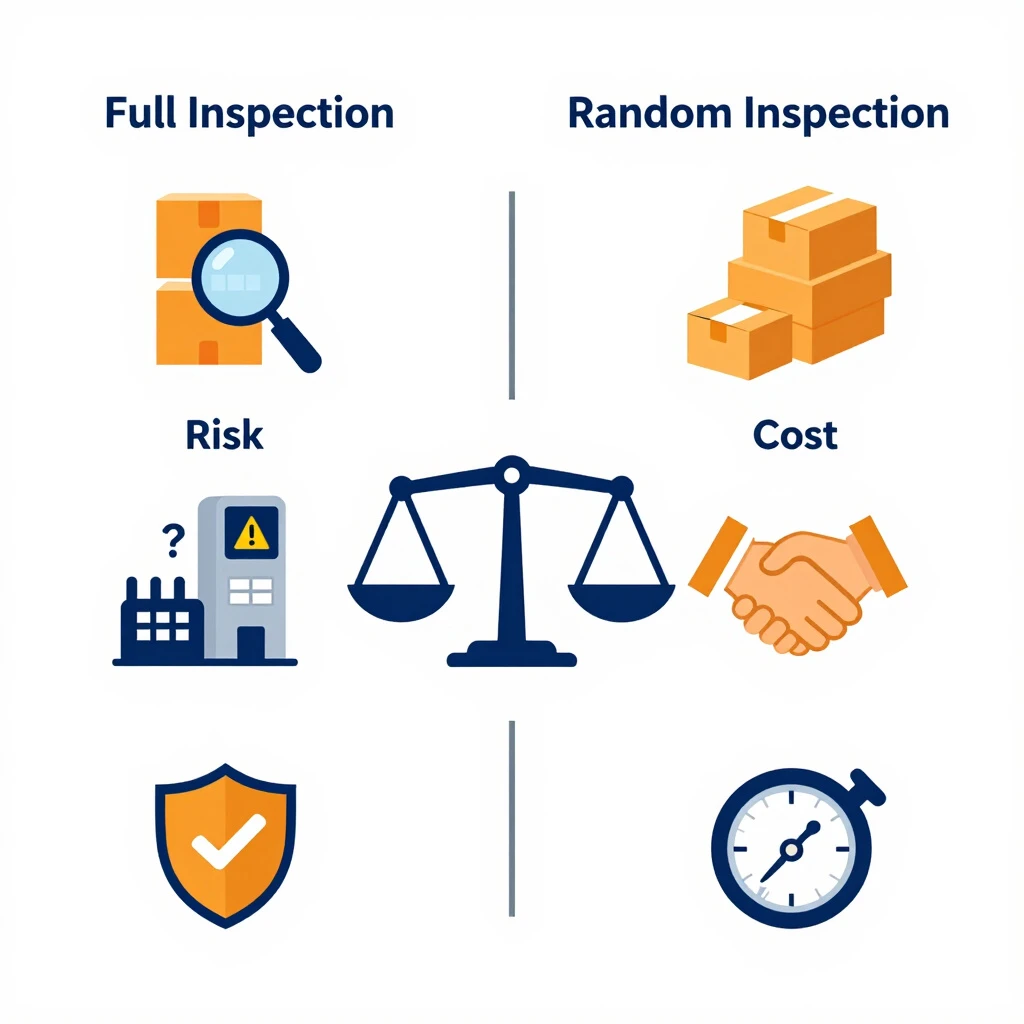
This is not about trusting or distrusting your supplier. It is about how much information you need versus how much inspection cost and lead time you can absorb. A full inspection gives you complete coverage but costs more and takes longer. A random inspection is cheaper and faster but leaves some uncertainty. You have to decide where your comfort level sits.
What Full Inspection and Random Inspection Mean
Let’s define these terms clearly, because they get used loosely.
- Full inspection: every unit or every carton in the shipment is checked against agreed criteria. You get a line-by-line report on what passed and what failed.
- Random inspection: a sample is pulled from the batch, checked, and the results are used to judge the whole consignment. The sample size and acceptance criteria need to be agreed on before the inspection starts.
Before any inspection, you need to nail down three things: what counts as a defect, what the checklist covers, and how the results will be reported. These are not details you can leave vague. If you do, you will end up arguing about the findings later.
Five Questions to Answer Before You Choose
Work through these before you commit to a scope.
1. What is the order value and what would a defect cost you?
Compare the inspection fee against the total order value and the potential loss if a defect slips through. If a single bad unit means a chargeback or a lost customer, that changes the math.
2. How complex is the product and how serious is a defect?
Think about components, assembly steps, packaging, and end use. A simple plastic part with broad tolerance is different from a device with safety implications.
3. What do you actually know about this supplier’s track record?
Have you worked with them before? What happened on previous batches? If this is a first order from a new factory, you have less data to rely on.
4. How much inspection cost and lead time can this order absorb?
Be honest about your margin and your deadline. A full inspection might add days to your schedule. If that pushes you past a retail launch date, it might not be worth it.
5. What is your defect tolerance?
Think about returns, refunds, and reputation. If a defect would cause a major headache, you probably want more coverage.
When Full Inspection Makes Sense
Consider full inspection if any of these apply to your order:
- A small order where checking every unit is affordable.
- A high-value product where one bad unit is a big loss.
- A product with safety implications, like electronics or children’s items.
- A first order from a factory you have never used.
- Complex assembly, multiple components, or strict packaging requirements.
These are factors to weigh, not guarantees. Here is a hypothetical example: you are ordering 500 units of a new electronic device from a factory you have never worked with. The product has a battery and a charging circuit. A single defect could cause a fire or a recall. In that scenario, full inspection is probably worth the extra cost.
When Random Inspection Might Be Enough
Random inspection can be a reasonable choice when:
- You have a repeat supplier with a track record you trust.
- The order is large and you want to keep inspection costs down.
- The product is simple and minor defects are acceptable.
- You are comfortable making a decision based on a sample.
Before you go this route, ask two questions. First, is the sampling method clearly defined? Second, are the quality criteria specific enough that the inspector knows what to look for? If you cannot answer both, random inspection will give you unreliable results.
How Inspection Fits Into a Sourcing Process
Inspection is one step in a larger chain. Yes Supplier can help you with requirement confirmation, supplier search and vetting, sample coordination, production monitoring, final inspection, product development support, and logistics coordination. You can see what is included on the services page. The point is that inspection does not happen in a vacuum. It works best when you have already defined your requirements and vetted your supplier.
A Decision Checklist You Can Copy Into an Email
Before you commission an inspection, run through this checklist. You can paste it directly into an email to your supplier or sourcing partner.
- What is the total value of this order and what would a defect cost my business?
- How complex is the product and how serious is the end-use risk?
- How long have I worked with this supplier and what do I know about their previous batches?
- How much inspection cost and lead time can this order absorb?
- Would I rather accept a sample-based result or pay for more comprehensive coverage?
Decision Matrix: Full vs. Random Inspection
This matrix is a starting point for discussion, not a rule.
| Factor | Full Inspection | Random Inspection |
|---|---|---|
| Order size | Small or high-value orders where checking every unit is affordable | Large orders where a sample-based check is preferred |
| Product risk | Complex, safety-relevant, or high-unit-value products | Simple, low-risk products with broad defect tolerance |
| Supplier history | First order or unproven factory | Repeat supplier with a track record you trust |
| Defect tolerance | Low tolerance; a defect would cause significant loss | Higher tolerance; minor defects are acceptable |
Next Step: Talk Through Your Order With a Sourcing Partner
If you are still unsure, talk through your order with a sourcing partner. You can discuss your product, supplier, timeline, and risk tolerance. You can also read frequently asked sourcing questions or see sourcing project examples for context. To understand how a sourcing partner works, visit how a sourcing partner works.
If you want to discuss your specific order, start a product inquiry and ask about inspection planning. The goal is to design an inspection plan around your order, not to copy a template.