
Suppose you’re sourcing a product from a factory in China. The supplier sends photos of the first production run and everything looks fine. Then the shipment arrives and the plastic housing has a visible seam line, or the printed logo sits slightly off-center. That’s a hypothetical example, but it shows why checkpoints before mass production matter. The point isn’t to eliminate every defect. It’s to catch the ones that matter while you can still do something about them.
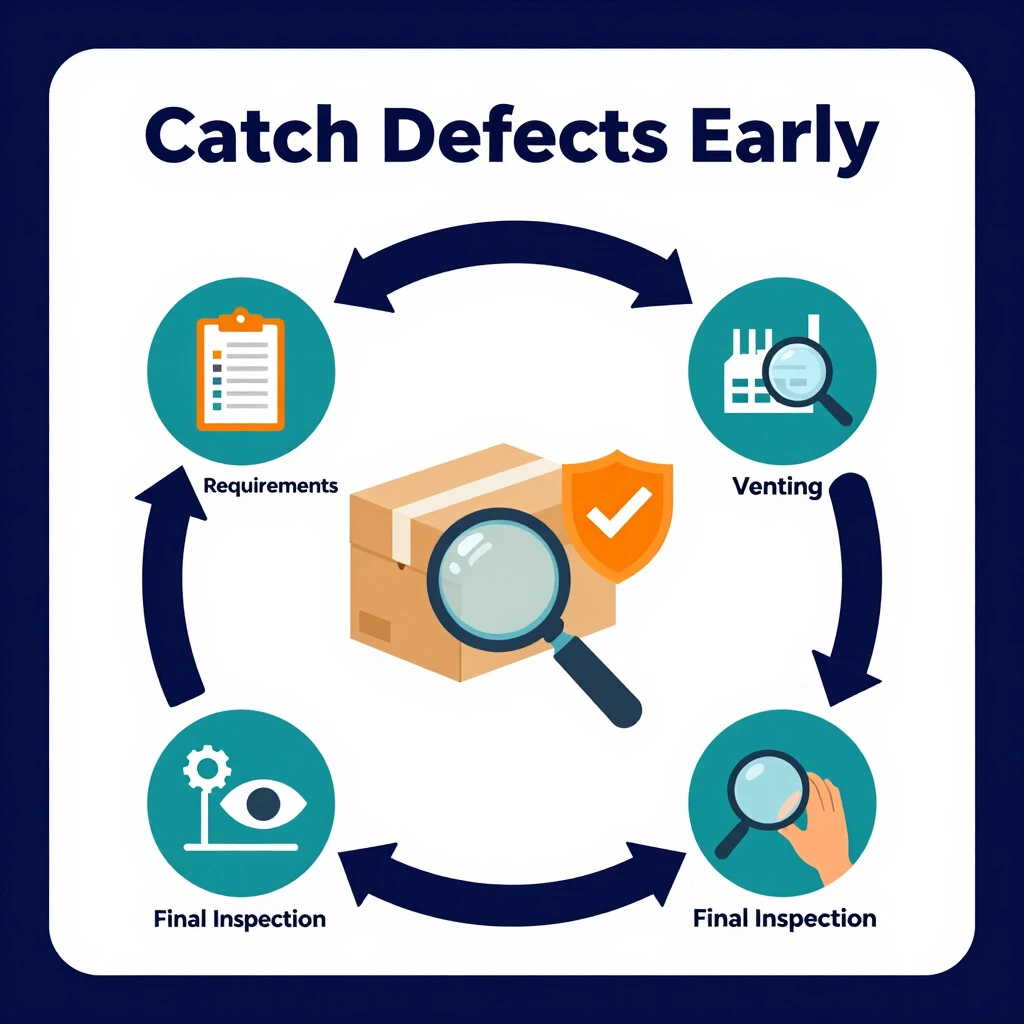
Early defect detection is a process, not a promise. You can start before the factory orders raw materials and keep checking through sampling, production, and final inspection. Each stage lets you compare what you asked for against what the supplier is actually making. The earlier you check, the more options you have: adjust the spec, change the process, or stop the run before the issue spreads through the whole batch.
Defects tend to surface at predictable stages of a sourcing engagement. Knowing where to look, and what to check at each stage, is most of the work. A structured sourcing service like YesSuppplier can help you build these checks into the workflow.
1. Start with clear requirements before production begins
The practical first step is to write a specification before anyone orders materials. If you don’t know the exact material, dimensions, tolerances, packaging, and labeling you expect, you have no basis for judging whether a sample or a production run is acceptable. Putting expectations in writing reduces ambiguity and gives everyone a common reference.
Write down everything that matters for your product:
- Material type and grade
- Dimensions and tolerances (for example, a small tolerance value on critical fits)
- Color and finish requirements (for example, a Pantone reference or gloss level)
- Packaging and labeling specs
- Functional tests or performance criteria
This document becomes the reference for later checks. When you review a sample, you check it against the spec. When an inspector visits the factory, they use the same document. Without it, you’re relying on memory and goodwill.
Requirement confirmation is one of the services YesSuppplier offers, and it’s a useful way to articulate what you need before anyone starts sourcing or manufacturing. It also gives the supplier a clear brief and reduces the chance of a mismatch later. It won’t guarantee a defect-free run, but it reduces ambiguity at the source.
2. Vet suppliers before mass production
A supplier may say they can meet your requirements, but capabilities vary. Before you commit to a production run, it’s worth assessing whether the factory is a good fit for your product. Supplier vetting is your chance to evaluate capability before you commit.
Vetting is a review, not a guarantee. It can help you spot red flags early: a factory that can’t show you its quality-control procedures, a salesperson who avoids technical questions, or a facility that looks disorganized on a video call. These signals don’t prove a defect will happen, but they tell you where to focus your attention.
Suppplier search and vetting is part of YesSuppplier’s service set. It helps you evaluate candidates in a structured way. Vetting won’t eliminate all risk. It helps you make an informed choice before you spend money on tooling or a first order.
When you vet a supplier, ask for specifics: production capacity, quality-control staff, inspection procedures, and examples of similar products they’ve made. If they can’t give clear answers, that’s a signal to dig deeper or look elsewhere.
3. Use sample coordination to catch issues before mass production
The sample stage is the first physical review before mass production. You get to see and touch the product before committing to a full run. This is where issues can surface. In a hypothetical scenario, you might see a color that’s off, a dimension that doesn’t match the spec, a finish that feels wrong, or a part that doesn’t fit as expected.
Sample coordination is more than asking the supplier to send a sample. You review it against your written requirements, document discrepancies, and decide whether to approve, request changes, or reject. It’s an efficient time to catch a problem before a larger investment.
Sample coordination is one of YesSuppplier’s services, and it helps you manage this stage and review what the supplier sends against the expectations you documented. The goal is to catch issues before they multiply across a production run.
Say you’re sourcing a custom phone case. Your spec calls for a matte finish and a width of 75mm. The sample arrives with a glossy finish and measures 76.5mm. If you approve it without checking, the factory might produce thousands of cases that don’t match your spec. Because you review the sample against the spec, you catch the discrepancy. You ask the supplier to adjust the mold and the finish, and they send a revised sample. The issue is resolved before mass production begins. This is a hypothetical scenario, but it shows how an early checkpoint can avoid a large rework later.
4. Monitor production during manufacturing
Once mass production starts, you can add inspection points during manufacturing instead of waiting until the end to find out whether anything is going wrong. Production monitoring gives you visibility while corrective action is still possible.
You can schedule monitoring activities such as reviewing production progress, confirming that the agreed materials and processes are being used, and sampling units from the line at intervals. If a defect appears early in the run, you may catch it before the entire batch is produced. This is especially useful for products with complex assembly or strict tolerances.
Production monitoring is part of YesSupplier’s service set and provides a structured way to add mid-process visibility. No monitoring plan catches every defect. It does give you a chance to intervene while the factory can still adjust.
Monitoring adds time and cost, so weigh that against the value and complexity of the order. For a high-volume product with tight tolerances, the extra inspection points may be worth it. For a lower-risk order, sampling and final inspection might be enough.
5. Conduct a final inspection before shipment
Final inspection is the last scheduled quality gate before your goods are packed and shipped. It gives you a structured look at finished products and a basis for deciding whether to accept, reject, or request correction before the shipment leaves the factory.
Choose what to inspect based on your product and specification: appearance, dimensions, function, packaging, and labeling. Use your original requirements as the reference and note any deviations. Then decide whether to accept, reject, or request rework based on what you find.
Final inspection is one of YesSuppplier’s services. No final inspection guarantees that every unit is perfect. It gives you a useful last look before logistics begins.
It’s especially useful because it’s the last scheduled chance to catch issues before shipment. Problems missed earlier can still be caught here. In a hypothetical scenario, this might be a packaging or labeling problem that only shows up at this stage.
6. Build a repeatable quality-control workflow
Early defect detection isn’t a one-time event. It’s a process you repeat for every order. A repeatable workflow means applying the same checks each time: clear requirements, supplier vetting, sample review, production monitoring, and final inspection.
YesSupplier’s service set covers requirement confirmation, supplier search and vetting, sample coordination, production monitoring, final inspection, product development support, and logistics coordination. You can use these as stages around your own quality process. The how it works page gives an overview of that process, and the case studies are worth reviewing as part of your research.
If you’re a small business or startup without a dedicated quality-control team, a clear process helps you stay consistent across orders. It also makes communication with suppliers easier, because they know what to expect.
Quality control works best when you treat it as a series of decisions, not a single test. Each check gives you information, and you decide whether to proceed, adjust, or stop. Over time, you learn which suppliers and products need more attention and can tailor the workflow accordingly.
7. FAQ: Early defect detection when sourcing from China
What kinds of defects can you look for?
The specific defects depend on your product and requirements. Your specification defines what matters: appearance, dimensions, fit, function, packaging, and labeling. A hypothetical scenario might involve a dimension off by a few millimeters or a finish that doesn’t match the approved sample. Define what matters in the spec so the inspector knows what to check.
How early can defects be caught?
You can start before mass production begins, with your written requirements, and continue through samples and production checkpoints. Checking early gives you more options before a full run is made. A defect found at the sample stage can be corrected before the factory starts the full production run.
What should I ask a supplier before mass production?
Confirm your specifications in writing, ask for a sample review, clarify the production timeline, and agree on inspection points. Ask about their quality-control procedures and how they handle defects. The more specific you are, the less room for misunderstanding.
How can a sourcing service help?
A sourcing service like YesSupplier provides structured checks and coordination. You can use its services to confirm requirements, vet suppliers, coordinate samples, monitor production, and conduct final inspections. That’s useful if you don’t have the time or expertise to manage these steps yourself. For more answers, check the frequently asked questions page.
The goal is visibility and control, not a zero-defect guarantee. Catch the issues that matter before they become larger problems, and you’ll have a process you can reuse on every order. If you’re sourcing from China and want to set up a structured quality-control workflow, see how YesSuppplier can support your sourcing and quality-control process.